الوضع الليلي


 1:30:35
 2026-10-10
 1317
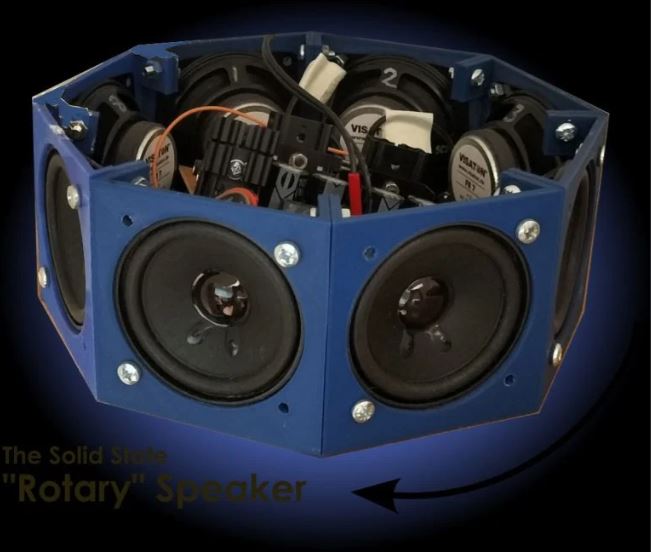
Researchers have demonstrated a solid-state approach to sound modulation that electronically creates the acoustic sensation of a moving sound source.
A new speaker system developed at the University of Nottingham creates audio effects by manipulating sound waves around the listener rather than modifying only the electronic signal. The solid-state design recreates aspects of a classic rotary speaker without motors, belts, or other moving components, offering a new approach that sits between mechanical and digital audio effects.
Researchers in the university’s Faculty of Engineering built the system from a circular array of speakers. Instead of physically rotating a horn or other sound source, the device electronically shifts the audio signal around the array, producing the acoustic impression of movement. The work has been published in the Journal of the Audio Engineering Society.
Moving the Sound, Not Just the Signal
Most electronic and digital audio effects alter a signal before it reaches a speaker. The Nottingham system takes a different approach. Its phase modulation occurs through the physical sound waves approaching and surrounding the listener, rather than solely within an electronic signal sent to a single loudspeaker.
The concept was inspired by the Leslie speaker (the Leslie speaker), an electromechanical system developed in the 1930s for electric organs. Traditional Leslie speakers use motors and belts to rotate horns and baffles, changing how sound reaches the listener and creating characteristic modulation through physical motion.
Recreating a Classic Effect Without Moving Parts
The Leslie sound became deeply embedded in popular music and has since inspired numerous electronic, digital, and software emulations (phasers, chorus, etc). These systems can reproduce aspects of the effect by electronically altering an audio signal, but they do not physically move the sound source through space in the way the original mechanism does.
The Nottingham prototype is designed to reproduce more of that spatial behavior without the mechanical complexity of a traditional rotary speaker. Because the apparent movement is generated across an array of stationary speakers, the researchers describe the system as a solid-state “rotary” speaker.
Blurring the Boundary Between Mechanical and Digital Audio
Fernando Perez-Cota, Assistant Professor in the Department of Electrical and Electronic Engineering, said the approach occupies a largely unexplored area between conventional acoustic and electronic effects. “Sound modulation for music application is either acoustic-mechanical like the original Leslie, or electronic-digital – there is no in-between. This work represents the first attempt to blur this boundary.”
The researchers see the prototype as more than a replacement for the Leslie speaker, viewing it as a broader platform for manipulating sound in physical space. Different signal patterns across the speaker array could potentially produce forms of modulation that are difficult to achieve with either conventional moving hardware or standard digital processing.
A New Direction for Music Production
Nicholas Wolstenholme, a Masters Engineering student who developed the prototype, said the same principle could extend beyond recreating established rotary effects. “We believe this concept can not only be used to achieve sound modulation like the Leslie speaker but also represents a completely new paradigm in sound effects and sound modulation with new possibilities. It has the potential to offer high-quality sound effects at a cost and scale accessible to anyone making music.”
Reality Of Islam |
|

Keeping sil
Two experim
Changing a

Plants are
 9:3:43
2018-11-05
10 benefits of Marriage in Islam
7:5:22
2019-04-08
benefits of reciting surat yunus, hud &
9:45:7
2018-12-24
advantages & disadvantages of divorce
11:35:12
2018-06-10
6:0:51
2018-10-16
8:15:37
2023-02-16
8:25:12
2022-03-09
bahlool & the throne of haroun rashid
8:20:35
2018-06-21
6:14:17
2018-06-21
5:57:34
2023-03-18
2:33:4
2023-02-15
4:25:57
2023-02-11
5:41:46
2023-03-18
| LATEST |
 HOME