الوضع الليلي


 8:1:49
 2026-04-29
 1077
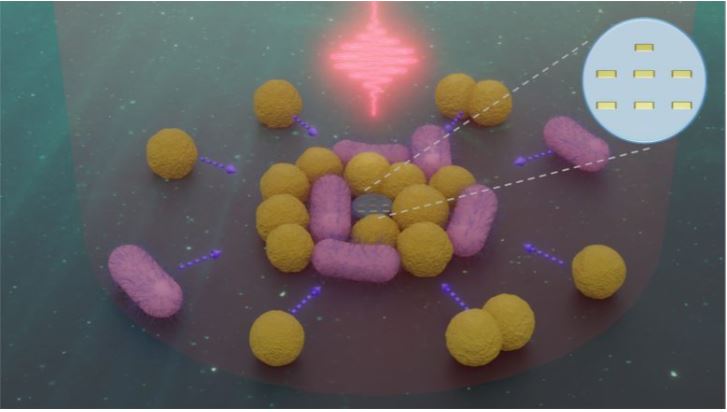
Photon-driven nanorobots can steer, capture, and move bacteria with precision, enabling controlled manipulation in microscopic environments and offering new tools for microbiology.
Tiny robots about 50 times smaller than the diameter of a human hair are opening new possibilities for working at very small scales. They allow scientists to precisely manipulate objects far beyond the reach of human hands, moving closer to the long-standing goal of directly interacting with the microscopic world.
This is especially important for biological materials in liquid environments, such as single cells or bacteria. Controlling these tiny objects with precision has been a major challenge, but these nanorobots show that tasks like collecting and relocating bacteria can now be done.
One of the biggest hurdles is how to power and guide machines at such a small scale. At Julius-Maximilians-Universität Würzburg (JMU), a team led by Professor Bert Hecht has developed a solution using the recoil of individual photons to move micrometer-sized devices known as microdrones.
Photon Recoil Powers Microdrones
These devices contain up to four plasmonic nanoantennas that absorb light with specific properties and then emit it in a directed way. Each emitted photon produces a tiny recoil force, similar in principle to the kickback from firing a bullet. Because the microdrones have extremely low mass, even these small forces can generate high speeds and rapid acceleration.
In this latest work, the researchers further reduced the size of these light-powered robots to less than one micrometer (about 0.000039 inches). A major advance was simplifying how they are steered while maintaining photon-based propulsion.
The team takes advantage of the fact that nanoscale antenna wires inside the robot naturally align with the polarization of incoming light. By adjusting that polarization, they can control the robot’s orientation while movement continues to rely on photon recoil, similar to how larger vehicles are steered.
Light-Driven Steering and Bacteria Capture
“In essence, we have built a light-driven nanorobot that can track down and collect bacteria,” says Jin Qin, lead experimental scientist of the study. “By simplifying the design, we reached a size at which these robots can operate directly in the microbial world—almost like microscopic cleaning devices.”
These nanorobots are highly agile. They can make very fast 90° turns, which allows them to scan large sample areas in a systematic and efficient way. They can also selectively capture, transport, and release significant numbers of bacteria.
This ability allows them to effectively “clean” microscopic environments in controlled lab settings by gathering bacteria and placing them at specific locations.
Applications in Microscopic Cleaning and Research
“This is a striking example of how light can be used not only to observe the microscopic world, but also to actively shape it,” adds Bert Hecht. “The idea of tiny robotic cleaners may sound futuristic, but we are already demonstrating the physical principles that make it possible.”
Even when carrying larger clusters of bacteria, the nanorobots remain fully maneuverable, although they move slightly more slowly. This durability highlights their promise for future use in microbiology, biomedical research, and precise manipulation at very small scales.
Reality Of Islam |
|

Keeping sil

Two experim

Changing a

Plants are
 9:3:43
2018-11-05
10 benefits of Marriage in Islam
7:5:22
2019-04-08
benefits of reciting surat yunus, hud &
9:45:7
2018-12-24
advantages & disadvantages of divorce
11:35:12
2018-06-10
6:0:51
2018-10-16
9:42:16
2022-10-19
1:38:41
2021-12-08
6:14:17
2018-06-21
8:4:21
2022-01-08
11:11:59
2023-02-01
allah will not answer all your prayers
6:56:28
2022-01-01
2:5:14
2023-01-28
5:41:46
2023-03-18
| LATEST |
 HOME