الوضع الليلي


 10:21:10
 2024-05-07
 2119
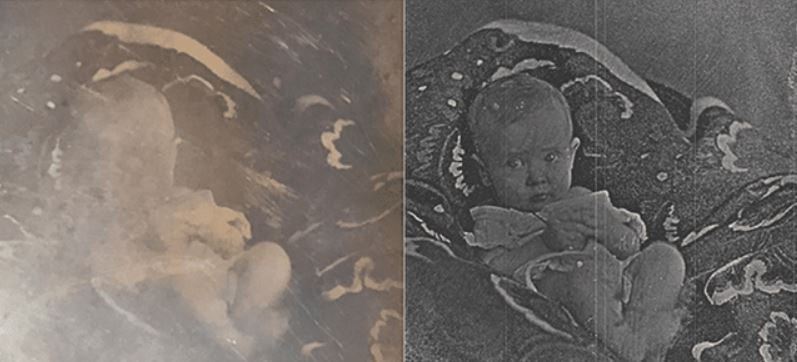
A team of Canadian and US researchers has demonstrated incredible results when restoring old corroded daguerreotypes (very early types of photos), via a technique known as synchrotron imaging – using X-ray beams to precisely identify material compositions.
At the simplest level, the technique runs a chemical analysis to detect where the corrosion and damage on a daguerreotype are. Once that's been established, it's possible to work backwards to figure out what the original image showed.
Daguerreotypes were popular in the mid-1800s, and involved images being impressed on copper plates that had been chemically treated to be light-sensitive. They naturally degrade, and trying to clean them up can make the damage worse. Scientists now seem to have found a way to bring them back.
"Revealing images that seemed lost forever is what's most exciting," says Tson-Kong Sham, a chemist at Western University in Canada.
"We get a glimpse of people living in the 19th century that we wouldn't have otherwise and learn about their history and culture."
Running the synchrotron imaging analysis on a daguerreotype gives the researchers measures for silver and mercury levels at each point in the photo. These chemicals are essential for creating the picture in the first place, so these snapshots can be used to reconstruct the image again.
The new study builds on a similar earlier study by establishing that this kind of picture recovery is always possible, as long as the image particles under any corrosion remain intact. It also adds new information about using the X-ray process safely – beams that are too intense can cause fresh damage.
"X-ray usually doesn't damage metals visibly, so I didn't think it would affect the plates," says Sham, who worked on both studies.
"Perhaps chemical impurities or the corrosion itself on the daguerreotype got heated and left a small mark where the X-ray beam light went through."
The researchers say their technique shows a lot of potential for exploring the cultural heritage of the mid-19th century. Many daguerreotypes are on display in museums and galleries worldwide, and this technique could reveal a lot more about how people looked, dressed, and lived during that period.
What's more, the process might also be able to be adapted for different types of materials where corrosion or degradation has occurred – such as archaeological artifacts and fossils that need to be restored.
"This technique can be used widely in all walks of science, from looking at tissues to materials science," says Sham.
"You could determine whether or how a metal may be corrosion-resistant. Or in the case of an already corroded material, you can learn what the product of that corrosion is and its distribution on the surface, and then you can work back and think about how to prevent that corrosion from happening."
Reality Of Islam |
|

Keeping sil
Two experim
Changing a

Plants are
 9:3:43
2018-11-05
10 benefits of Marriage in Islam
7:5:22
2019-04-08
benefits of reciting surat yunus, hud &
9:45:7
2018-12-24
advantages & disadvantages of divorce
11:35:12
2018-06-10
6:0:51
2018-10-16
8:39:51
2022-09-23
2:11:12
2022-10-15
3:18:29
2022-12-24
allah will not answer all your prayers
6:56:28
2022-01-01
5:58:12
2021-12-18
4:25:57
2023-02-11
9:42:16
2022-10-19
5:41:46
2023-03-18
| LATEST |
 HOME