الوضع الليلي


 10:12:11
  2023-12-27
  2096
2096
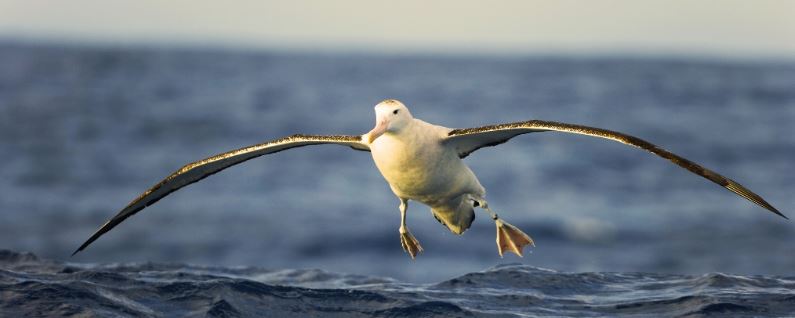
Animals cover astonishing distances when they are looking for food. While caribou, reindeer and wolves clock up impressive mileage on land, seabirds are unrivalled in their travelling distances.
Arctic terns travel from the Arctic to Antarctica and back as part of their annual migration. Wandering albatrosses (Diomedea exulans) fly the equivalent of ten times to the Moon and back over their lifetimes.
There has been a lot of research into how seabirds choose their flight paths and find food. They seem to use their sight or sense of smell to assess local conditions.
Wandering albatrosses can travel more than 10,000km in a single foraging trip, though, and we don't know much about how these birds use mid- and long- range cues from their environment to decide where to go.
For the first time, however, my team's recent study gives an insight into how birds such as wandering albatrosses may use sound to determine what conditions are like further away.
How seabirds use low-frequency sound
Previous research has shown that seabirds not only seek information about where to find food, but how to do so efficiently. We discovered that the way wandering albatrosses use their sense of sound may be crucial.
Our study looked at how these birds respond to a very low-frequency type of sound called infrasound, which can travel for thousands of kilometers.
While it's typically inaudible to humans, we know that some animals can hear infrasound. When waves crash together or against coastlines, they create a frequency of infrasound called microbarums. This was the type of infrasound our study looked at.
We know that areas of high wave activity can be associated with upwellings - where fish are brought to the surface. Infrasound could provide information about where these areas are, and inform birds of good foraging patches.
Efficient foraging is particularly important for large seabird species like the wandering albatross, which have a wing span of 3.5 meters. Their size means they rely on wind to take off and fly efficiently, unlike smaller birds such as puffins, which flap their wings up to 400 times a minute.
High wave activity also indicates strong winds. Given we know that wandering albatrosses depend on wind to fly efficiently; my team's study suggests that infrasound could give them a long-range cue for where optimal foraging conditions may be.
Infrasound is also generated when waves crash against coastlines, and we know that many coastal seabirds use the coast to select their flight paths and find their way back to their breeding colonies. So, infrasound could reveal the location of static features like coastlines, giving seabirds important information across long distances.
Despite the potential of this cue for seabirds, our paper (published in PNAS) is the first evidence that seabirds may respond to infrasound, which is monitored globally through a network of sensors installed by the Comprehensive Nuclear-Test-Ban Treaty Organization (CTBTO).
This system was installed to detect nuclear tests, but its byproduct is huge amounts of data which scientists can use. We combined the CTBTO's records with our own GPS tracking data from 89 wandering albatrosses to compare microbarums and the birds' movements.
This allowed us to isolate data that showed how these albatrosses appeared to make decisions about where to go next. Our findings showed they chose the direction with the loudest infrasound.
This suggests the birds could use infrasound to find food or to minimize the energy they use on their travels. However, we are not able to say for sure why louder areas are better.
Our findings may also give scientists insights into how other birds make decisions on medium- and long-distance journeys.
As with many studies testing a hypothesis for the first time, my team's study raises as many questions as it answers. If seabirds respond to infrasound, they must be able to hear it and know where it is coming from. Lab studies have found evidence that some birds can hear infrasound, but there have been no tests on seabirds.
Taking a wandering albatross into a lab and creating a sound chamber large enough to run experimental tests seems unlikely in the near term, but other seabird species can live in captivity and research could focus on this.
Weather changes driven by climate change, and the damaging effects these are having on seabirds as well as many other plants and animals, are well documented - making it harder for them to find food, for example.
As humans alter ocean habitats, infrasound may help birds adapt by aiding them to find food, even as stocks diminish. Or human activity, such as more noise, could mask this kind of essential information, with harmful consequences for wildlife.
Either way, understanding how and why seabirds use infrasound will help scientists understand its importance in the climate crisis.
Reality Of Islam |
|

A study of

Researchers

MIT enginee
 9:3:43
2018-11-05
9:3:43
2018-11-05
10 benefits of Marriage in Islam
7:5:22
2019-04-08
benefits of reciting surat yunus, hud &
9:45:7
2018-12-24
advantages & disadvantages of divorce
11:35:12
2018-06-10
6:0:51
2018-10-16
10:35:40
2022-05-26
7:32:24
2022-02-14
6:28:21
2022-12-20
2:5:14
2023-01-28
6:14:3
2023-01-18
9:42:16
2022-10-19
8:25:12
2022-03-09
5:41:46
2023-03-18
| LATEST |
 HOME
HOME