الوضع الليلي


 10:54:14
 2025-05-29
 2252
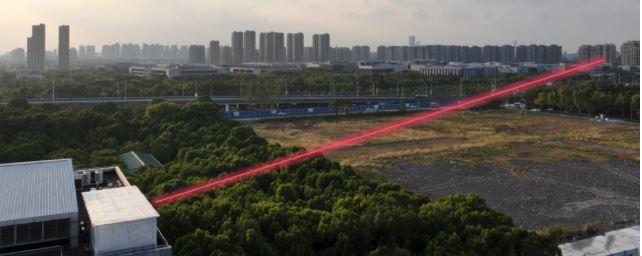
Your eyesight might be good enough to confidently read the tiny text at the optometrist from a few meters away. But you're left in the dust by a new device recently demoed by researchers, which was able to scan tiny individual characters of text from a distance of 1.36 kilometers (about 0.85 miles).
Intensity interferometry takes a different approach to imaging than conventional cameras: rather than measuring light waves directly, these devices measure the way light reflects and interferes with itself, then compiles an image from that data.
A new study, led by researchers from the University of Science and Technology of China, tested an instrument that emits eight infrared laser beams fired across to a specific point in the distance.
Then, two telescopes were used to capture the intensity of the light reflections. Through a careful calibration of the eight laser beams lighting up the target, the image can be reconstructed by comparing variations between the readings from the two telescopes.
"Through outdoor experiments, we have successfully imaged millimeter-scale targets located at 1.36 km away, achieving a resolution enhancement by about 14 times over the diffraction limit of a single telescope," write the researchers in their published paper.
Long range cameras like this have uses everywhere from space telescopes to remote sensors, and the method used here can handle atmospheric turbulence and better manage imperfections in the camera setup.
Through the setup described in their new study, the researchers were able to accurately read letters at a resolution of 3 mm. Using just one of the telescopes deployed here on its own, at the same distance, would've resulted in a resolution of 42 mm. That's a big upgrade, and shows the potential of intensity interferometry.
First used in space observatories, we're now seeing the tech being used in a variety of ways on Earth, notably in advanced physics experiments. Previously, the approach has been used to spot very bright distant stars, or closer objects that are lit up by a nearby source – so this is a new development.
"The application of long-baseline active intensity interferometry holds promise for advancing high-resolution optical imaging and sensing," write the researchers.
The way that photons of light bunch together and can be interpreted through this tech is actually a quantum effect that wouldn't be predicted by normal physics, and that's one of the crucial parts of the high resolution here.
Further improvements are possible, the researchers say, in the way the infrared laser lights are controlled. There's also scope for adding AI algorithms to the system, to interpret specific text and shapes more accurately.
"The new work represents a significant technical advancement in imaging distant objects that do not emit their own light," optics researcher Shaurya Aarav from Sorbonne University in France, who wasn't involved in the research, told Michael Schirber at Physics Magazine.
Reality Of Islam |
|

Keeping sil
Two experim
Changing a

Plants are
 9:3:43
2018-11-05
10 benefits of Marriage in Islam
7:5:22
2019-04-08
benefits of reciting surat yunus, hud &
9:45:7
2018-12-24
advantages & disadvantages of divorce
11:35:12
2018-06-10
6:0:51
2018-10-16
10:35:40
2022-05-26
10:43:56
2022-06-22
2:2:13
2022-10-08
6:28:21
2022-12-20
bahlool & the throne of haroun rashid
8:20:35
2018-06-21
8:39:51
2022-09-23
9:50:37
2023-02-28
5:41:46
2023-03-18
| LATEST |
 HOME