الوضع الليلي


 4:20:42
 2024-05-12
 1883

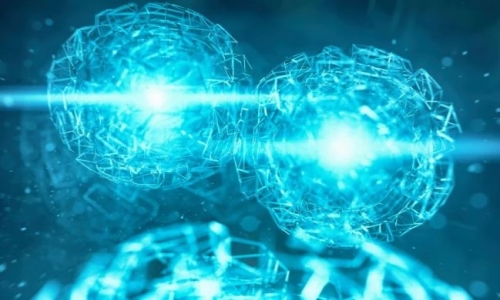
Scientists have long been on the lookout for 'glueballs', which are bound states of subatomic gluon particles on their own, without any quarks involved. Now, we may just have found them, hiding away in a particle accelerator experiment.
It promises to be a hugely significant breakthrough in physics, but for the benefit of everyone without a PhD in the subject, we'll start at the beginning. The main job of gluons is to hold quarks in place and keep atoms stable – quarks being the building blocks that make up protons and neutrons.
This role makes the gluon part of the strong nuclear force – one of the four fundamental forces of nature that hold the laws of physics together, along with gravity, electromagnetism, and the weak nuclear force.
Hopefully, you're still with us so far. Until now, glueballs have only been theoretical propositions that physicists think should exist – because gluons should be able to stick to each other – rather than something that's actually been observed.
Individual gluons don't contain any matter, they just carry force, but glueballs do have mass created by the interactions of gluons. If we can spot them, it's another indication that our current understanding of the way the Universe works, also known as the Standard Model of particle physics, is indeed right.
And so to the experiments at the Beijing Electron-Positron Collider II in China. The collider was used to smash together mesons, which are particles made up of a quark and antiquark held together by the strong nuclear force.
Sifting through the subatomic debris from these particle-smashing sessions – and we're talking a decade of data involving some 10 billion samples – researchers were able to see evidence of particles with an average mass of 2,395 MeV/c2. That's the mass that glueballs are predicted to have.
The particle in question goes by the name X(2370), and while some of the other calculations involved don't exactly fit what the researchers were looking for, they're not far off. More measurements and more observations will be needed to get a definitive answer.
So it's not quite proof of glueballs yet, but the evidence is starting to mount. Back in 2015, scientists also thought they had caught a glimpse of glueballs. Before too long, another particle might be making the jump from the theoretical to the actual.
A lot of this scientific research is made possible by continuing advances in mathematical techniques and computing capabilities – required to calculate the vast number of particular interactions and evolutions that are possible, and that might have originated from a glueball.
Plus of course, we now have the equipment and instruments necessary to peer into the most fundamental workings of the natural world, and to produce the billions of particle states required to spot something as rare and exotic as a glueball.
Reality Of Islam |
|
Keeping sil
Two experim
Changing a

Plants are
 9:3:43
2018-11-05
10 benefits of Marriage in Islam
7:5:22
2019-04-08
benefits of reciting surat yunus, hud &
9:45:7
2018-12-24
advantages & disadvantages of divorce
11:35:12
2018-06-10
6:0:51
2018-10-16
8:21:9
2018-06-21
11:2:27
2022-10-06
allah will not answer all your prayers
6:56:28
2022-01-01
2:13:43
2022-05-27
6:14:3
2023-01-18
12:10:56
2022-11-17
1:16:44
2018-05-14
5:41:46
2023-03-18
| LATEST |
 HOME