الوضع الليلي


 8:51:34
  2023-07-27
  1701
1701
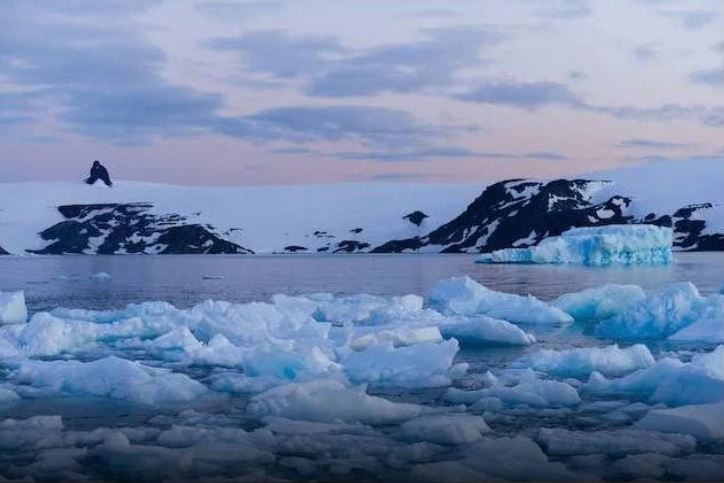
In February, climate researchers announced that sea ice in Antarctica had reached its lowest summer level since satellite records began 45 years ago.
A few months later, in June, during what should have been the "winter growth phase," the floating sea ice around Antarctica was still struggling to recover.
A time series of sea ice in the Southern Ocean, compiled by climate researchers at the US National Oceanic and Atmospheric Administration, shows that July coverage is much less than it should be.
Compared to the amount of winter sea ice before 2010, the ocean has now lost about 2.6 million square kilometers of ice - nearly four times the area of Texas. It surpasses the previous record lows recorded in 2016, 2017 and 2022.
"To say its unprecedented is not strong enough," oceanographer physicist Edward Doddridge told ABC News Australia.
"For those of you who are interested in statistics, this is a five sigma event. So there are five standard deviations above the mean. Which means if nothing changes, we would expect to see a winter like this about once every 7.5 million years," Doddridge said.
It has since reached 6.4 standard deviations away from the 1991 to 2020 average.
The most likely culprit, Doddridge says, is the climate crisis, although how it leads to extreme sea ice melt remains unclear.
For years, Antarctica's ice has been melting in a way that climate models did not predict.
The mismatch shows that scientists do not yet have a detailed understanding of how the ocean, ice and atmosphere in the Southern Hemisphere actually interact.
As the global atmosphere has warmed from fossil fuel emissions, evidence suggests that the surface of the Southern Ocean has cooled somewhat, while the deep parts have warmed.
Cold surface waters may seem like a hopeful case of floating sea ice, but after years of steady increase in ice sheets, sea ice in Antarctica suddenly collapsed in 2016.
Preliminary studies indicate that warmer winds in the region may be driving the melting.
Our transition to El Niño has produced gusty westerlies across the Southern Ocean over the past few months.
This will likely break up much of the new sea ice that normally forms with the onset of winter. But it can't fully explain the extent of lost sea ice, Princeton University climatologist Zachary Lapp explains in a publication. Rising warm waters can also erode icebergs from below.
Lapp hypothesizes that the lack of ice also helped increase surface air temperatures, which in turn would likely warm surface waters to create a positive feedback loop that prevents further ice formation.
And if enough of the sea ice around Antarctica melts, scientists fear it could trigger more positive feedback loops, with waves and warm winds reaching the shore more easily.
Cryospheric scientist Rob Masum, of Australia's Antarctic Division, explained to the Guardian: "It's not just about the extent of the ice, but also the duration of coverage. If you remove sea ice, you expose the floating ice edges to waves that can bend them and increase the likelihood of ice shelves forming." This then allows more land ice to enter the ocean."
Without further research, scientists simply won't be able to predict what will happen to Southern Ocean sea ice in the coming years.
And since the Southern Ocean helps drive the Earth's entire ocean circulation, it seems like something we should get around quickly.
Reality Of Islam |
|

After spend

A study of

Researchers
 9:3:43
2018-11-05
9:3:43
2018-11-05
10 benefits of Marriage in Islam
7:5:22
2019-04-08
benefits of reciting surat yunus, hud &
9:45:7
2018-12-24
advantages & disadvantages of divorce
11:35:12
2018-06-10
6:0:51
2018-10-16
1:34:8
2022-02-01
8:39:51
2022-09-23
8:25:12
2022-03-09
7:32:24
2022-02-14
9:50:37
2023-02-28
7:6:7
2022-03-21
4:2:19
2022-10-10
5:41:46
2023-03-18
| LATEST |
 HOME
HOME