الوضع الليلي


 2:36:27
  2023-05-18
  1860
1860
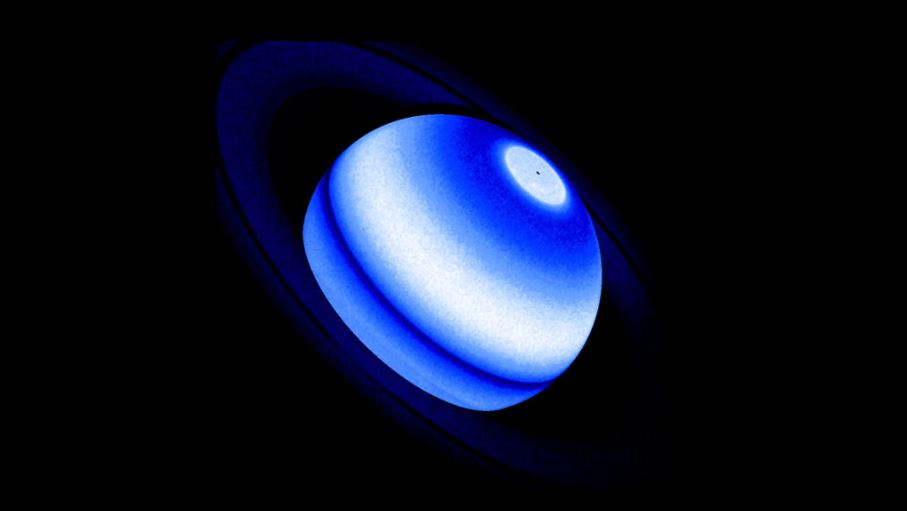
Saturn’s icy rings are probably heating its atmosphere, giving it an ultraviolet glow
The rings that make Saturn such a spectacle are probably heating its atmosphere and making it glow at ultraviolet wavelengths.
Researchers detected an excess of ultraviolet emission in Saturn’s northern hemisphere that comes from hydrogen atoms. The emission, known as Lyman-alpha radiation, is probably the result of water ice, which contains hydrogen, falling into the atmosphere from the planet’s rings, the researchers propose March 30 in the Planetary Science Journal.
The detection of similar emission from a distant world could someday lead to the discovery of a Saturn-like planet orbiting another star.
The key to the discovery came after two spacecraft — the Hubble Space Telescope and Cassini — observed Saturn simultaneously in 2017, right before Cassini plunged into the planet’s atmosphere, says Lotfi Ben-Jaffel, an astrophysicist at the Institut d’Astrophysique de Paris.
This allowed Ben-Jaffel and colleagues to calibrate the ultraviolet detectors on those spacecraft as well as detectors on Voyager 1 and 2, which flew past Saturn in 1980 and 1981, and the International Ultraviolet Explorer, an Earth-orbiting satellite that also observed Saturn. Comparing these ultraviolet observations revealed a band of excess Lyman-alpha radiation spanning 5° to 35° N latitude on Saturn.
The researchers’ explanation for the extra ultraviolet glow is plausible, says Paul Estrada, a planetary scientist at NASA’s Ames Research Center in Moffett Field, Calif., who was not involved with the new work.
“We know material is falling in from the rings,” he says, because Cassini detected it during the spacecraft’s spiral into Saturn. “The rings are predominantly water ice. It may be the source of the atomic hydrogen” emitting the Lyman-alpha radiation that the researchers have detected, he says.
When icy ring particles fall into Saturn’s atmosphere, they carry kinetic energy with them. “They have to release that energy to the surrounding gas,” Ben-Jaffel says, and that energy heats up the atmosphere. When the icy particles vaporize, they release additional energy, further heating the atmosphere and making it glow at UV wavelengths. The researchers suspect that the emission also appears in the planet’s southern hemisphere.
All the giant planets of our solar system have rings, but only Saturn’s are so bright and beautiful. Astronomers don’t yet know whether any of the thousands of worlds found orbiting other stars have rings that are equally magnificent.
The new discovery may help astronomers identify those spectacularly ringed worlds, if they exist. Future planet hunters could look for the telltale ultraviolet glow of the Lyman-alpha radiation, Ben-Jaffel says, and then further observations could confirm the rings’ existence.
Reality Of Islam |
|

Keeping sil
Two experim

Changing a

Plants are
 9:3:43
2018-11-05
9:3:43
2018-11-05
10 benefits of Marriage in Islam
7:5:22
2019-04-08
benefits of reciting surat yunus, hud &
9:45:7
2018-12-24
advantages & disadvantages of divorce
11:35:12
2018-06-10
6:0:51
2018-10-16
2:11:12
2022-10-15
5:58:12
2021-12-18
8:15:37
2023-02-16
10:55:53
2022-06-13
8:25:12
2022-03-09
12:47:1
2022-12-20
7:26:19
2022-04-08
5:41:46
2023-03-18
| LATEST |
 HOME
HOME