الوضع الليلي


 10:23:45
 2022-12-14
 1693
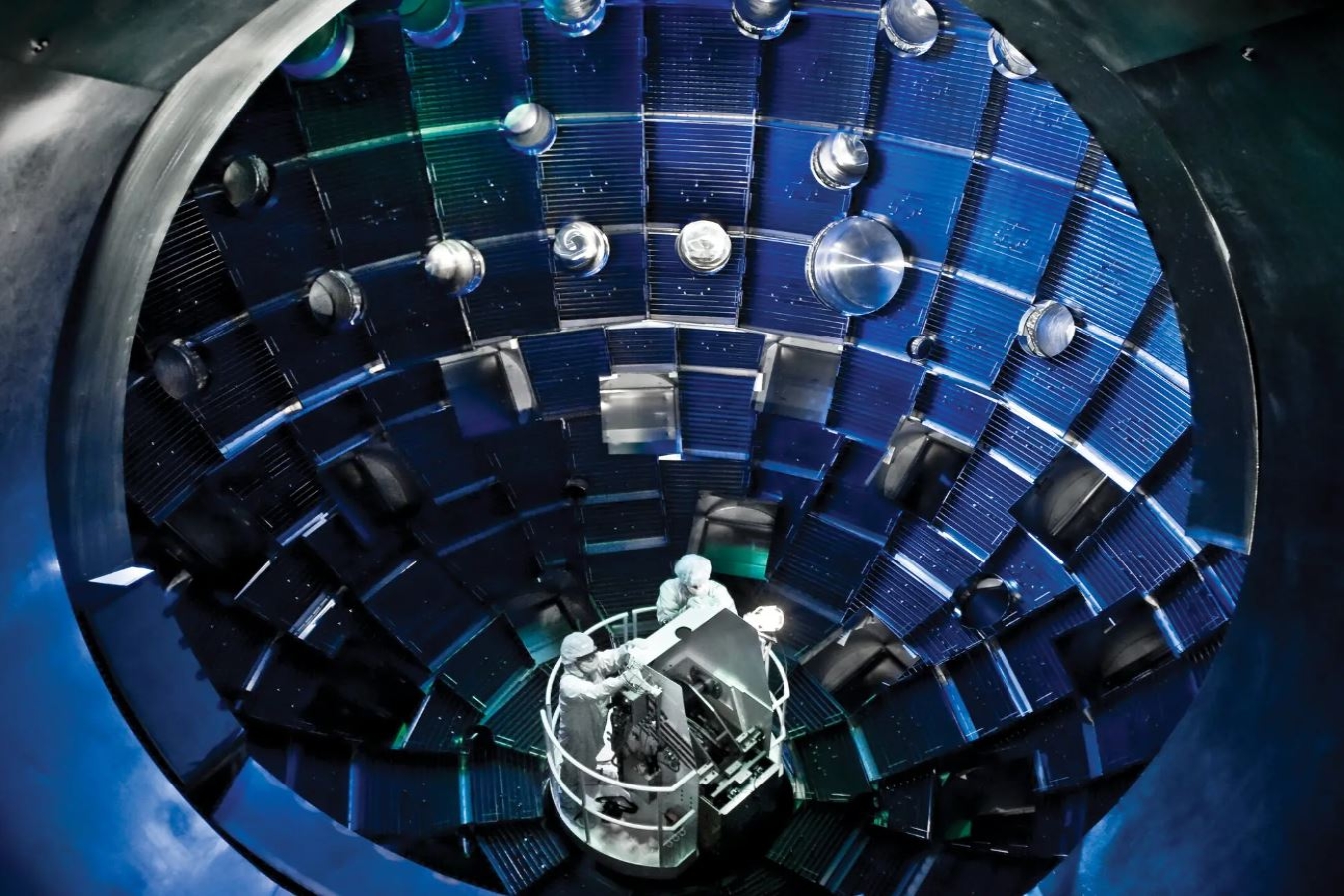
The advancement by Lawrence Livermore National Laboratory researchers will be built on to further develop fusion energy research.
Scientists studying fusion energy at Lawrence Livermore National Laboratory in California said they produced the first fusion reaction in a laboratory that created more energy than it took to start it.
Scientists studying fusion energy at Lawrence Livermore National Laboratory in California announced on Tuesday that they had crossed a long-awaited milestone in reproducing the power of the sun in a laboratory.
That sparked public excitement as scientists have for decades talked about how fusion, the nuclear reaction that makes stars shine, could provide a future source of bountiful energy.
The result announced on Tuesday is the first fusion reaction in a laboratory setting that actually produced more energy than it took to start the reaction.
“This is such a wonderful example of a possibility realized, a scientific milestone achieved, and a road ahead to the possibilities for clean energy,” Arati Prabhakar, the White House science adviser, said during a news conference on Tuesday morning at the Department of Energy’s headquarters in Washington, D.C. “And even deeper understanding of the scientific principles that are applied here.”
If fusion can be deployed on a large scale, it would offer an energy source devoid of the pollution and greenhouse gases caused by the burning of fossil fuels and the dangerous long-lived radioactive waste created by current nuclear power plants, which use the splitting of uranium to produce energy.
Within the sun and stars, fusion continually combines hydrogen atoms into helium, producing sunlight and warmth that bathes the planets. In experimental reactors and laser labs on Earth, fusion lives up to its reputation as a very clean energy source.
There was always a nagging caveat, however. In all of the efforts by scientists to control the unruly power of fusion, their experiments consumed more energy than the fusion reactions generated.
That changed at 1:03 a.m. on Dec. 5 when 192 giant lasers at the laboratory’s National Ignition Facility blasted a small cylinder about the size of a pencil eraser that contained a frozen nubbin of hydrogen encased in diamond.
The laser beams entered at the top and bottom of the cylinder, vaporizing it. That generated an inward onslaught of X-rays that compresses a BB-size fuel pellet of deuterium and tritium, the heavier forms of hydrogen.
In a brief moment lasting less than 100 trillionths of a second, 2.05 megajoules of energy — roughly the equivalent of a pound of TNT — bombarded the hydrogen pellet. Out flowed a flood of neutron particles — the product of fusion — which carried about 3 megajoules of energy, a factor of 1.5 in energy gain.
The successful experiment finally delivers the ignition goal that was promised when construction of the National Ignition Facility started in 1997. When operations began in 2009, however, the facility hardly generated any fusion at all, an embarrassing disappointment after a $3.5 billion investment from the federal government.
Reality Of Islam |
|
Keeping sil
Two experim
Changing a
Plants are
 9:3:43
2018-11-05
10 benefits of Marriage in Islam
7:5:22
2019-04-08
benefits of reciting surat yunus, hud &
9:45:7
2018-12-24
advantages & disadvantages of divorce
11:35:12
2018-06-10
6:0:51
2018-10-16
7:45:39
2018-06-21
7:34:7
2023-02-28
5:58:12
2021-12-18
7:32:24
2022-02-14
3:42:22
2021-12-24
8:19:41
2018-06-21
9:50:37
2023-02-28
5:41:46
2023-03-18
| LATEST |
 HOME