الوضع الليلي


 4:20:19
 2024-10-21
 1720
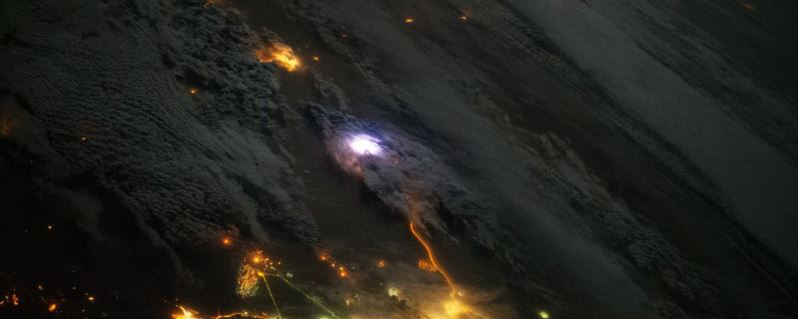
Lightning storms are some of the most spectacle, wild, and dramatic events our world has to offer – but the effects are not just directed towards Earth's surface.
According to new research, lightning storms can rip high-energy "killer" electrons out of the planet's radiation belt and fling them in all directions. It's a new link between Earth's meteorology and 'weather' in the space around us, and it may help us better protect our space equipment and the humans we send into orbit.
"These particles are the scary ones or what some people call 'killer electrons'," says aerospace engineer Max Feinland of the University of Colorado, Boulder. "They can penetrate metal on satellites, hit circuit boards and can be carcinogenic if they hit a person in space."
The Van Allen radiation belts that surround our planet like a giant donut are a product of Earth's magnetic field, which traps charged particles from the wind that constantly blows out of the Sun. The inner belt extends from 640 to 9,600 kilometers (400 to 6,000 miles) in altitude, and the outer belt from about 13,500 to 58,000 kilometers.
This trap is good for our planet; it protects us from the brunt of the solar wind and the charged particles we'd be pelted with otherwise. But particles can, and do, escape. The so-called "killer" electrons are those that have so much energy that they're moving at close to the speed of light, or relativistic speed.
Because they have so much energy, shielding can't keep them out; they can penetrate satellites (and there are a lot of them in low-Earth orbit nowadays), carrying a charge that risks damaging electronics within and shortening the technology's lifespan. Uncontrolled killer electrons aren't great for human health, either, potentially exposing astronauts to dangerous doses of cosmic radiation.
It's worth noting that we harness high speed electrons for treating cancer, too. In general, however, these zippy particles don't make for a good time for anything related to humans in their path.
There are processes that can accelerate electrons from more sedate energy levels, including the solar storms generated by the flares and coronal mass ejections that are so frequent at the peak of the solar activity cycle.
The researchers discovered the connection with lightning by analyzing satellite data that appeared to show clumps of high-energy electrons moving through the inner radiation belt. This was a surprise: the inner radiation belt has traditionally been considered pretty stable and boring.
But when Feinland made a closer study of archival records, he discovered 45 surges of high-energy electrons between 1996 and 2006. And some of these surges could be linked to lightning strikes in Earth's atmosphere, occurring less than a second after lightning was recorded.
Lightning is known to generate electromagnetic waves known as whistler waves, which occur in the low frequency radio range of the spectrum. Previous research suggests that whistler waves rippling through the unstable plasma of the radiation belt can cause electrons to jostle together, with lower-energy electrons transferring energy to higher-energy electrons in a chain reaction that can ultimately produce relativistic killer electrons.
The researchers believe that their observations reflect a similar mechanism, with the whistler waves producing surges in killer electrons that bounce between the poles before subsiding.
It's unclear how often it occurs, and what specific conditions are needed to trigger it. It's possible that solar activity plays a role, and previous research suggests that plasma density and wave activity are also important factors in the generation of relativistic electrons. It's going to take a little more work to figure out the different factors at play in lightning-induced killer electrons.
Future observations and analysis would help us better understand the nature of the wave-particle interactions at play.
Meanwhile, the findings suggest that astronauts may want to stay safely indoors while it's stormy outside. You don't want to get caught in a downpour of electron rain.
Reality Of Islam |
|
Keeping sil
Two experim
Changing a
Plants are
 9:3:43
2018-11-05
10 benefits of Marriage in Islam
7:5:22
2019-04-08
benefits of reciting surat yunus, hud &
9:45:7
2018-12-24
advantages & disadvantages of divorce
11:35:12
2018-06-10
6:0:51
2018-10-16
8:3:0
2018-06-21
the happy life of mankind requirement
6:36:36
2022-01-25
al-hussain (peace be upon him)
10:18:1
2022-09-21
7:34:7
2023-02-28
2:2:13
2022-10-08
10:35:40
2022-05-26
8:39:51
2022-09-23
5:41:46
2023-03-18
| LATEST |
 HOME