Attenuated total reflectance
Light that arrives at an appropriate angle to the boundary between two media (or materials) with appropriate refractive indices n1 and n2 can be reflected back into the first medium (Fig. 1A). This is known as internal reflectance. For this to happen, the light beam must have at least sampled the second medium, if only to a depth of approximately 10 μm. The light in this fine slice of the second medium is referred to as an evanescent wave. If the second medium has absorption properties, this is sensed by the evanescent wave and the reflected beam has a reduced (attenuated) intensity, the attenuated total reflectance (ATR). The detected beam now provides intensity versus wavenumber characteristics that are effectively the absorption spectrum of the second medium.
Several proprietary attachments on the market are based upon a single rhomboid prism, of which an example is illustrated in Figure 16.17B. Suitable optical materials for medium 1 are zinc selenide (ZnSe), germanium and diamond. A sample well is created on the side of the rhomboid optical block. A typical ZnSe block is 50 mm 1 or 2 mm, which gives 15–45 reflections, depending on rhomb angles. In this case, 5 to 10 μm sections of medium 2 are sampled 7–22 times, which results in an effective optical pathlength of the order 35–220 μm. The path length is reproducible and samples are easy to change in comparison with the equivalent simple transmission spacer cell, although the latter may be preferred for simple solutions. Any material that forms a good optical contact with the prism can, in principle, be measured (solutions, oils, waxes, creams, pastes, powders and films). More sophisticated devices exist, such as the DuraSamplIR attachment (Fig. 2) supplied by Sens IR Technologies, Warrington, UK. The IR radiation from the interferometer is directed into a ZnSe prism by mirror M1. Subsequent internal refection directs the IR radiation through a diamond prism, where the evanescent wave is reflected back through the ZnSe prism and then onto the detector via mirror M2. In principle, a powder sample, with no sample preparation, is placed on the diamond prism surface, where it is compacted by a plunger. Powders, films, solutions, etc., can all be measured with equal ease and no sample pretreatment. This device produces excellent results in minimal time and baselines are flat as the technique is not dependent on light scattering. The initial cost of ATR accessories may seem high compared to purchase of KBr to make discs, but the outlay is recouped quickly owing to cost savings in the time taken to analyse samples.
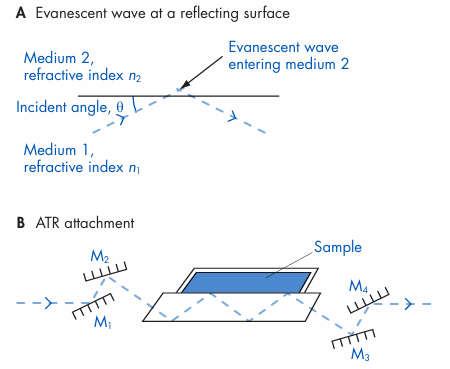
Figure 1 (A) Evanescent wave senses medium 2. (B) The attenuated total reflectance attachment, with light directed by mirrors M1 and M2, enters the rhomboid prism at 90. Here the sample is measured twice (two internal reflections) before the light exits the prism at 90 and is directed to the detector by mirrors M3 and M4. In practice, there can be as many as 45 reflections.
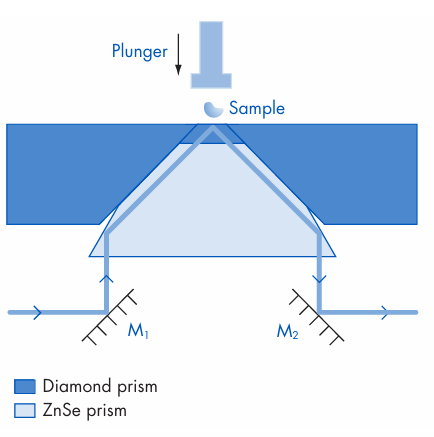
Figure 2 The DuraSamplIR attachment.








