Alkali halide discs
The technique of dispersing the compound in an alkali halide has been used widely in the identification of drugs. Originally, KBr was used and the technique is still often referred to as the ‘KBr technique’. However, potassium chloride (KCl) is superior to KBr because it is less hygroscopic. Storage of the alkali halide in an 80C oven helps to ensure anhydrous conditions. The finely powdered, dry, test compound (about 1 mg) is mixed with the alkali halide (about 250 mg) and ground either mechanically in an agate ball mill or by hand in an agate mortar. A texture approaching that of talcum powder is a good consistency. The mixture is then pressed under a load of approximately 10 tons of force in a purpose-designed press to produce an optically good, thin disc (Fig. 1). A vacuum helps to retain dry conditions and smooth disc formation. The load is applied for 10 minutes.
If only small quantities of the compound are available (about 200 lg), a thin cardboard mask with a slot in the centre can be used. The mask is placed in the die and the slot is filled with the mixture before pressing. A mask is often employed routinely because it provides a support for the alkali halide and so enables the disc to be handled more easily. Microdiscs of diameter down to 0.5 mm can be prepared using metal (lead or stainless steel) discs of 13 mm diameter with a hole of the appropriate size in the centre. The hole is filled with KBr (about 1 mg) that contains from 0.05% to 0.2% of the sample, which is then pressed in the usual way. The metal discs should be washed before use in both polar and nonpolar solvents and finally in good quality acetone to remove traces of oil and grease, which may produce artefacts in the C-H region of the spectrum. The method may fail if excessive pressure is used, as this causes deformation of the lead disc.
Another useful technique consists of dis solving the compound in a small volume of chloroform and drawing it into a Hamilton-type syringe held in a repeater holder. A small cluster of fine KBr particles is picked up on the end of the needle by a trace of chloroform expressed from the needle. The solvent is evaporated gently and the rest of the solution is fed into the KBr from the syringe as it evaporates. A disc is then made from the powder. It is important that the end of the needle be cut at right angles to the shaft and ground flat; those supplied for use with liquid chromatographs are suitable. For compounds which are bases, one must decide whether to evaporate solvents without the addition of hydrochloric acid, and accept the consequent loss of certain amines by volatilisation, or to add hydrochloric acid and accept the reduced solubility of the amine hydrochlorides in chloro form. Considerable losses of the sample by evaporation may occur for other types of compound (e.g. phenols), particularly when dilute solutions are used.
KBr is hygroscopic which means it is sometimes difficult to remove the last trace of water, and so silver chloride may be used instead. An indentation about 0.8 mm deep and slightly wider is made in the centre of a small piece of silver chloride sheet, and a solution (about 0.1 μL) that contains as little as 500 ng of substance is placed in the indentation and gently warmed to evaporate the solvent. The sheet is then placed in a die, which produces a cone of silver chloride with the sample embedded in it. A similar cone of plain silver chloride is mounted in the reference beam. Excellent spectra can be obtained with this technique. The alkali halide discs can be stored in a dry environment and give good spectra several years after preparation. A well-prepared disc should have over 80% transmittance in regions where the sample does not absorb, although it will not necessarily be visually clear. It is not always easy to obtain a good disc when a very small amount of a recovered drug is available. In these circumstances, attenuation of the reference beam can ‘sharpen’ the spectrum. Another technique is to heat the alkali halide disc to about 80C for 30 to 60 minutes with an IR lamp to evaporate any absorbed water. However, the high temperature accentuates the disadvantages of the alkali halide disc technique. In addition, the following artefacts have been observed:
• formation of anhydrides from carboxylic acids
• ketals and cyanohydrins reverting to the parent ketone
• loss of water from secondary alcohols.
Several disadvantages are inherent in the alkali halide disc technique. The alkali halides that are generally used are hygroscopic, and it is very difficult to exclude all traces of water. This often results in an O-H band in the spectrum. A number of compounds that contain O-H groups either form hydrogen bonds with the alkali halide or are adsorbed on its surface, so the method is unsuitable if the O-H band is to be examined. In such cases, polytetrafluoroethylene (PTFE) powder can sometimes be used in place of the alkali halide. Polymorphism occurs in many compounds and the grinding and pressing can alter the crystal form and consequently the spectrum. Splitting of bands also frequently occurs. Another disadvantage is the possibility that chemical changes will occur during the preparation of the disc. For example, double decomposition can occur:
Base·HCl+KBr→ Base·HBr+KCl
Hydrochlorides should, preferably, be examined in KCl. Bromide may be oxidised to bromine by some compounds, particularly strong oxidising agents, which may result in a disc becoming either discoloured or having yellow–brown spots. If the sample is a potential oxidising agent, other techniques of sample preparation should also be used to check the reliability of the spectra obtained from the alkali disc. Organic compounds that contain nitrogen in a functional group should not be used with plates that are made of thallium bromide and thallium iodide as they appear to react with the plates. Despite these disadvantages, the technique is still very useful for solid drugs. The advantages are that, besides being easy to use, the absorption of the alkali halide is very low and the quantity of compound required is small. The discs can easily be stored for reference purposes or the compound can be recovered if required.
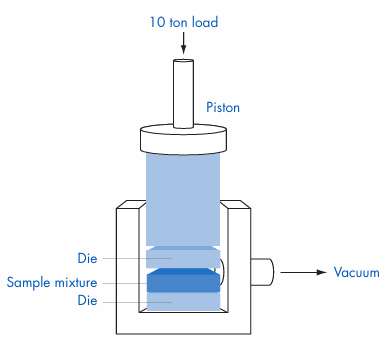
Figure 1 KBr disc press.








