Headless relatives and free relatives
At the beginning of Relative clauses, we identified the basic parts of a relative clause construction as being a head noun, a modifying clause, and (optionally) a relativizer. Now consider the following Tagalog noun phrases. In each case the (a) example is a complete, normal, relative clause construction, but the corresponding (b) example seems incomplete. Specifically, the (b) examples contain no head noun; they are “headless.”
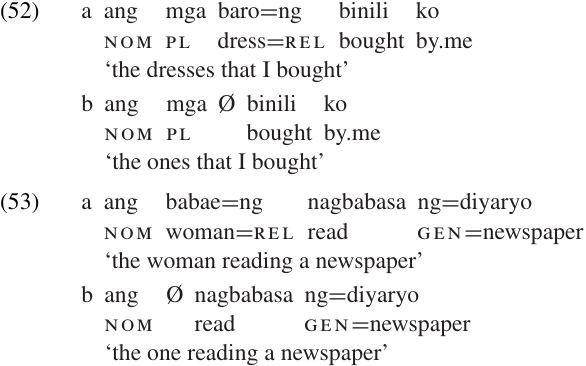
NPs like the (b) examples are referred to as HEADLESS RELATIVE CLAUSES. They take the normal NP markers (case, determiners, etc.) and contain a modifying clause, which may be preceded by a relative pronoun or relativizer if these are present in normal relative clauses; but they lack a head noun. Notice that the English translations of these examples include a pronominal element one as head of the NP, since English does not allow true headless relative clauses. The interpretation of a headless relative clause will depend on context; the ones that I bought could refer to dresses, fish, bicycles, shares of stock, etc., depending on the previous discourse. But quite often headless relatives are used to refer to people; so (53b) could be translated the person reading a newspaper.
There is no real headless relative construction in English. The closest approximation is the “free relative” construction, as in You can’t always get what you want. However, headless NPs with adjectival modifiers (the rich; the poor; etc.) are quite common, especially in movie and book titles: The good, the bad, and the ugly; The naked and the dead; Lonely are the brave; etc. These are quite similar to headless relative clauses except that the modifier is just a single adjective, rather than an entire clause.
The free relative construction mentioned in the previous paragraph is basically an NP that looks like a content question; an example is given in (54a). A free relative can easily be mistaken for an interrogative complement clause (54b), i.e. an indirect question, because both of them begin with a question word. The key difference is that the free relative is an NP and typically refers to a thing, as in (54a); an interrogative complement clause is an ¯ S and typically refers to a proposition (the proposition that would answer the embedded question), as in (54b).
(54) a I don’t eat [what he cooks on that old stove]NP. [ FREE RELATIVE]
b I don’t know [what he cooks on that old stove]S՛. [INTERROG.COMPL.]
Recall that the verb know selects a clausal complement, whereas the verb eat does not. This means that the embedded clause in (54a) cannot be a complement clause; it must be the NP object of eat. Similarly, ask selects a clausal complement but buy does not; thus, the embedded clause in (55a) can only be the NP object of buy.
(55) (McCawley 1988:431–432)
a I’ll buy [what he is selling]NP. [FREE RELATIVE]
b I’ll ask [what he is selling]S՛. [ INTERROGATIVE COMPLEMENT]
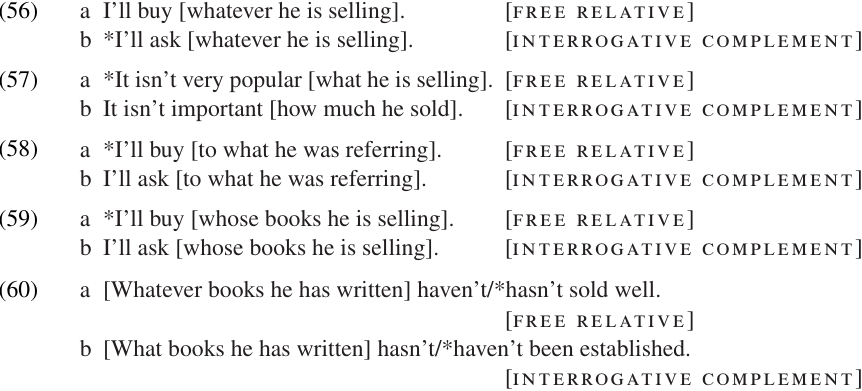
Several grammatical differences between these two constructions are noted by Bresnan and Grimshaw (1978); and McCawley (1988).1 Only in free relatives can the question word end with–ever (56). Only interrogative complements can be extraposed (57). Only in interrogative complements can the Wh-phrase contain a preposition (58) or a possessor (59). And only free relatives can trigger plural number agreement (60).
1. (55–57) are adapted from McCawley (1988:431–432).








