Adjunct (or Adverbial) clauses
We defined ADJUNCTS as elements which are not subcategorized by the verb, but which are added to the sentence to provide various kinds of information. Several different types of expression may function as adjuncts. The most common types are adverbs (27a), prepositional phrases (27b), and adjunct clauses (27c):
(27) a Mary seldom makes her bed.
b Mary makes her bed on Tuesdays.
c Mary makes her bed when her mother comes to visit her.
All three types of adjuncts can be used to express similar kinds of information: time, place, manner, reason, etc. Many of the prepositions used in English to introduce PP adjuncts can also be used to introduce adjunct clauses, both finite and non-finite (participial), as the examples in (28–29) illustrate.1
(28) a Mary opened her presents [before dinner].
b Mary opened her presents [before finishing her dinner].
c Mary opened her presents [before John finished his dinner].
(29) a The elephant’s child was spanked [for his curiosity].
b The elephant’s child was spanked [for asking too many questions].
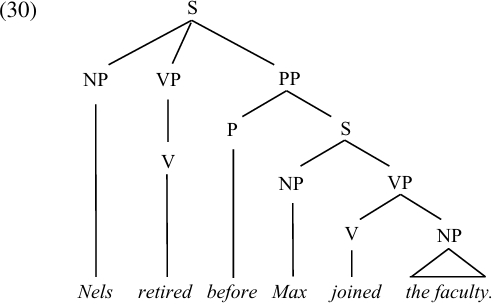
These prepositions are sometimes referred to as “subordinating conjunctions” when they are used to introduce adverbial clauses. Some linguists prefer to analyze them as complementizers in this context, and to assign the adverbial clauses which they introduce to the category S՛. However, in view of the parallelism illustrated in (28–29), we will treat them as prepositions and assign the adverbial clause to the category PP, as illustrated in (30). This analysis requires us to modify our PS rules for English slightly, to allow prepositions to take objects which belong to one of two categories, NP or S.
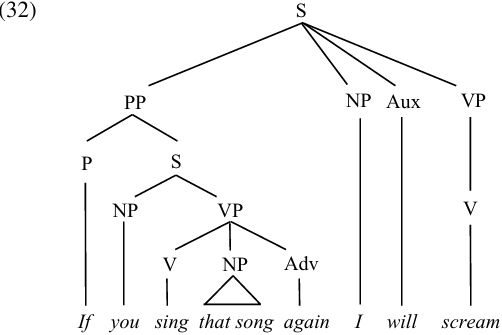
There are other “subordinating conjunctions” in English, including because, while, if, unless, although, etc., which only introduce adjunct clauses; they do not take NP objects like normal prepositions. In order to have a single, consistent treatment for all adjunct clauses, we will assume that these conjunctions also belong to the category P. It may seem odd to call something a preposition that never appears in a “normal” prepositional phrase (i.e. never takes an NP object). But we face a somewhat similar situation with verbs: some take NP objects (31a,b); others take clausal complements (31c,d); while still others can take either (31e,f) or both (31g).We are analyzing because, while, if, etc., as prepositions which take only clausal objects, similar to verbs like realize (in the sense illustrated in (31c,d)).2 A sample tree structure with an if clause is given in (32).
(31) a Sam kissed [my sister].
b *Sam kissed [that Elvis was dead].
c *Susan didn’t realize [my sister].
d Susan didn’t realize [that Elvis was dead].
e Arthur believed [my sister].
f Arthur believed [that Elvis was dead].
g Margaret told [my sister] [that Elvis was dead].
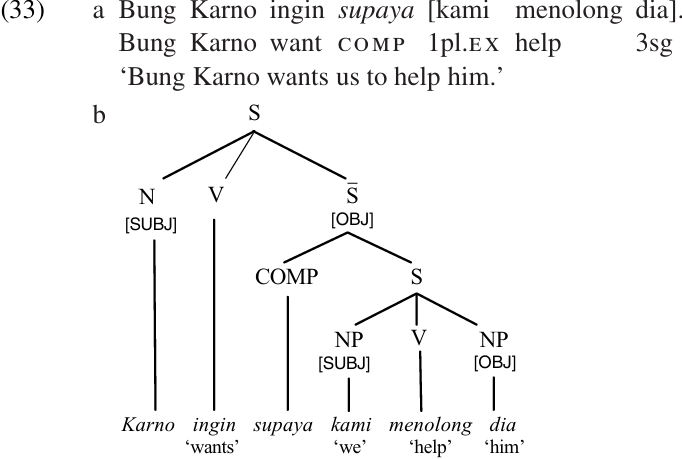
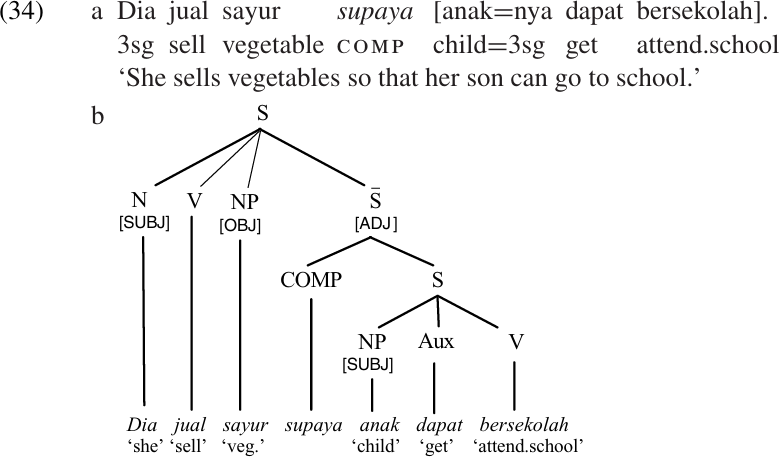
Treating adjunct clauses as PPs provides a more economical description for the sentence structure of English, but this is not true for all languages. In Southern Azerbaijani (Lee1996), for example, the particle ki is used to mark a variety of complement clauses such as ‘Hasan saw that X,’ ‘I hope that X,’ ‘He ordered the servants to X,’ etc. However, the same particle can also be used to mark adjunct clauses of purpose as in ‘He did X in order to Y.’ In Warlpiri the clitic particle =ku is used to mark both complement clauses (for matrix verbs like the coercion and modality predicates listed in Complement clauses) and adjunct clauses expressing purpose. Similarly, the Indonesian word supaya is used not only to introduce complement clauses corresponding to English for . . . to complements, as in (33), but also for certain adjunct purpose clauses as in (34) (examples adapted from Sneddon 1996). In such cases it makes sense to treat these markers as complementizers in both uses, analyzing both the complement and the adjunct clauses as S constituents, as indicated in diagrams (33b) and (34b).
Remember that the term COMPLEMENTIZER is a label for a syntactic category, rather than a restriction on function. It is not meant to imply that elements belonging to this category can only appear in complement clauses. Indeed, it is quite common for them to mark not only adjunct clauses but also relative clauses, to which we now turn.
1. See Kroeger (2004), Lexical entries and well-formed clauses for arguments that participial adjuncts like those in (28b) and (29b) are in fact clauses, even though they do not contain a subject NP.
2. Additional support for this analysis is provided by Emonds (1976:172ff.); and Radford (1988:134–137). The analysis is also adopted by McCawley (1988:191), citing Jespersen (1924:89).








