Structure Homomorphism
In logic, the term "homomorphism" is used in a manner similar to but a bit different from its usage in abstract algebra. The usage in logic is a special case of a "morphism" from category theory.
Let  , and
, and  be structures for a common language
  , and let
  . Then
  is a homomorphism from
  to
to  provided that it satisfies the following:
1. For each constant  ,
,  .
.
2. For each predicate symbol  , if the arity of
  is
is  , then
![P^B=<span style=]() {h(a_1),...,h(a_n)|(a_1,...,a_n) in P^A}. " src="https://mathworld.wolfram.com/images/equations/StructureHomomorphism/NumberedEquation1.svg" style="height:23px; width:295px" /> {h(a_1),...,h(a_n)|(a_1,...,a_n) in P^A}. " src="https://mathworld.wolfram.com/images/equations/StructureHomomorphism/NumberedEquation1.svg" style="height:23px; width:295px" /> |
3. For each function symbol (or operation)  , if the arity of
  is
is  , then for any
 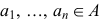 ,
,
For example, let  and
and  be (directed) graphs (the set
  is the set of vertices of
  , and
, and  is the set of vertices of
  , while
  is the relational representation of the edges of the graph
  , etc.). A homomorphism from
  to
to  is a function
  such that for any vertices
  and
and  of
of  ,
,  and
and  are connected by a directed edge (from
  to
to  if and only if the vertices
  and
and  are connected by a directed edge from
  to
to  .
.
Another example is available in the theory of ordered groups. Let  and
and  be ordered groups. (We are using the symbol
  to denote the multiplicative inversion operation. We will drop the superscripts
  and
and  , and for any
  (or
(or  ), we denote
  by
by  .) Formal application of our definition of a homomorphism in this setting indicates that
  is a homomorphism if and only if it satisfies the following:
1.  .
.
2. For  ,
,  .
.
3. For any  ,
, 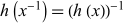 .
.
4. For any  ,
,  if and only if
  .
.
(Of course, these conditions can be shown to be redundant. Hence many texts define homomorphisms with requiring the preservation of the group identity ( ), and with postulating the preservation of multiplicative inversion.)
The homomorphisms of universal algebra are special cases of structure homomorphisms, and the notion of a structure homomorphism also extends the corresponding morphism notions in categories of ordered sets and various relational/algebraic structures.
REFERENCES
Bell, J. L. and Slomson, A. B. Models and Ultraproducts: an Introduction. Amsterdam, Netherlands: North-Holland, 1971.
Enderton, H. B. A Mathematical Introduction to Logic. New York: Academic Press, 1972.
Insall, E. "Nonstandard Methods and Finiteness Conditions in Algebra." Ph.D. dissertation. Houston, Texas: University of Houston, 1989.








