Riemann-von Mangoldt Formula
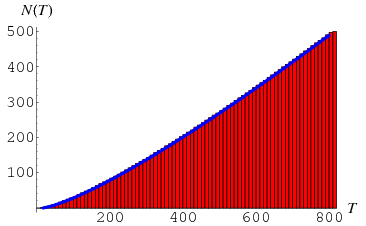
In his famous paper of 1859, Riemann stated that the number  of Riemann zeta function zeros
  with
with  is asymptotically given by
 |
(1)
|
as  (Edwards 2001, p. 19; Havil 2003, p. 203; Derbyshire 2004, p. 258). This can be written more compactly as
 |
(2)
|
This result was proved by von Mangoldt in 1905 and is hence known as the Riemann-von Mangoldt formula.
It follows that the density  of zeros at height
  is
is
 |
(3)
|
where, as usual, the asymptotic notation  means that the ratio
  tends to 1 as
  .
.
Another consequence of this result is that the imaginary parts of consecutive zeta zeros in the upper half-plane  satisfy
 |
(4)
|
Thus the mean spacing  between
  and
and  is
is
 |
(5)
|
which tends to zero as  .
.
REFERENCES:
Derbyshire, J. Prime Obsession: Bernhard Riemann and the Greatest Unsolved Problem in Mathematics. New York: Penguin, p. 217, 2004.
Edwards, H. M. Riemann's Zeta Function. New York: Dover, 2001.
Finch, S. R. Mathematical Constants. Cambridge, England: Cambridge University Press, p. 138, 2003.
Havil, J. Gamma: Exploring Euler's Constant. Princeton, NJ: Princeton University Press, 2003.
Ivic, A. A. The Riemann Zeta-Function. New York: Wiley, pp. 17-20, 1985.
Riemann, G. F. B. "Über die Anzahl der Primzahlen unter einer gegebenen Grösse." Monatsber. Königl. Preuss. Akad. Wiss. Berlin, 671-680, Nov. 1859.
Reprinted in Das Kontinuum und Andere Monographen (Ed. H. Weyl). New York: Chelsea, 1972.








