Square Root
A square root of  is a number
  such that
  . When written in the form
  or especially
  , the square root of
  may also be called the radical or surd. The square root is therefore an nth root with
  .
.
Note that any positive real number has two square roots, one positive and one negative. For example, the square roots of 9 are  and
and  , since
  . Any nonnegative real number
  has a unique nonnegative square root
  ; this is called the principal square root and is written
  or
or  . For example, the principal square root of 9 is
  , while the other square root of 9 is
  . In common usage, unless otherwise specified, "the" square root is generally taken to mean the principal square root. The principal square root function
  is the inverse function of
  for
for  .
.
Any nonzero complex number  also has two square roots. For example, using the imaginary unit i, the two square roots of
  are
are  . The principal square root of a number
  is denoted
  (as in the positive real case) and is returned by the Wolfram Language function Sqrt[z].
When considering a positive real number  , the Wolfram Language function Surd[x, 2] may be used to return the real square root.
The square roots of a complex number  are given by
![sqrt(x+iy)=+/-(x^2+y^2)^(1/4)<span style=]() {cos[1/2tan^(-1)(x,y)]+isin[1/2tan^(-1)(x,y)]}. " src="http://mathworld.wolfram.com/images/equations/SquareRoot/NumberedEquation1.gif" style="height:36px; width:406px" /> {cos[1/2tan^(-1)(x,y)]+isin[1/2tan^(-1)(x,y)]}. " src="http://mathworld.wolfram.com/images/equations/SquareRoot/NumberedEquation1.gif" style="height:36px; width:406px" /> |
(1)
|
In addition,
![sqrt(x+iy)=1/2sqrt(2)[sqrt(sqrt(x^2+y^2)+x)+isgn(y)sqrt(sqrt(x^2+y^2)-x)].](http://mathworld.wolfram.com/images/equations/SquareRoot/NumberedEquation2.gif) |
(2)
|
As can be seen in the above figure, the imaginary part of the complex square root function has a branch cut along the negative real axis.
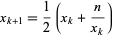
There are a number of square root algorithms that can be used to approximate the square root of a given (positive real) number. These include the Bhaskara-Brouncker algorithm and Wolfram's iteration. The simplest algorithm for  is Newton's iteration:
 |
(3)
|
with  .
.
The square root of 2 is the irrational number  (OEIS A002193) sometimes known as Pythagoras's constant, which has the simple periodic continued fraction [1, 2, 2, 2, 2, 2, ...] (OEIS A040000). The square root of 3 is the irrational number
  (OEIS A002194), sometimes known as Theodorus's constant, which has the simple periodic continued fraction [1, 1, 2, 1, 2, 1, 2, ...] (OEIS A040001). In general, the continued fractions of the square roots of all positive integers are periodic.
A nested radical of the form  can sometimes be simplified into a simple square root by equating
 |
(4)
|
Squaring gives
 |
(5)
|
so
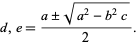
Solving for  and
and  gives
gives
 |
(8)
|
For example,
 |
(9)
|
 |
(10)
|
The Simplify command of the Wolfram Language does not apply such simplifications, but FullSimplify does. In general, radical denesting is a difficult problem (Landau 1992ab, 1994, 1998).
A counterintuitive property of inverse functions is that
![sqrt(z)sqrt(1/z)=<span style=]() {-1 for I[z]=0 and R[z]<0; undefined for z=0; 1 otherwise, " src="http://mathworld.wolfram.com/images/equations/SquareRoot/NumberedEquation9.gif" style="height:62px; width:302px" /> {-1 for I[z]=0 and R[z]<0; undefined for z=0; 1 otherwise, " src="http://mathworld.wolfram.com/images/equations/SquareRoot/NumberedEquation9.gif" style="height:62px; width:302px" /> |
(11)
|
so the expected identity (i.e., canceling of the  s) does not hold along the negative real axis.
REFERENCES:
Landau, S. "A Note on 'Zippel Denesting.' " J. Symb. Comput. 13, 31-45, 1992a.
Landau, S. "Simplification of Nested Radicals." SIAM J. Comput. 21, 85-110, 1992b.
Landau, S. "How to Tangle with a Nested Radical." Math. Intell. 16, 49-55, 1994.
Landau, S. " : Four Different Views." Math. Intell. 20, 55-60, 1998.
Sloane, N. J. A. Sequences A002193/M3195, A002194/M4326, A040000, and A040001 in "The On-Line Encyclopedia of Integer Sequences."
Spanier, J. and Oldham, K. B. "The Square-Root Function  and Its Reciprocal," "The
  Function and Its Reciprocal," and "The
  Function." Chs. 12, 14, and 15 in An Atlas of Functions. Washington, DC: Hemisphere, pp. 91-99, 107-115, and 115-122, 1987.
Williams, H. C. "A Numerical Investigation into the Length of the Period of the Continued Fraction Expansion of  ." Math. Comput. 36, 593-601, 1981.








