Rogers L-Function
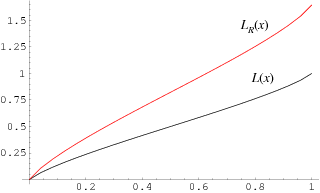
If  denotes the usual dilogarithm, then there are two variants that are normalized slightly differently, both called the Rogers
  -function (Rogers 1907). Bytsko (1999) defines
(which he calls "the" dilogarithm), while Gordon and McIntosh (1997) and Loxton (1991, p. 287) define the Rogers  -function as
The function  satisfies the concise reflection relation
 |
(6)
|
(Euler 1768), as well as Abel's functional equation
 |
(7)
|
(Abel 1988, Bytsko 1999). Abel's duplication formula for  follows from Abel's functional equation and is given by
 |
(8)
|
The function has the nice series
 |
(9)
|
(Lewin 1982; Loxton 1991, p. 298).
In terms of  , the well-known dilogarithm identities become
(Loxton 1991, pp. 287 and 289; Bytsko 1999), where  .
.
Numbers  which satisfy
 |
(15)
|
for some value of  are called L-algebraic numbers. Loxton (1991, p. 289) gives a slew of identities having rational coefficients
 |
(16)
|
instead of integers, where  is a rational number, a corrected and expanded version of which is summarized in the following table. In this table, polynomials
  denote the real root of
  . Many more similar identities can be found using integer relationalgorithms.
 |
 |
 |
| 1 |
1 |
1 |
 |
1 |
 |
 |
 |
 |
 |
 |
1 |
 |
1 |
 |
 |
 |
 |
 |
 |
1 |
 |
 |
 |
 |
 |
 |
 |
 |
1 |
 |
 |
 |
 |
 |
 |
 |
 |
 |
 |
 |
 |
 |
 |
3 |
 |
 |
 |
 |
 |
 |
 |
 |
 |
 |
 |
 |
 |
 |
 |
 , , |
 |
 |
 |
 |
 |
 |
 |
 |
 |
 |
 |
 |
 |
 |
 |
 |
 |
 |
 |
1 |
 |
 |
2 |
 |
 |
 |
 |
 |
3 |
 |
 |
1 |
 |
 |
2 |
 |
 |
 |
 |
 |
 |
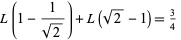
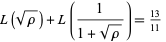
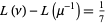
Bytsko (1999) gives the additional identities
 |
(17)
|
 |
(18)
|
 |
(19)
|
 |
(20)
|
 |
(21)
|
 |
(22)
|
 |
(23)
|
 |
(24)
|
 |
(25)
|
where
with  the positive root of
 |
(29)
|
and  and
and  the real roots of
 |
(30)
|
Here, (◇) and (◇) are special cases of Watson's identities and (◇) is a special case of Abel's duplication formula with  (Gordon and McIntosh 1997, Bytsko 1999).
Rogers (1907) obtained a dilogarithm identity in  variables with
  terms which simplifies to Euler's identity for
  and Abel's functional equation for
  (Gordon and McIntosh 1997). For
  , it is equivalent to
 |
(31)
|
with
(Gordon and McIntosh 1997).
REFERENCES:
Abel, N. H. Oeuvres Completes, Vol. 2 (Ed. L. Sylow and S. Lie). New York: Johnson Reprint Corp., pp. 189-192, 1988.
Bytsko, A. G. "Fermionic Representations for Characters of  ,
,  ,
,  and
and  Minimal Models and Related Dilogarithm and Rogers-Ramanujan-Type Identities." J. Phys. A: Math. Gen. 32, 8045-8058, 1999.
Bytsko, A. G. "Two-Term Dilogarithm Identities Related to Conformal Field Theory." 9 Nov 1999. http://arxiv.org/abs/math-ph/9911012.
Euler, L. Institutiones calculi integralis, Vol. 1. Basel, Switzerland: Birkhäuser, pp. 110-113, 1768.
Gordon, B. and McIntosh, R. J. "Algebraic Dilogarithm Identities." Ramanujan J. 1, 431-448, 1997.
Lewin, L. "The Dilogarithm in Algebraic Fields." J. Austral. Math. Soc. (Ser. A) 33, 302-330, 1982.
Lewin, L. (Ed.). Structural Properties of Polylogarithms. Providence, RI: Amer. Math. Soc., 1991.
Loxton, J. H. "Partition Identities and the Dilogarithm." Ch. 13 in Structural Properties of Polylogarithms (Ed. L. Lewin). Providence, RI: Amer. Math. Soc., pp. 287-299, 1991.
Rogers, L. J. "On Function Sum Theorems Connected with the Series  ." Proc. London Math. Soc. 4, 169-189, 1907.
Watson, G. N. "A Note on Spence's Logarithmic Transcendent." Quart. J. Math. Oxford Ser. 8, 39-42, 1937.








