Zernike Polynomial
The Zernike polynomials are a set of orthogonal polynomials that arise in the expansion of a wavefront function for optical systems with circular pupils. The odd and even Zernike polynomials are given by
 |
(1)
|
where the radial function  is defined for
  and
and  integers with
  by
by
 |
(2)
|
Here,  is the azimuthal angle with
  and
and  is the radial distance with
  (Prata and Rusch 1989). The even and odd polynomials are sometimes also denoted
Zernike polynomials are implemented in the Wolfram Language as ZernikeR[n, m, rho].
Other closed forms for  include
 |
(5)
|
for  odd and
  , where
  is the gamma function and
  is a hypergeometric function. This can also be written in terms of the Jacobi polynomial
  as
as
 |
(6)
|
The first few nonzero radial polynomials are
(Born and Wolf 1989, p. 465).
The radial functions satisfy the orthogonality relation
 |
(16)
|
where  is the Kronecker delta, and are related to the Bessel function of the first kind by
 |
(17)
|
(Born and Wolf 1989, p. 466). The radial Zernike polynomials have the generating function
 |
(18)
|
(correcting the typo of Born and Wolf) and are normalized so that
 |
(19)
|
(Born and Wolf 1989, p. 465).
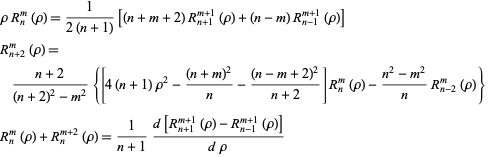
The Zernike polynomials also satisfy the recurrence relations
 |
(20)
|
(Prata and Rusch 1989). The coefficients  and
and  in the expansion of an arbitrary radial function
  in terms of Zernike polynomials
![F(rho,phi)=sum_(m=0)^inftysum_(n=m)^infty[A_n^m^oU_n^m(rho,phi)+B_n^m^eU_n^m(rho,phi)]](http://mathworld.wolfram.com/images/equations/ZernikePolynomial/NumberedEquation10.gif) |
(21)
|
are given by
 |
(22)
|
where
![epsilon_(mn)=<span style=]() {epsilon=1/(sqrt(2)) for m=0, n!=0; 1 otherwise " src="http://mathworld.wolfram.com/images/equations/ZernikePolynomial/NumberedEquation12.gif" style="height:64px; width:200px" /> {epsilon=1/(sqrt(2)) for m=0, n!=0; 1 otherwise " src="http://mathworld.wolfram.com/images/equations/ZernikePolynomial/NumberedEquation12.gif" style="height:64px; width:200px" /> |
(23)
|
Let a "primary" aberration be given by
 |
(24)
|
with  and where
  is the complex conjugate of
  , and define
 |
(25)
|
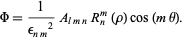
giving
 |
(26)
|
Then the types of primary aberrations are given in the following table (Born and Wolf 1989, p. 470).
| aberration |
 |
 |
 |
 |
 |
| spherical aberration |
0 |
4 |
0 |
 |
 |
| coma |
0 |
3 |
1 |
 |
 |
| astigmatism |
0 |
2 |
2 |
 |
 |
| field curvature |
1 |
2 |
0 |
 |
 |
| distortion |
1 |
1 |
1 |
 |
 |
REFERENCES:
Bezdidko, S. N. "The Use of Zernike Polynomials in Optics." Sov. J. Opt. Techn. 41, 425, 1974.
Bhatia, A. B. and Wolf, E. "On the Circle Polynomials of Zernike and Related Orthogonal Sets." Proc. Cambridge Phil. Soc. 50, 40, 1954.
Born, M. and Wolf, E. "The Diffraction Theory of Aberrations." Ch. 9 in Principles of Optics: Electromagnetic Theory of Propagation, Interference, and Diffraction of Light, 6th ed. New York: Pergamon Press, pp. 459-490, 1989.
Mahajan, V. N. "Zernike Circle Polynomials and Optical Aberrations of Systems with Circular Pupils." In Engineering and Lab. Notes 17 (Ed. R. R. Shannon), p. S-21, Aug. 1994.
Prata, A. and Rusch, W. V. T. "Algorithm for Computation of Zernike Polynomials Expansion Coefficients." Appl. Opt. 28, 749-754, 1989.
Wang, J. Y. and Silva, D. E. "Wave-Front Interpretation with Zernike Polynomials." Appl. Opt. 19, 1510-1518, 1980.
Wyant, J. C. "Zernike Polynomials." http://wyant.optics.arizona.edu/zernikes/zernikes.htm.
Zernike, F. "Beugungstheorie des Schneidenverfahrens und seiner verbesserten Form, der Phasenkontrastmethode." Physica 1, 689-704, 1934.
Zhang, S. and Shannon, R. R. "Catalog of Spot Diagrams." Ch. 4 in Applied Optics and Optical Engineering, Vol. 11. New York: Academic Press, p. 201, 1992.








