
Oxidation of Alkenes: Cleavage to Carbonyl Compounds
 المؤلف:
..................
المؤلف:
..................
 المصدر:
LibreTexts Project
المصدر:
LibreTexts Project
 الجزء والصفحة:
.................
الجزء والصفحة:
.................
 18-7-2019
 1976
1976
Oxidation of Alkenes: Cleavage to Carbonyl Compounds
Ozonolysis is a method of oxidatively cleaving alkenes or alkynes using ozone (O3), a reactive allotrope of oxygen. The process allows for carbon-carbon double or triple bonds to be replaced by double bonds with oxygen. This reaction is often used to identify the structure of unknown alkenes. by breaking them down into smaller, more easily identifiable pieces. Ozonolysis also occurs naturally and would break down repeated units used in rubber and other polymers. On an industrial scale, azelaic acid and pelargonic acids are produced from ozonolysis.
.jpg?revision=1&size=bestfit&width=476&height=116)
Introduction
The gaseous ozone is first passed through the desired alkene solution in either methanol or dichloromethane. The first intermediate product is an ozonide molecule which is then further reduced to carbonyl products. This results in the breaking of the Carbon-Carbon double bond and is replaced by a Carbon-Oxygen double bond instead.
Reaction Mechanism
Step 1:
.jpg?revision=1&size=bestfit&width=462&height=145)
The first step in the mechanism of ozonolysis is the initial electrophilic addition of ozone to the Carbon-Carbon double bond, which then form the molozonide intermediate. Due to the unstable molozonide molecule, it continues further with the reaction and breaks apart to form a carbonyl and a carbonyl oxide molecule.
Step 2:
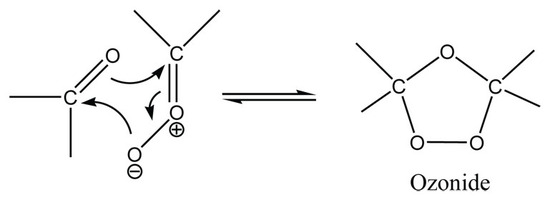
The carbonyl and the carbonyl oxide rearranges itself and reforms to create the stable ozonide intermediate. A reductive workup could then be performed to convert convert the ozonide molecule into the desired carbonyl products.
 0
0
 0
0
 الاكثر قراءة في تجارب وتفاعلات في الكيمياء العضوية
 اخر الاخبار
اخبار العتبة العباسية المقدسة








