Polygamma Function
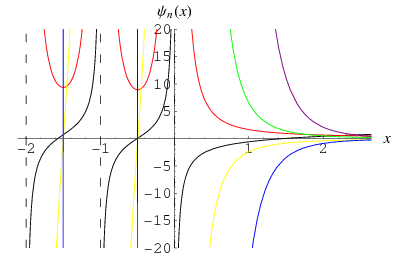
A special function mostly commonly denoted  ,
,  , or
, or  which is given by the
  st derivative of the logarithm of the gamma function
  (or, depending on the definition, of the factorial
  ). This is equivalent to the
  th normal derivative of the logarithmic derivative of
  (or
(or  ) and, in the former case, to the
  th normal derivative of the digamma function
  . Because of this ambiguity in definition, two different notations are sometimes (but not always) used, namely
which, for  can be written as
where  is the Hurwitz zeta function.
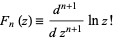
The alternate notation
 |
(6)
|
is sometimes used, with the two notations connected by
 |
(7)
|
Unfortunately, Morse and Feshbach (1953) adopt a notation no longer in standard use in which Morse and Feshbach's " " is equal to
  in the usual notation. Also note that the function
  is equivalent to the digamma function
  and
and  is sometimes known as the trigamma function.
 is implemented in the Wolfram Language as PolyGamma[n, z] for positive integer
  . In fact, PolyGamma[nu, z] is supported for all complex
  (Grossman 1976; Espinosa and Moll 2004).
The polygamma function obeys the recurrence relation
 |
(8)
|
the reflection formula
 |
(9)
|
and the multiplication formula,
 |
(10)
|
where  is the Kronecker delta.
The polygamma function is related to the Riemann zeta function  and the generalized harmonic numbers
  by
by
![psi_n(z)=(-1)^(n+1)n![zeta(n+1)-H_(z-1)^((n+1))]](http://mathworld.wolfram.com/images/equations/PolygammaFunction/NumberedEquation6.gif) |
(11)
|
for  , 2, ..., and in terms of the Hurwitz zeta function
  as
as
 |
(12)
|
The Euler-Mascheroni constant is a special value of the digamma function  , with
In general, special values for integral indices are given by
giving the digamma function, trigamma function, and tetragamma function identities
and so on.
The polygamma function can be expressed in terms of Clausen functions for rational arguments and integer indices. Special cases are given by
where  is Catalan's constant,
  is the Riemann zeta function, and
  is the Dirichlet beta function.
REFERENCES:
Abramowitz, M. and Stegun, I. A. (Eds.). "Polygamma Functions." §6.4 in Handbook of Mathematical Functions with Formulas, Graphs, and Mathematical Tables, 9th printing. New York: Dover, p. 260, 1972.
Adamchik, V. S. "Polygamma Functions of Negative Order." J. Comput. Appl. Math. 100, 191-199, 1999.
Arfken, G. "Digamma and Polygamma Functions." §10.2 in Mathematical Methods for Physicists, 3rd ed. Orlando, FL: Academic Press, pp. 549-555, 1985.
Berndt, B. C. Ramanujan's Notebooks: Part I. New York: Springer-Verlag, p. 163, 1985.
Davis, H. T. Tables of the Higher Mathematical Functions. Bloomington, IN: Principia Press, 1933.
Espinosa, O. and Moll, V. H. "A Generalized Polygamma Function." Integral Trans. Special Func. 15, 101-115, 2004.
Grossman, N. "Polygamma Functions of Arbitrary Order." SIAM J. Math. Anal. 7, 366-372, 1976.
Hansen, E. R. A Table of Series and Products. Englewood Cliffs, NJ: Prentice-Hall, 1975.
Kölbig, K. S. "The Polygamma Function  for
for  and
and  ." J. Comp. Appl. Math. 75, 43-46, 1996.
Kölbig, K. S. "The Polygamma Function and the Derivatives of the Cotangent Function for Rational Arguments." Report CN/96/5. CERN Computing and Networks Division, 1996.
Morse, P. M. and Feshbach, H. Methods of Theoretical Physics, Part I. New York: McGraw-Hill, pp. 422-424, 1953.








