Lanczos Approximation
An approximation for the gamma function  with
with ![R[z]>0](http://mathworld.wolfram.com/images/equations/LanczosApproximation/Inline2.gif) is given by
is given by
 |
(1)
|
where  is an arbitrary constant such that
 ![R[z+sigma+1/2]>0](http://mathworld.wolfram.com/images/equations/LanczosApproximation/Inline4.gif) ,
,
 |
(2)
|
where  is a Pochhammer symbol and
![epsilon_k=<span style=]() {1 for k=0; 2 otherwise, " src="http://mathworld.wolfram.com/images/equations/LanczosApproximation/NumberedEquation3.gif" style="height:41px; width:122px" /> {1 for k=0; 2 otherwise, " src="http://mathworld.wolfram.com/images/equations/LanczosApproximation/NumberedEquation3.gif" style="height:41px; width:122px" /> |
(3)
|
and
with  (Lanczos 1964; Luke 1969, p. 30).
  satisfies
 |
(6)
|
and if  is a positive integer, then
  satisfies the identity
 |
(7)
|
(Luke 1969, p. 30).
A similar result is given by
where  is a Pochhammer symbol,
  is a factorial, and
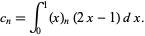 |
(11)
|
The first few values of  are
are
(OEIS A054379 and A054380; Whittaker and Watson 1990, p. 253). Note that Whittaker and Watson incorrectly give  as 227/60.
Yet another related result gives
![ln[Gamma(z)]=(z-1/2)lnz-z+1/2ln(2pi)+1/2[1/(2·3)sum_(r=1)^infty1/((z+r)^2)+2/(3·4)sum_(r=1)^infty1/((z+r)^3)+3/(4·5)sum_(r=1)^infty1/((z+r)^4)+...]
=(z-1/2)lnz-z+1/2ln(2pi)+1/2sum_(n=2)^infty((n-1))/(n(n+1))zeta(n,z+1)
=(z-1/2)lnz-z+1/2ln(2pi)+1/2sum_(n=2)^infty((-1)^n(n-1))/((n+1)!)psi_(n-1)(z)](http://mathworld.wolfram.com/images/equations/LanczosApproximation/NumberedEquation7.gif) |
(17)
|
(Whittaker and Watson 1990, p. 261), where  is a Hurwitz zeta function and
  is a polygamma function.
REFERENCES:
Lanczos, C. J. Soc. Indust. Appl. Math. Ser. B: Numer. Anal. 1, 86-96, 1964.
Luke, Y. L. "An Expansion for  ." §2.10.3 in The Special Functions and their Approximations, Vol. 1. New York: Academic Press, pp. 29-31, 1969.
Sloane, N. J. A. Sequences A054379 and A054379 in "The On-Line Encyclopedia of Integer Sequences."
Whittaker, E. T. and Watson, G. N. A Course in Modern Analysis, 4th ed. Cambridge, England: Cambridge University Press, 1990.








