Lemniscate Function
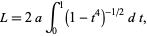
The lemniscate functions arise in rectifying the arc length of the lemniscate. The lemniscate functions were first studied by Jakob Bernoulli and Giulio Fagnano. A historical account is given by Ayoub (1984), and an extensive discussion by Siegel (1969). The lemniscate functions were the first functions defined by inversion of an integral
 |
(1)
|
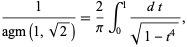
which was first done by Gauss, who noticed that
 |
(2)
|
where  is the arithmetic-geometric mean (Borwein and Bailey 2003, p. 13).
Define the inverse lemniscate functions as
where  is a hypergeometric function,
  is an incomplete elliptic integral of the first kind,
  is an elliptic integral of the second kind, and
 |
(10)
|
so that
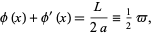
Now, there is an identity connecting  and
and  since
since
 |
(13)
|
so
 |
(14)
|
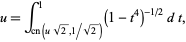
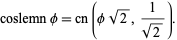
These functions can be written in terms of Jacobi elliptic functions,
 |
(15)
|
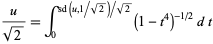
Now, if  , then
Let  so
so  ,
,
 |
(18)
|
 |
(19)
|
 |
(20)
|
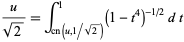
and
 |
(21)
|
Similarly,
 |
(25)
|
 |
(26)
|
and
 |
(27)
|
We know
 |
(28)
|
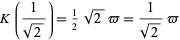
But it is true that
 |
(29)
|
so
 |
(30)
|
 |
(31)
|
 |
(32)
|
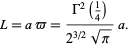
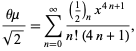
By expanding  in a binomial series and integrating term by term, the arcsinlemn function can be written
where  is a Pochhammer symbol (Berndt 1994).
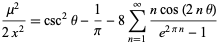
Ramanujan gave the following inversion formula for  . If
. If
 |
(36)
|
where
 |
(37)
|
is the constant obtained by letting  and
and  , and
, and
 |
(38)
|
then
 |
(39)
|
(Berndt 1994).
Ramanujan also showed that if  , then
 |
(40)
|
 |
(41)
|
 |
(42)
|
 |
(43)
|
and
 |
(44)
|
(Berndt 1994).
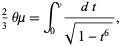
A generalized version of the lemniscate function can be defined by letting  and
and  . Write
 |
(45)
|
where  is the constant obtained by setting
  and
and  . Then
 |
(46)
|
and Ramanujan showed
 |
(47)
|
(Berndt 1994).
REFERENCES:
Ayoub, R. "The Lemniscate and Fagnano's Contributions to Elliptic Integrals." Arch. Hist. Exact Sci. 29, 131-149, 1984.
Berndt, B. C. Ramanujan's Notebooks, Part IV. New York: Springer-Verlag, pp. 245, and 247-255, 258-260, 1994.
Borwein, J. and Bailey, D. Mathematics by Experiment: Plausible Reasoning in the 21st Century. Wellesley, MA: A K Peters, 2003.
Siegel, C. L. Topics in Complex Function Theory, Vol. 1. New York: Wiley, 1969.








