Klein's Absolute Invariant
Let  and
and  be periods of a doubly periodic function, with
  the half-period ratio a number with
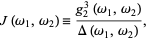
 ![I[tau]!=0](http://mathworld.wolfram.com/images/equations/KleinsAbsoluteInvariant/Inline4.gif) . Then Klein's absolute invariant (also called Klein's modular function) is defined as
. Then Klein's absolute invariant (also called Klein's modular function) is defined as
 |
(1)
|
where  and
and  are the invariants of the Weierstrass elliptic function with modular discriminant
 |
(2)
|
(Klein 1877). If  , where
  is the upper half-plane, then
 |
(3)
|
is a function of the ratio  only, as are
  ,
,  , and
, and  . Furthermore,
  ,
,  ,
,  , and
, and  are analytic in
  (Apostol 1997, p. 15).
Klein's absolute invariant is implemented in the Wolfram Language as KleinInvariantJ[tau].
The function  is the same as the j-function, modulo a constant multiplicative factor.
Every rational function of  is a modular function, and every modular function can be expressed as a rational functionof
  (Apostol 1997, p. 40).
Klein's invariant can be given explicitly by
(Klein 1878-1879, Cohn 1994), where  is the elliptic lambda function
![lambda(tau)=[(theta_2(0,q))/(theta_3(0,q))]^4,](http://mathworld.wolfram.com/images/equations/KleinsAbsoluteInvariant/NumberedEquation4.gif) |
(6)
|
 is a Jacobi theta function, the
  are Eisenstein series, and
  is the nome. Klein's invariant can also be simply expressed in terms of the five Weber functions
  ,
,  ,
,  ,
,  , and
, and  .
.
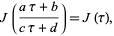
 is invariant under a unimodular transformation, so
 |
(7)
|
and  is a modular function.
  takes on the special values
 satisfies the functional equations
It satisfies a number of beautiful multiple-argument identities, including the duplication formula
with
and  the Dedekind eta function, the triplication formula
with
and the quintuplication formula
with
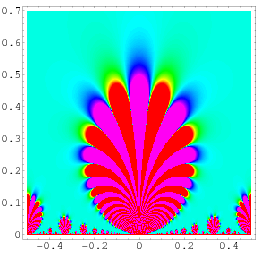
Plotting the real or imaginary part of  in the complex plane produces a beautiful fractal-like structure, illustrated above.
REFERENCES:
Apostol, T. M. "Klein's Modular Function  ," "Invariance of
  Under Unimodular Transformation," "The Fourier Expansions of
  and
and  ," "Special Values of
  ," and "Modular Functions as Rational Functions of
  ." §1.12-1.13, 1.15, and 2.5-2.6 in Modular Functions and Dirichlet Series in Number Theory, 2nd ed. New York: Springer-Verlag, pp. 15-18, 20-22, and 39-40, 1997.
Brezhnev, Y. V. "Uniformisation: On the Burnside Curve  ." 9 Dec 2001. http://arxiv.org/abs/math.CA/0111150.
Borwein, J. M. and Borwein, P. B. Pi & the AGM: A Study in Analytic Number Theory and Computational Complexity. New York: Wiley, pp. 115 and 179, 1987.
Cohn, H. Introduction to the Construction of Class Fields. New York: Dover, p. 73, 1994.
Klein, F. "Sull' equazioni dell' Icosaedro nella risoluzione delle equazioni del quinto grado [per funzioni ellittiche]." Reale Istituto Lombardo, Rendiconto, Ser. 2 10, 1877.
Klein, F. "Über die Transformation der elliptischen Funktionen und die Auflösung der Gleichungen fünften Grades." Math. Ann.14, 111-172, 1878-1879.
Nesterenko, Yu. V. A Course on Algebraic Independence: Lectures at IHP 1999. Unpublished manuscript. 1999.








