Wigner 6j-Symbol
The Wigner  -symbols (Messiah 1962, p. 1062), commonly simply called the
  -symbols, are a generalization of Clebsch-Gordan coefficients and Wigner 3j-symbol that arise in the coupling of three angular momenta. They are variously called the "
 symbols" (Messiah 1962, p. 1062) or 6-
 symbols (Shore and Menzel 1968, p. 279).
The Wigner  -symbols are returned by the Wolfram Language function SixJSymbol[
![<span style=]() {" src="http://mathworld.wolfram.com/images/equations/Wigner6j-Symbol/Inline6.gif" style="height:15px; width:5px" />j1, j2, j3
{" src="http://mathworld.wolfram.com/images/equations/Wigner6j-Symbol/Inline6.gif" style="height:15px; width:5px" />j1, j2, j3![<span style=]() }" src="http://mathworld.wolfram.com/images/equations/Wigner6j-Symbol/Inline7.gif" style="height:15px; width:5px" />,
}" src="http://mathworld.wolfram.com/images/equations/Wigner6j-Symbol/Inline7.gif" style="height:15px; width:5px" />, ![<span style=]() {" src="http://mathworld.wolfram.com/images/equations/Wigner6j-Symbol/Inline8.gif" style="height:15px; width:5px" />j4, j5, j6
{" src="http://mathworld.wolfram.com/images/equations/Wigner6j-Symbol/Inline8.gif" style="height:15px; width:5px" />j4, j5, j6![<span style=]() }" src="http://mathworld.wolfram.com/images/equations/Wigner6j-Symbol/Inline9.gif" style="height:15px; width:5px" />].
}" src="http://mathworld.wolfram.com/images/equations/Wigner6j-Symbol/Inline9.gif" style="height:15px; width:5px" />].
Let tensor operators  and
and  act, respectively, on subsystems 1 and 2 of a system, with subsystem 1 characterized by angular momentum
  and subsystem 2 by the angular momentum
  . Then the matrix elements of the scalar product of these two tensor operators in the coupled basis
  are given by
 |
(1)
|
where  is the Wigner
  -symbol and
  and
and  represent additional pertinent quantum numbers characterizing subsystems 1 and 2 (Gordy and Cook 1984).
The  symbols are denoted
 ![<span style=]() {j_1 j_2 j_3; J_1 J_2 J_3}" src="http://mathworld.wolfram.com/images/equations/Wigner6j-Symbol/Inline20.gif" style="height:34px; width:81px" /> and are defined for integers and half-integers
{j_1 j_2 j_3; J_1 J_2 J_3}" src="http://mathworld.wolfram.com/images/equations/Wigner6j-Symbol/Inline20.gif" style="height:34px; width:81px" /> and are defined for integers and half-integers  ,
,  ,
,  ,
,  ,
,  ,
,  whose triads
  ,
,  ,
,  , and
, and  satisfy the following conditions (Messiah 1962, p. 1063).
1. Each triad satisfies the triangular inequalities.
2. The sum of the elements of each triad is an integer. Therefore, the members of each triad are either all integers or contain two half-integers and one integer.
If these conditions are not satisfied, ![<span style=]() {j_1 j_2 j_3; J_1 J_2 J_3}=0" src="http://mathworld.wolfram.com/images/equations/Wigner6j-Symbol/Inline31.gif" style="height:34px; width:105px" />.
{j_1 j_2 j_3; J_1 J_2 J_3}=0" src="http://mathworld.wolfram.com/images/equations/Wigner6j-Symbol/Inline31.gif" style="height:34px; width:105px" />.
The  -symbols are invariant under permutation of their columns, e.g.,
![<span style=]() {j_1 j_2 j_3; J_1 J_2 J_3}={j_2 j_1 j_3; J_2 J_1 J_3} " src="http://mathworld.wolfram.com/images/equations/Wigner6j-Symbol/NumberedEquation2.gif" style="height:34px; width:179px" /> {j_1 j_2 j_3; J_1 J_2 J_3}={j_2 j_1 j_3; J_2 J_1 J_3} " src="http://mathworld.wolfram.com/images/equations/Wigner6j-Symbol/NumberedEquation2.gif" style="height:34px; width:179px" /> |
(2)
|
and under exchange of two corresponding elements between rows, e.g.,
![<span style=]() {j_1 j_2 j_3; J_1 J_2 J_3}={J_1 J_2 j_3; j_1 j_2 J_3} " src="http://mathworld.wolfram.com/images/equations/Wigner6j-Symbol/NumberedEquation3.gif" style="height:34px; width:179px" /> {j_1 j_2 j_3; J_1 J_2 J_3}={J_1 J_2 j_3; j_1 j_2 J_3} " src="http://mathworld.wolfram.com/images/equations/Wigner6j-Symbol/NumberedEquation3.gif" style="height:34px; width:179px" /> |
(3)
|
(Messiah 1962, pp. 1063-1064).
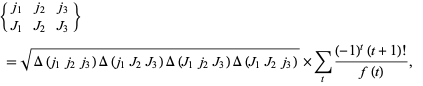
The  -symbols can be computed using the Racah formula
 |
(4)
|
where  is a triangle coefficient,
 |
(5)
|
and the sum is over all integers  for which the factorials in
  all have nonnegative arguments (Wigner 1959; Messiah 1962, p. 1065; Shore and Menzel 1968, p. 279). In particular, the number of terms is equal to
  , where
  is the smallest of the twelve numbers
 |
(6)
|
(Messiah 1962, p. 1064).
The  symbols satisfy the so-called Racah-Elliot and orthogonality relations,
![sum_(x)(-1)^(2x)(2x+1)<span style=]() {a b x; a b f}=1 " src="http://mathworld.wolfram.com/images/equations/Wigner6j-Symbol/Inline40.gif" style="height:41px; width:202px" /> {a b x; a b f}=1 " src="http://mathworld.wolfram.com/images/equations/Wigner6j-Symbol/Inline40.gif" style="height:41px; width:202px" /> |
(7)
|
![sum_(x)(-1)^(a+b+x)(2x+1)<span style=]() {a b x; b a f} " src="http://mathworld.wolfram.com/images/equations/Wigner6j-Symbol/Inline41.gif" style="height:41px; width:193px" /> {a b x; b a f} " src="http://mathworld.wolfram.com/images/equations/Wigner6j-Symbol/Inline41.gif" style="height:41px; width:193px" /> |
(8)
|
 |
(9)
|
![sum_(x)(2x+1)<span style=]() {a b x; c d f}{c d x; a b g}=(delta_(fg))/(2f+1) " src="http://mathworld.wolfram.com/images/equations/Wigner6j-Symbol/Inline43.gif" style="height:43px; width:269px" /> {a b x; c d f}{c d x; a b g}=(delta_(fg))/(2f+1) " src="http://mathworld.wolfram.com/images/equations/Wigner6j-Symbol/Inline43.gif" style="height:43px; width:269px" /> |
(10)
|
![sum_(x)(-1)^(f+g+x)(2x+1)<span style=]() {a b x; c d f}{c d x; b a g} " src="http://mathworld.wolfram.com/images/equations/Wigner6j-Symbol/Inline44.gif" style="height:41px; width:263px" /> {a b x; c d f}{c d x; b a g} " src="http://mathworld.wolfram.com/images/equations/Wigner6j-Symbol/Inline44.gif" style="height:41px; width:263px" /> |
(11)
|
![=<span style=]() {a d f; b c g} " src="http://mathworld.wolfram.com/images/equations/Wigner6j-Symbol/Inline45.gif" style="height:34px; width:91px" /> {a d f; b c g} " src="http://mathworld.wolfram.com/images/equations/Wigner6j-Symbol/Inline45.gif" style="height:34px; width:91px" /> |
(12)
|
![sum_(x)(-1)^(a+b+c+d+e+f+g+h+x+j)(2x+1)<span style=]() {a b x; c d g}×{c d x; e f h}{e f x; b a j} " src="http://mathworld.wolfram.com/images/equations/Wigner6j-Symbol/Inline46.gif" style="height:41px; width:415px" /> {a b x; c d g}×{c d x; e f h}{e f x; b a j} " src="http://mathworld.wolfram.com/images/equations/Wigner6j-Symbol/Inline46.gif" style="height:41px; width:415px" /> |
(13)
|
![=<span style=]() {j h j; e a d}{g h j; f b c} " src="http://mathworld.wolfram.com/images/equations/Wigner6j-Symbol/Inline47.gif" style="height:34px; width:155px" /> {j h j; e a d}{g h j; f b c} " src="http://mathworld.wolfram.com/images/equations/Wigner6j-Symbol/Inline47.gif" style="height:34px; width:155px" /> |
(14)
|
(Messiah 1962, p. 1065).
Edmonds (1968) gives analytic forms of the  -symbol for simple cases, and Shore and Menzel (1968) and Gordy and Cook (1984) give
where
(Edmonds 1968; Shore and Menzel 1968, p. 281; Gordy and Cook 1984, p. 809). Note that since  must be an integer,
  , so replacing the definition of
  with its negative above gives an equivalent result.
Messiah (1962, p. 1066) gives the additional special cases
for  .
.
The Wigner  -symbols are related to the Racah W-coefficients by
![(-1)^(a+b+c+d)W(abcd;ef)=<span style=]() {a b c; d e f} " src="http://mathworld.wolfram.com/images/equations/Wigner6j-Symbol/NumberedEquation7.gif" style="height:34px; width:236px" /> {a b c; d e f} " src="http://mathworld.wolfram.com/images/equations/Wigner6j-Symbol/NumberedEquation7.gif" style="height:34px; width:236px" /> |
(22)
|
(Messiah 1962, p. 1062; Shore and Menzel 1968, p. 279).
REFERENCES:
Biedenharn, L. C. and Louck, J. D. The Racah-Wigner Algebra in Quantum Theory. Reading, MA: Addison-Wesley, 1981.
Biedenharn, L. C. and Louck, J. D. Angular Momentum in Quantum Physics: Theory and Applications. Reading, MA: Addison-Wesley, 1981.
Carter, J. S.; Flath, D. E.; and Saito, M. The Classical and Quantum 6j-Symbols. Princeton, NJ: Princeton University Press, 1995.
Edmonds, A. R. Angular Momentum in Quantum Mechanics, 2nd ed., rev. printing. Princeton, NJ: Princeton University Press, 1968.
Gordy, W. and Cook, R. L. Microwave Molecular Spectra, 3rd ed. New York: Wiley, pp. 807-809, 1984.
Messiah, A. "Racah Coefficients and ' ' Symbols." Appendix C.II in Quantum Mechanics, Vol. 2. Amsterdam, Netherlands: North-Holland, pp. 567-569 and 1061-1066, 1962.
Racah, G. "Theory of Complex Spectra. II." Phys. Rev. 62, 438-462, 1942.
Rotenberg, M.; Bivens, R.; Metropolis, N.; and Wooten, J. K. The 3j and 6j Symbols. Cambridge, MA: MIT Press, 1959.
Shore, B. W. and Menzel, D. H. Principles of Atomic Spectra. New York: Wiley, pp. 279-284, 1968.
Wigner, E. P. Group Theory and Its Application to the Quantum Mechanics of Atomic Spectra, expanded and improved ed. New York: Academic Press, 1959.








