Fourier-Bessel Series
Let  and
and  ,
,  , ...be the positive roots of
  , where
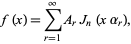
  is a Bessel function of the first kind. An expansion of a function in the interval
  in terms of Bessel functions of the first kind
 |
(1)
|
has coefficients found as follows:
 |
(2)
|
But orthogonality of Bessel function roots gives
![int_0^1xJ_n(xalpha_l)J_n(xalpha_r)dx=1/2delta_(l,r)[J_(n+1)(alpha_r)]^2](http://mathworld.wolfram.com/images/equations/Fourier-BesselSeries/NumberedEquation3.gif) |
(3)
|
(Bowman 1958, p. 108), so
and the coefficients are given by
![A_l=2/([J_(n+1)(alpha_l)]^2)int_0^1xf(x)J_n(xalpha_l)dx.](http://mathworld.wolfram.com/images/equations/Fourier-BesselSeries/NumberedEquation4.gif) |
(6)
|
REFERENCES:
Bowman, F. Introduction to Bessel Functions. New York: Dover, 1958.
Kaplan, W. "Fourier-Bessel Series." §7.15 in Advanced Calculus, 4th ed. Reading, MA: Addison-Wesley, pp. 512-518, 1992.








