الوضع الليلي


 11:58:52
  2025-09-28
  2054
2054
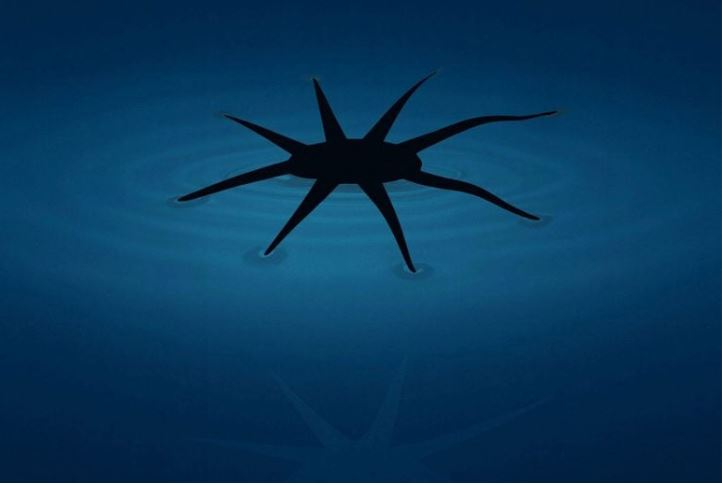
Picture a miniature robot, no larger than a leaf, gliding effortlessly across the surface of a pond, much like a water strider. In the future, machines of this scale could be deployed to monitor pollution, gather water samples, or explore flooded zones too hazardous for people.
At the University of Virginia’s School of Engineering and Applied Science, mechanical and aerospace engineering professor Baoxing Xu is working on a way to make such devices a reality. His team’s latest study, published in Science Advances, unveils HydroSpread, a fabrication method unlike any before it. The approach enables researchers to create soft, buoyant machines directly on water, a breakthrough with applications that could range from medical care to consumer electronics to environmental monitoring.
Previously, producing the thin and flexible films essential for soft robotics required building them on solid surfaces such as glass. The fragile layers then had to be lifted off and placed onto water, a tricky procedure that frequently led to tearing and material loss.
HydroSpread sidesteps this issue by letting liquid itself serve as the “workbench.” Droplets of liquid polymer could naturally spread into ultrathin, uniform sheets on the water’s surface. With a finely tuned laser, Xu’s team can then carve these sheets into complex patterns — circles, strips, even the UVA logo — with remarkable precision.
From Films to Moving Machines
Using this approach, the researchers built two insect-like prototypes:
In the lab, the team powered these devices with an overhead infrared heater. As the films warmed, their layered structure bent or buckled, creating paddling or walking motions. By cycling the heat on and off, the devices could adjust their speed and even turn — proof that controlled, repeatable movement is possible. Future versions could be designed to respond to sunlight, magnetic fields, or tiny embedded heaters, opening the door to autonomous soft robots that can move and adapt on their own.
“Fabricating the film directly on liquid gives us an unprecedented level of integration and precision,” Xu said. “Instead of building on a rigid surface and then transferring the device, we let the liquid do the work to provide a perfectly smooth platform, reducing failure at every step.”
The potential reaches beyond soft robots. By making it easier to form delicate films without damaging them, HydroSpread could open new possibilities for creating wearable medical sensors, flexible electronics, and environmental monitors — tools that need to be thin, soft and durable in settings where traditional rigid materials don’t work.
Reality Of Islam |
|
Keeping sil
Two experim
Changing a
Plants are
 9:3:43
2018-11-05
9:3:43
2018-11-05
10 benefits of Marriage in Islam
7:5:22
2019-04-08
benefits of reciting surat yunus, hud &
9:45:7
2018-12-24
advantages & disadvantages of divorce
11:35:12
2018-06-10
6:0:51
2018-10-16
10:47:11
2022-11-22
2:13:43
2022-05-27
4:2:19
2022-10-10
7:32:24
2022-02-14
11:34:48
2022-06-29
1:34:8
2022-02-01
bahlool & the throne of haroun rashid
8:20:35
2018-06-21
5:41:46
2023-03-18
| LATEST |
 HOME
HOME