الوضع الليلي


 5:50:33
  2023-02-06
  1804
1804
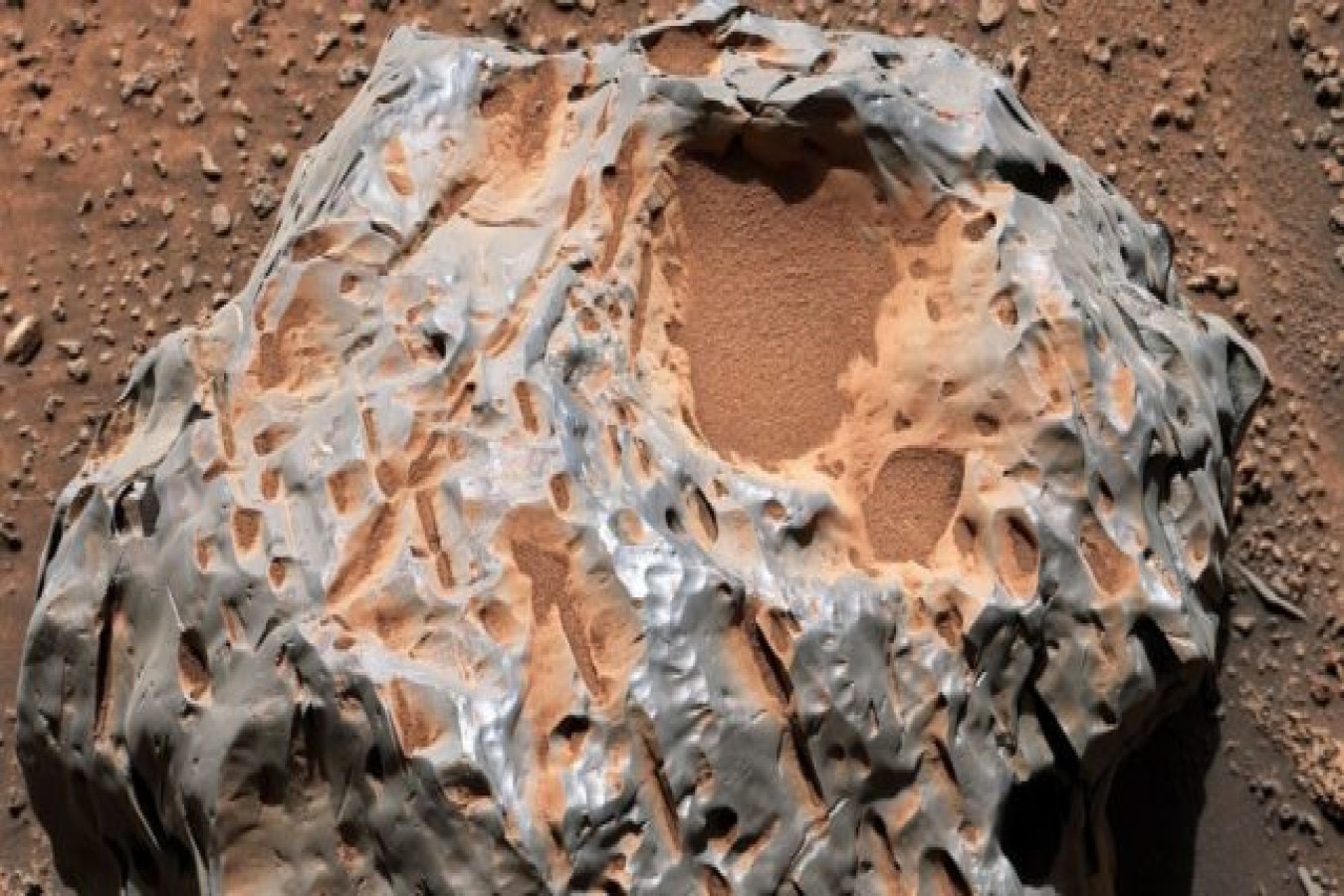
MSL Curiosity is going about its business exploring Mars. The high-tech rover is currently exploring the sulphate-bearing unit on Mt. Sharp, the central peak in Mars' Gale Crater. Serendipity placed a metal meteorite in its path.
The meteorite is made mostly of nickel and iron, and it has a name: Cacao. (Chocolate comes from cacao) Cacao isn't very large; it's only about 30 cm (1 ft.) across.
Curiosity has come across several meteorites since landing in Gale Crater in August 2012.
Cacao stands out visually from its surroundings. While the Martian surface is red from oxides, the meteorite is dark grey and metallic-looking. It's also smooth and rounded, obvious signs that it passed through an atmosphere.
The image is a composite of six individual images taken with the rover's Mastcam. Curiosity captured the images on 27 Jan 2023, the 3,724th Martian day, or sol, of the mission. The colors in the image have been corrected to match the lighting conditions as seen with human eyes on Earth.
The grooves and pits are called regmaglypts. They're particularly interesting on iron meteorites. They formed when Cacao was travelling through the atmosphere.
Even though Mars' atmosphere is much thinner than Earth's, it still creates enough friction to heat the meteorite's surface. The regmaglypts are likely created by vortices of hot gas that melted the rock as it travelled through the atmosphere.
The meteorite may have been on Mars' surface for a long time, but nobody knows for sure.
This isn't the first meteorite rovers have found on Mars. In 2016, MSL Curiosity found another metal meteorite about the size of a golf ball named "Egg Rock." It examined that one with its ChemCam instrument to determine its composition.
Iron-nickel meteorites are the rarest type of meteorites, making up about six percent of witnessed falls. But because of their tell-tale visual appearance, they're over-represented in collections. That's because they're more likely to survive passage through an atmosphere and are more resistant to weathering, even on Mars.
Most iron-nickel meteorites come from the cores of shattered planetesimals that formed in the early Solar System. Those objects were large enough to differentiate when they were molten. They formed a core of dense iron and nickel, much like Earth did.
Reality Of Islam |
|

Keeping sil
Two experim
Changing a
Plants are
 9:3:43
2018-11-05
9:3:43
2018-11-05
10 benefits of Marriage in Islam
7:5:22
2019-04-08
benefits of reciting surat yunus, hud &
9:45:7
2018-12-24
advantages & disadvantages of divorce
11:35:12
2018-06-10
6:0:51
2018-10-16
8:4:21
2022-01-08
6:14:3
2023-01-18
9:50:37
2023-02-28
10:55:53
2022-06-13
5:58:12
2021-12-18
4:25:57
2023-02-11
8:39:51
2022-09-23
5:41:46
2023-03-18
| LATEST |
 HOME
HOME