APPENDIX 2 - BRACKETING
We have so far talked only of the semantic descriptions of words. It is worthwhile asking whether the semantic description of a phrase is to be regarded merely as the sum of the semantic descriptions of its constituents,1 or whether some of the syntactic bracketing of the phrase should be retained in the semantic description. For example, bracketing could tell us whether a certain feature in the semantic description of a VP was supplied by a verb, or by a locational adjunct; in the absence of bracketing we would not be able to tell the syntactic origin of a particular feature.
It appears that some syntactic bracketing must be retained in the semantic descriptions of phrases. The following example demonstrates this need.
We mentioned that each verb of position includes in its semantic description one of the features ‘motion’ or ‘rest’, and can only select appropriate locational qualifiers; locational qualifiers can be verb markers and/or nouns and adjectives in allative/ ablative or locative inflection. Verbs in other sets do not include ‘ motion’ or ‘ rest’ in their semantic descriptions, and can only select unmarked locative (‘at’) qualifiers. Exceptions are verbs of ‘ seeing’ which can occur freely with either allative or locative qualification: ‘look towards’, ‘look at’, etc.; in fact these are the only verbs that can take either motion or rest qualification.
Verb markers and nouns and adjectives in allative or locative (but not in ablative) inflection can be verbalized. Such a verbalized form has exactly the same possibilities of aspectual modification, inflection, etc. as the other verbs in the VP (in fact a VP in Dyirbal can consist of any number of verbs - that have simultaneous reference - provided they all agree in surface transitivity and in final inflection).
Thus we have VP:
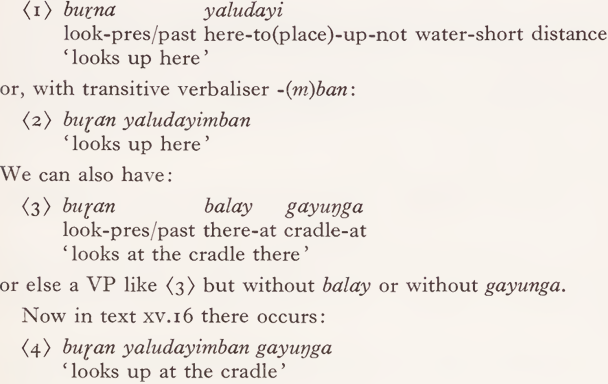
However, we cannot have:
(5) * buɽan yaludayi gayuŋga
That is, although buɽan can occur with ‘to’ or ‘at’ qualification, it cannot take both together; however, buɽan and a verbalized ‘ to’ qualifier can take ‘ at’ qualification.
It seems desirable to show that there is a semantic difference between (1) and (2), and between and between (4) and (5) - a difference that is intuitively felt by speakers of Dyirbal but which is difficult to bring out in English translation - and at the same time to account semantically for the non-acceptability of (5). Now the features in any semantic system are mutally exclusive; the semantic description of a word can contain only one feature from any system. The non-acceptability of (5) can be accounted for in terms of this constraint, if we say that within a VP the semantic information coming from verbs and verbalized forms is bracketed off from that coming from qualifiers. The constraint is now that more than one feature from a given system cannot occur within the same brackets in a semantic description. Thus for (4) the semantic information coming from buɽan and yaludayimban is bracketed off from that coming from gayuŋga; features ‘ motion ’ - from yalu - and ‘ rest ’ - from the locative inflection on gayu ‘ cradle ’ - do not appear within the same brackets; (4) is thus an acceptable VP. In the case of (5), however, the semantic description of buɽan is bracketed off from that of yaludayi gayuŋga; in this case the incompatible features ‘ motion ’ and ‘ rest ’ appear within the same brackets, and the VP is thus unacceptable.
The example has shown that some syntactic bracketing must be carried over into semantic descriptions,2 if we are to be able to make correct predictions concerning acceptability. Probably not all syntactic bracketing has to be retained; each type of bracketing would have to be considered individually, and its semantic relevance assessed.
1 For the discussion here we are effectively restricting attention to nuclear words, which have componential semantic descriptions. The semantic description of a non-nuclear word is likely itself to involve a phrase marker (as in recent unpublished work of McCawley).
2 In some cases the semantic description of a non-nuclear verb may involve the same features as the semantic description of a VP containing a nuclear verb together with some locational qualification. For example, waban ‘look up’ and buɽan [yalu] gala. The difference here is that the semantic description of waban involves no bracketing, whereas for the VP the semantic features coming from buɽan are bracketed off from the one coming from gala. (Note that if it were thought desirable semantically to distinguish waban from buɽan [yalu] galamban - where the locational qualifier is verbalized and there is thus no bracketing in the semantic description of the VP - then this would indicate the need for further bracketing, separating off the features coming from a full verb, and those coming from a verbalized locational adjunct.)








