Grammar
Tenses
Present

Present Simple
Present Continuous
Present Perfect
Present Perfect Continuous
Past
Past Simple
Past Continuous
Past Perfect
Past Perfect Continuous
Future
Future Simple
Future Continuous
Future Perfect
Future Perfect Continuous
Parts Of Speech
Nouns
Countable and uncountable nouns
Verbal nouns
Singular and Plural nouns
Proper nouns
Nouns gender
Nouns definition
Concrete nouns
Abstract nouns
Common nouns
Collective nouns
Definition Of Nouns
Animate and Inanimate nouns
Nouns
Verbs
Stative and dynamic verbs
Finite and nonfinite verbs
To be verbs
Transitive and intransitive verbs
Auxiliary verbs
Modal verbs
Regular and irregular verbs
Action verbs
Verbs
Adverbs
Relative adverbs
Interrogative adverbs
Adverbs of time
Adverbs of place
Adverbs of reason
Adverbs of quantity
Adverbs of manner
Adverbs of frequency
Adverbs of affirmation
Adverbs
Adjectives
Quantitative adjective
Proper adjective
Possessive adjective
Numeral adjective
Interrogative adjective
Distributive adjective
Descriptive adjective
Demonstrative adjective
Pronouns
Subject pronoun
Relative pronoun
Reflexive pronoun
Reciprocal pronoun
Possessive pronoun
Personal pronoun
Interrogative pronoun
Indefinite pronoun
Emphatic pronoun
Distributive pronoun
Demonstrative pronoun
Pronouns
Pre Position
Preposition by function
Time preposition
Reason preposition
Possession preposition
Place preposition
Phrases preposition
Origin preposition
Measure preposition
Direction preposition
Contrast preposition
Agent preposition
Preposition by construction
Simple preposition
Phrase preposition
Double preposition
Compound preposition
prepositions
Conjunctions
Subordinating conjunction
Correlative conjunction
Coordinating conjunction
Conjunctive adverbs
conjunctions
Interjections
Express calling interjection
Phrases
Sentences
Clauses
Part of Speech
Grammar Rules
Passive and Active
Preference
Requests and offers
wishes
Be used to
Some and any
Could have done
Describing people
Giving advices
Possession
Comparative and superlative
Giving Reason
Making Suggestions
Apologizing
Forming questions
Since and for
Directions
Obligation
Adverbials
invitation
Articles
Imaginary condition
Zero conditional
First conditional
Second conditional
Third conditional
Reported speech
Demonstratives
Determiners
Direct and Indirect speech
Linguistics
Phonetics
Phonology
Linguistics fields
Syntax
Morphology
Semantics
pragmatics
History
Writing
Grammar
Phonetics and Phonology
Semiotics
Reading Comprehension
Elementary
Intermediate
Advanced
Teaching Methods
Teaching Strategies
Assessment

Arguments and semantic roles
 المؤلف:
PAUL R. KROEGER
المؤلف:
PAUL R. KROEGER
 المصدر:
Analyzing Grammar An Introduction
المصدر:
Analyzing Grammar An Introduction
 الجزء والصفحة:
P53-C4
الجزء والصفحة:
P53-C4
 2025-12-12
 591
591




+
-
20
Arguments and semantic roles
The properties or relationships described by different predicates may differ in any number of specific details, but many of these differences will have no effect on the grammatical structure of the sentence. For example, someone who slaps John (as Mary did in(5d)) is performing a different action from someone who spanks, beats, whips, punches, or clubs him. But, in most contexts, the semantic differences among these verbs are irrelevant to the grammar. Simple sentences which express the relationship between John and Mary will have exactly the same grammatical structure no matter which of these verbs is used. On the other hand, in some languages sentences like Mary loves John or Mary sees John would have different grammatical properties from Mary slaps John.
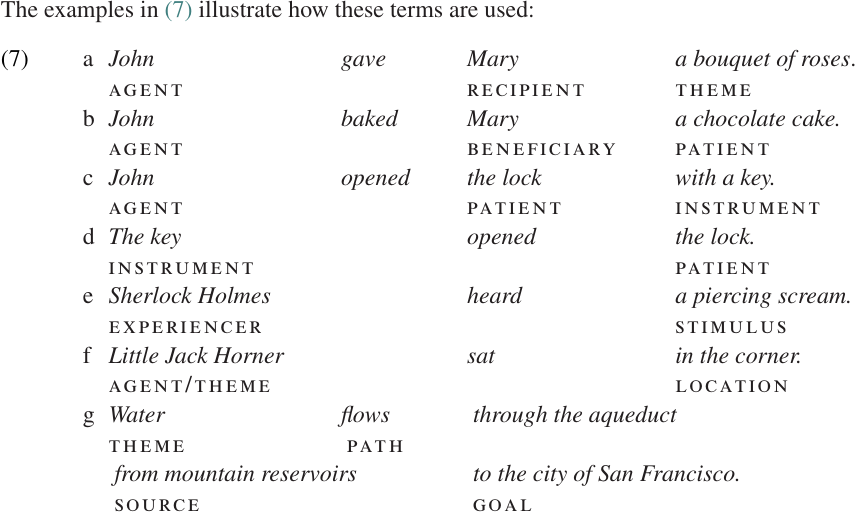
It is helpful to classify arguments into broad semantic categories according to the kind of role they play in the situations described by their predicates. For example in the sentence Mary slaps John, Mary plays the role of an AGENT, while John plays the role of a PATIENT. The same roles are involved if Mary spanks, beats, whips, punches, or clubs John. In the sentence Mary sees John, however, Mary plays the role of an EXPERIENCER; John is the perceived object, which we will call a STIMULUS. The use of a different role label implies a potential difference in grammatical properties.1
How many of these categories are there? How many role labels do we need to use? Different linguists have different opinions on this issue, and (unfortunately but not surprisingly) sometimes use the same labels in different ways. We will make use of (at least) the following semantic roles:
(6) INVENTORY OF SEMANTIC ROLES:2
AGENT: causer or initiator of events
EXPERIENCER: animate entity which perceives a stimulus or registers a particular mental or emotional process or state
RECIPIENT: animate entity which receives or acquires something
BENEFICIARY: entity (usually animate) for whose benefit an action is performed
INSTRUMENT: inanimate entity used by an agent to perform some action
THEME: entity which undergoes a change of location or possession, or whose location is being specified
PATIENT: entity which is acted upon, affected, or created; or of which a state or change of state is predicated
STIMULUS: object of perception, cognition, or emotion; entity which is seen, heard, known, remembered, loved, hated, etc.
LOCATION: spatial reference point of the event (the SOURCE, GOAL, and PATH roles are often considered to be sub-types of LOCATION)
SOURCE: the origin or beginning point of a motion
GOAL: the destination or end-point of a motion
PATH: the trajectory or path way of a motion
ACCOMPANIMENT (or COMITATIVE): entity which accompanies or is associated with the performance of an action
1. Of course, semantic-role categories do not reflect all the semantic differences which could be relevant to grammar. However, semantic roles generally play a crucial part in the assignment of Grammatical Relations, which, in turn, determine a number of important grammatical features. As we will see, these features often include case, agreement, word order, and participation in various syntactic processes.
2. Notice that this list is restricted to ARGUMENT roles. Some other commonly expressed types of semantic information, e.g. time, manner, purpose, etc., are not included here, because the elements which express these concepts are almost always ADJUNCTS rather than arguments.
 الاكثر قراءة في Semantics
 اخر الاخبار
اخبار العتبة العباسية المقدسة

الآخبار الصحية


مواضيع ذات صلة
 قسم الشؤون الفكرية يصدر كتاباً يوثق تاريخ السدانة في العتبة العباسية المقدسة
 "المهمة".. إصدار قصصي يوثّق القصص الفائزة في مسابقة فتوى الدفاع المقدسة للقصة القصيرة
 (نوافذ).. إصدار أدبي يوثق القصص الفائزة في مسابقة الإمام العسكري (عليه السلام)