Boolean Model
In most modern literature, a Boolean model is a probabilistic model of continuum percolation theory characterized by the existence of a stationary point process  and a random variable
  which independently determine the centers and the random radii of a collection of closed balls in
  for some
  .
.
In this case, the model is said to be driven by  .
.
Worth noting is that the most intuitive ideas about constructing a feasible model using  and
and  often lead to unexpected and undesirable results (Meester and Roy 1996). For that reason, some more sophisticated machinery and quite a bit of care is needed to translate from the language of
  and
and  into a reasonable model of continuum percolation. The formal construction is as follows.
Let  be a stationary point process as discussed above and suppose that
  is defined on a probability space
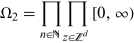
  . Next, define the space
  to be the product space
 |
(1)
|
and define associated to  the usual product sigma-algebra and product measure
  where here, all the marginal probabilities are given by some probability measure
  on
on  . Finally, define
  , equip
  with the product measure
  and usual product
  -algebra. Under this construction, a Boolean model is a measurable mapping from
  into
into  defined by
 |
(2)
|
where here,  denotes the set of all counting measures on the
  -algebra
  of Borel sets in
  which assign finite measure to all bounded Borel sets and which assign values of at most 1 to points
  .
.
One then transitions to percolation by first defining the collection of so-called binary cubes of order 
![K(n,z)=product_(i=1)^d(z_i2^(-n),(z_i+1)2^(-n)]](https://mathworld.wolfram.com/images/equations/BooleanModel/NumberedEquation3.svg) |
(3)
|
for all  ,
,  , and by noting that each point
  is contained in a unique binary cube
  of order
  . Moreover, for each
  , there is a unique smallest number
  such that
  contains no other points of
 -almost surely. This fact allows one to define the radius
  of the ball centered at
  to be
to be
 |
(4)
|
where  is the notation used to denote an element
  . Using this construction, one gets a collection of overlapping
  -dimensional closed spheres whose radii are independent of the point process
  and for which different points have balls with independent and identically-distributed radii.
It is not uncommon for a general Boolean model constructed in this way to be denoted  or
or  , interchangeably. In the particular instance that
  is a Poisson process with density
  , the measure
  is sometimes written
  while the probability of an event
  is then written
  or
or ![P<span style=]() {A}" src="https://mathworld.wolfram.com/images/equations/BooleanModel/Inline54.svg" style="height:22px; width:41px" /> interchangeably.
{A}" src="https://mathworld.wolfram.com/images/equations/BooleanModel/Inline54.svg" style="height:22px; width:41px" /> interchangeably.
In Boolean models, the space  is partitioned into two regions, namely the occupied region-the subset of
  covered by at least one ball, denoted
  -and its complement, the vacant region. These two regions are similar in that both consist of connected components (the occupied components and the vacant components, respectively) and the notation
  is used to denote the union of all occupied components having non-empty intersection with a subset
  . For
. For ![A=<span style=]() {0}" src="https://mathworld.wolfram.com/images/equations/BooleanModel/Inline60.svg" style="height:22px; width:59px" />, the notation
{0}" src="https://mathworld.wolfram.com/images/equations/BooleanModel/Inline60.svg" style="height:22px; width:59px" />, the notation ![W=W(<span style=]() {0})" src="https://mathworld.wolfram.com/images/equations/BooleanModel/Inline61.svg" style="height:22px; width:98px" /> is used, and in the event of vacancy, the same notation is used throughout with
{0})" src="https://mathworld.wolfram.com/images/equations/BooleanModel/Inline61.svg" style="height:22px; width:98px" /> is used, and in the event of vacancy, the same notation is used throughout with  instead of
  . Two points
  which are in the same occupied component are said to be connected in the occupied region, sometimes denoted
 |
(5)
|
Connectedness in the vacant region is defined analogously and denoted
 |
(6)
|
If for some 
 and
and  are in the same occupied, respectively vacant, component of
  , respectively of
  , the notation
  in
in  , respectively
  in
in  is used.
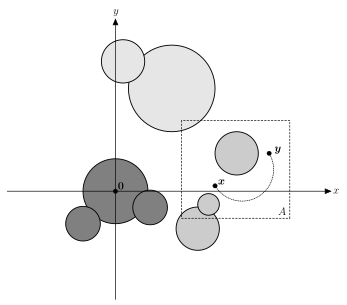
The above figure illustrates a realization of a Boolean model, illustrating some of the terminology related to thereto. In this figure, the shaded region is  while the darker shaded region is
  . Note that
 ![V=V(<span style=]() {0})" src="https://mathworld.wolfram.com/images/equations/BooleanModel/Inline76.svg" style="height:22px; width:90px" /> is empty due to the fact that
{0})" src="https://mathworld.wolfram.com/images/equations/BooleanModel/Inline76.svg" style="height:22px; width:90px" /> is empty due to the fact that  is non-empty. Moreover, the path joining
  and
and  lies entirely in
  ; this indicates that
  are in the same vacant component of
  , whereby it follows that
  in
in  .
.
Historically, the term Boolean model was also used to refer to what's now known as the Boolean-Poisson model (Hanisch 1981).
REFERENCES
Hanisch, K. H. "On Classes of Random Sets and Point Process Models." Serdica Bulgariacae Mathematicae Publicationes 7, 160-166, 1981.
Meester, R. and Roy, R. Continuum Percolation. New York: Cambridge University Press, 2008.








