Tutte Polynomial
Let  be an undirected graph, and let
  denote the cardinal number of the set of externally active edges of a spanning tree
  of
of  ,
,  denote the cardinal number of the set of internally active edges of
  , and
, and  the number of spanning trees of
  whose internal activity is
  and external activity is
  . Then the Tutte polynomial, also known as the dichromate or Tutte-Whitney polynomial, is defined by
 |
(1)
|
(Biggs 1993, p. 100).
An equivalent definition is given by
 |
(2)
|
where the sum is taken over all subsets  of the edge set of a graph
  ,
,  is the number of connected components of the subgraph on
  vertices induced by
  ,
,  is the vertex count of
  , and
, and  is the number of connected components of
  .
.
Several analogs of the Tutte polynomial have been considered for directed graphs, including the cover polynomial (Chung and Graham 1995), Gordon-Traldi polynomials (Gordon and Traldi 1993), and three-variable  -polynomial (Awan and Bernardi 2016; Chow 2016). However, with the exceptions of the the Gordon-Traldi polynomial
  and
and  -polynomial, these are not proper generalizations of the Tutte polynomial since they are not equivalent to the Tutte polynomial for the special case of undirected graphs (Awan and Bernardi 2016).
The Tutte polynomial can be computed in the Wolfram Language using TuttePolynomial[g, ![<span style=]() {" src="https://mathworld.wolfram.com/images/equations/TuttePolynomial/Inline23.svg" style="height:22px; width:6px" />x, y
{" src="https://mathworld.wolfram.com/images/equations/TuttePolynomial/Inline23.svg" style="height:22px; width:6px" />x, y![<span style=]() }" src="https://mathworld.wolfram.com/images/equations/TuttePolynomial/Inline24.svg" style="height:22px; width:6px" />].
}" src="https://mathworld.wolfram.com/images/equations/TuttePolynomial/Inline24.svg" style="height:22px; width:6px" />].
The Tutte polynomial is multiplicative over disjoint unions.
For an undirected graph on  vertices with
  connected components, the Tutte polynomial is given by
 |
(3)
|
where  is the rank polynomial (generalizing Biggs 1993, p. 101). The Tutte polynomial is therefore a rather general two-variable graph polynomial from which a number of other important one- and two-variable polynomials can be computed.
For not-necessarily connected graphs, the Tutte polynomial  is related the chromatic polynomial
  , flow polynomial
  , rank polynomial
  , and reliability polynomial
  by
by
where  is the number of vertices in the graph,
  is the number of edges, and
  is the number of connected components.
The Tutte polynomial of the dual graph  of a graph
  is given by
 |
(8)
|
i.e., by swapping the variables of the Tutte polynomial of the original graph. A special case of this identity relates the flow polynomial  of a planar graph
  to the chromatic polynomial of its dual graph
  by
by
 |
(9)
|
The Tutte polynomial of a connected graph  is also completely defined by the following two properties (Biggs 1993, p. 103):
1. If  is an edge of
  which is neither a loop nor an isthmus, then
  .
.
2. If  is formed from a tree with
  edges by adding
  loops, then
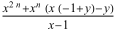
Closed forms for some special classes of graphs are summarized in the following table, where  and
and  . The Tutte polynomial of the web graph was considered by Biggs et al. (1972) and Brennan et al. (2013).
| graph |
 |
book graph  |
![((1+x+x^2)^n[x(y-1)-y]+y(x+x^2+y)^n)/(y-1)](https://mathworld.wolfram.com/images/equations/TuttePolynomial/Inline65.svg) |
| centipede graph |
 |
cycle graph  |
 |
empty graph  |
1 |
| forest |
 |
| gear graph |
 |
| helm graph |
![x^n<span style=]() {-1-x-y+xy+2^(-n)[(1-t+x+y)^n+(1+t+x+y)^n]}" src="https://mathworld.wolfram.com/images/equations/TuttePolynomial/Inline72.svg" style="height:22px; width:470px" /> {-1-x-y+xy+2^(-n)[(1-t+x+y)^n+(1+t+x+y)^n]}" src="https://mathworld.wolfram.com/images/equations/TuttePolynomial/Inline72.svg" style="height:22px; width:470px" /> |
| ladder graph |
 |
| ladder rung graph |
 |
| pan graph |
![(x[x^n+x(y-1)-y])/(x-1)](https://mathworld.wolfram.com/images/equations/TuttePolynomial/Inline75.svg) |
path graph  |
 |
star graph  |
 |
sunlet graph  |
 |
wheel graph  |
![xy-x-y-1+2^(1-n)[(x+y+1+t)^(n-1)+(x+y+1-t)^(n-1)]](https://mathworld.wolfram.com/images/equations/TuttePolynomial/Inline83.svg) |
The following table summarizes the recurrence relations for Tutte polynomials for some simple classes of graphs.
| graph |
order |
recurrence |
| antiprism graph |
6 |
|
book graph  |
2 |
 |
| centipede graph |
1 |
 |
cycle graph  |
2 |
 |
| gear graph |
3 |
 |
| helm graph |
3 |
 |
| ladder graph |
2 |
 |
| ladder rung graph |
1 |
 |
Möbius ladder  |
6 |
|
| pan graph |
2 |
 |
| path graph |
1 |
 |
prism graph  |
6 |
|
star graph  |
1 |
 |
sunlet graph  |
2 |
 |
| web graph |
6 |
|
wheel graph  |
3 |
 |
An equation for the Tutte polynomial  of the complete graph
  was found by Tutte (1954, 1967). In particular,
  has exponential generating function
![sum_(n=1)^inftyT_(K_n)(x,y)(u^n)/(n!)=1/(x-1)<span style=]() {[sum_(n=0)^inftyy^((n; 2))(y-1)^(-n)(u^n)/(n!)]^((x-1)(y-1))-1}, " src="https://mathworld.wolfram.com/images/equations/TuttePolynomial/NumberedEquation6.svg" style="height:58px; width:423px" /> {[sum_(n=0)^inftyy^((n; 2))(y-1)^(-n)(u^n)/(n!)]^((x-1)(y-1))-1}, " src="https://mathworld.wolfram.com/images/equations/TuttePolynomial/NumberedEquation6.svg" style="height:58px; width:423px" /> |
(10)
|
(Gessel 1995, Gessel and Sagan 1996). This can be written more simply in terms of the coboundary polynomial
 |
(11)
|
where  is the connected component count and
  is the vertex count of a graph
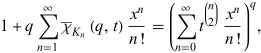
  (Martin and Reiner 2005). In this form, the exponential generating function of
  is given by
 |
(12)
|
which can be converted to the corresponding Tutte polynomial using the above relationship and the substitution  and
and  . The formula was rediscovered by Pak in the form of the following recurrence
 |
(13)
|
where  .
.
A formula for the Tutte polynomial of a complete bipartite graph  is given in terms of an bivariate exponential generating function for the coboundary polynomial as
 |
(14)
|
by Martin and Reiner (2005).
Nonisomorphic graphs do not necessarily have distinct Tutte polynomials. de Mier and Noy (2004) call a graph that is determined by its Tutte polynomial a  -unique graph and showed that wheel graphs, ladder graphs, Möbius ladders, complete multipartite graphs (with the exception of
  ), and hypercube graphs are
  -unique graphs. Kuhl (2008) showed that the generalized Petersen graphs
  and their line graphs
  are
are  -unique.
The numbers of simple graphs on  , 2, ... nodes that are not Tutte-unique for a given value of
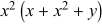
  are 0, 0, 0, 4, 15, 84, 548, 5629, ... (OEIS A243048), while the corresponding numbers of Tutte-unique graphs are 1, 2, 4, 7, 19, 72, 496, 6717, ... (OEIS A243049). The following table summarizes some small co-Tutte graphs.
 |
Tutte polynomial |
graphs |
| 4 |
 |
 , ladder rung graph , ladder rung graph  |
| 4 |
 |
claw graph  , path graph , path graph  |
| 5 |
 |
 , ,  |
| 5 |
 |
 , ,  , ,  |
| 5 |
 |
fork graph, path graph  , star graph , star graph  |
| 5 |
 |
paw graph  , ,  |
| 5 |
 |
bull graph, cricket graph,  -tadpole graph -tadpole graph |
| 5 |
 |
dart graph, kite graph |
REFERENCES
Andrzejak, A. "Splitting Formulas for Tutte Polynomials." J. Combin. Th., Ser. B. 70, 346-366, 1997.
Andrzejak, A. "An Algorithm for the Tutte Polynomials of Graphs of Bounded Treewidth." Disc. Math. 190, 39-54, 1998.
Biggs, N. L. "The Tutte Polynomial." Ch. 13 in Algebraic Graph Theory, 2nd ed. Cambridge, England: Cambridge University Press, pp. 97-105, 1993.
Biggs, N. L.; Damerell, R. M.; and Sands, D. A. "Recursive Families of Graphs." J. Combin. Theory Ser. B 12, 123-131, 1972.
Björklund, A.; Husfeldt, T.; Kaski, P.; and Koivisto, M. "Computing the Tutte Polynomial in Vertex-Exponential Time." In Proceedings of the IEEE Symposium on the Foundations of Computer Science (FOCS), 677-686, 2008.
Brennan, C.; Mansour, T.; and Mphako-Banda, E. "Tutte Polynomials of Wheels Via Generating Functions." Bull. Iranian Math. Soc. 39, 881-891, 2013.
Brylawski, T. and Oxley, J. "The Tutte Polynomial and Its Applications." Ch. 6 in Matroid Applications (Ed. N. White). Cambridge, England: Cambridge University Press, pp. 123-225, 1992.
Chow, T Y. "Digraph Analogues of the Tutte Polynomials." Preprint chapter for The CRC Handbook on the Tutte Polynomial and Related Topics (Ed. I. Moffat and J. Ellis-Monaghan). 2016.
Chung, F. R. K. and Graham, R. L. "On the Cover Polynomial of a Digraph." J. Combin. Theory, Ser. B 65, 273-290, 1995.
de Mier, A. and Noy, M. "On Graphs Determined by Their Tutte Polynomial." Graphs Combin. 20, 105-119, 2004.
de Mier, A. and Noy, M. "Tutte Uniqueness of Line Graphs." Disc. Math. 301, 57-65, 2005.
Ellis-Monaghan, J. A. and Merino, C. "Graph Polynomials and Their Applications I: The Tutte Polynomial." 28 Jun 2008. http://arxiv.org/abs/0803.3079.
Ellis-Monaghan, J. A. and Merino, C. "Graph Polynomials and Their Applications II: Interrelations and Interpretations." 28 Jun 2008. http://arxiv.org/abs/0806.4699.
Gessel, I. M. "Enumerative Applications of a Decomposition for Graphs and Digraphs." Disc. Math. 139, 257-271, 1995.
Gessel, I. M. and Sagan, B. E. "The Tutte Polynomial of a Graph, Depth-First Search, and Simplicial Complex Partitions." Electronic J. Combinatorics 3, No. 2, R9, 1-36, 1996. http://www.combinatorics.org/Volume_3/Abstracts/v3i2r9.html.
Gordon, G. and Traldi, L. "Polynomials for Directed Graphs." Congr. Numer. 94, 187-201, 1993.
Haggard, G.; Pearce, D. J.; and Royle, G. "Computing Tutte Polynomials" ACM Trans. Math. Software 37, Art. 24, 17 pp., 2010.
Jaeger, F. "Tutte Polynomials and Link Polynomials." Proc. Amer. Math. Soc. 103, 647-665, 1988.
Jaeger, F.; Vertigan, D.; and Welsh, D. "On the Computational Complexity of the Jones and Tutte Polynomials." Math. Proc. Camb. Phil. Soc. 108, 35-53, 1990.
Kuhl, J. S. "The Tutte Polynomial and the Generalized Petersen Graph." Australas. J. Combin. 40, 87-97, 2008.
Pak, I. "Computation of Tutte Polynomials of Complete Graphs." http://www.math.ucla.edu/~pak/papers/Pak_Computation_Tutte_polynomial_complete_graphs.pdf.Martin, J. and Reiner, V. "Cyclotomic and Simplicial Matroids." Israel J. Math. 150, 229-240, 2005.
Sloane, N. J. A. Sequences A243048 and A243049 in "The On-Line Encyclopedia of Integer Sequences."Tutte, W. T. "A Contribution to the Theory of Chromatic Polynomials." Canad. J. Math. 6, 80-91, 1954.
Tutte, W. T. "On Dichromatic Polynomials." J. Combin. Th. 2, 301-320, 1967.








