Chromatic Polynomial
The chromatic polynomial  of an undirected graph
  , also denoted
  (Biggs 1973, p. 106) and
  (Godsil and Royle 2001, p. 358), is a polynomial which encodes the number of distinct ways to color the vertices of
  (where colorings are counted as distinct even if they differ only by permutation of colors). For a graph
  on
on  vertices that can be colored in
  ways with no colors,
  way with one color, ..., and
  ways with
  colors, the chromatic polynomial of
  is defined as the unique Lagrange interpolating polynomial of degree
  through the
  points
  ,
,  , ...,
  . Evaluating the chromatic polynomial in variables
  at the points
  , 2, ...,
  then recovers the numbers of 1-, 2-, ..., and
  -colorings. In fact, evaluating
  at integers
  still gives the numbers of
  -colorings.
The chromatic polynomial is called the "chromial" for short by Bari (1974).
The chromatic number of a graph gives the smallest number of colors with which a graph can be colored, which is therefore the smallest positive integer  such that
  (Skiena 1990, p. 211).
For example, the cubical graph  has 1-, 2-, ... k-coloring counts of 0, 2, 114, 2652, 29660, 198030, 932862, 3440024, ... (OEIS A140986), resulting in chromatic polynomial
 |
(1)
|
Evaluating  at
at  , 2, ... then gives 0, 2, 114, 2652, 29660, 198030, 932862, 3440024, ... as expected.
The chromatic polynomial of a graph  in the variable
  can be determined in the Wolfram Language using ChromaticPolynomial[g, x]. Precomputed chromatic polynomials for many named graphs can be obtained using GraphData[graph, "ChromaticPolynomial"][z].
The chromatic polynomial is multiplicative over graph components, so for a graph  having connected components
  ,
,  , ..., the chromatic polynomial of
  itself is given by
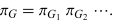 |
(2)
|
The chromatic polynomial for a forest on  vertices,
  edges, and with
  connected components is given by
 |
(3)
|
For a graph with vertex count  and
and  connected components, the chromatic polynomial
  is related to the rank polynomial
  and Tutte polynomial
  by
by
(extending Biggs 1993, p. 106). The chromatic polynomial of a planar graph  is related to the flow polynomial
  of its dual graph
  by
by
 |
(6)
|
Chromatic polynomials are not diagnostic for graph isomorphism, i.e., two nonisomorphic graphs may share the same chromatic polynomial. A graph that is determined by its chromatic polynomial is said to be a chromatically unique graph; nonisomorphic graphs sharing the same chromatic polynomial are said to be chromatically equivalent.
The following table summarizes the chromatic polynomials for some simple graphs. Here  is the falling factorial.
| graph |
chromatic polynomial |
| barbell graph |
 |
book graph  |
 |
| centipede graph |
 |
complete graph  |
 |
cycle graph  |
 |
| gear graph |
![z[z-2+(3-3z+z^2)^n]](https://mathworld.wolfram.com/images/equations/ChromaticPolynomial/Inline62.svg) |
| helm graph |
![z[(1-z)^n(z-2)+(z-2)^n(z-1)^n]](https://mathworld.wolfram.com/images/equations/ChromaticPolynomial/Inline63.svg) |
ladder graph  |
 |
ladder rung graph  |
 |
Möbius ladder  |
 |
| pan graph |
 |
path graph  |
 |
prism graph  |
![1+[z(z-3)+3]^n+z[(1-z)^n+(3-z)^n+z-3]-(1-z)^n-(3-z)^n](https://mathworld.wolfram.com/images/equations/ChromaticPolynomial/Inline74.svg) |
star graph  |
 |
| sun graph |
 |
sunlet graph  |
 |
| triangular honeycomb rook graph |
![product_(k=1)^(n)[(z)_k]^n](https://mathworld.wolfram.com/images/equations/ChromaticPolynomial/Inline80.svg) |
| web graph |
^n+(z-1)^n-[-(z-3)(z-1)]^n-[-(z-1)^2]^n+[(z-1)((z-3)z+3)]^n](https://mathworld.wolfram.com/images/equations/ChromaticPolynomial/Inline81.svg) |
wheel graph  |
![z[(z-2)^(n-1)-(-1)^n(z-2)]](https://mathworld.wolfram.com/images/equations/ChromaticPolynomial/Inline83.svg) |
The following table summarizes the recurrence relations for chromatic polynomials for some simple classes of graphs.
| graph |
order |
recurrence |
| antiprism graph |
4 |
 |
| barbell graph |
1 |
 |
book graph  |
1 |
 |
| centipede graph |
1 |
 |
complete graph  |
1 |
 |
cycle graph  |
2 |
 |
| gear graph |
2 |
 |
| helm graph |
2 |
 |
ladder graph  |
1 |
 |
ladder rung graph  |
1 |
 |
| Möbius ladder |
4 |
 |
| pan graph |
2 |
 |
path graph  |
1 |
 |
prism graph  |
4 |
 |
star graph  |
1 |
 |
sunlet graph  |
2 |
 |
| web graph |
4 |
 |
wheel graph  |
2 |
 |
The chromatic polynomial of a disconnected graph is the product of the chromatic polynomials of its connected components. The chromatic polynomial of a graph of order  has degree
  , with leading coefficient 1 and constant term 0. Furthermore, the coefficients alternate signs, and the coefficient of the
  st term is
  , where
  is the number of edges. Interestingly,
  is equal to the number of acyclic orientations of
  (Stanley 1973).
Except for special cases (such as trees), the calculation of  is exponential in the minimum number of edges in
  and the graph complement
  (Skiena 1990, p. 211), and calculating the chromatic polynomial of a graph is at least an NP-complete problem (Skiena 1990, pp. 211-212).
Tutte (1970) showed that the chromatic polynomial of a planar triangulation of a sphere possess a root close to  (OEIS A104457), where
  is the golden ratio. More precisely, if
  is the number of graph vertices of such a graph
  , then
 |
(7)
|
(Tutte 1970, Le Lionnais 1983).
Read (1968) conjectured that, for any chromatic polynomial
 |
(8)
|
there does not exist a  such that
  and
and  (Skiena 1990, p. 221).
REFERENCES
Bari, R. A. "Chromatically Equivalent Graphs." In Graphs and Combinatorics (Ed. R. A. Bari and F. Harary). Berlin: Springer-Verlag, pp. 186-200, 1974.
Berman, G. and Tutte, W. T. "The Golden Root of a Chromatic Polynomial." J. Combin. Th. 6, 301-302, 1969.
Biggs, N. L. "Chromatic Polynomials and Spanning Trees." Ch. 14 in Algebraic Graph Theory, 2nd ed. Cambridge, England: Cambridge University Press, pp. 106-111, 1993.
Birkhoff, G. D. "A Determinant Formula for the Number of Ways of Coloring a Map." Ann. Math. 14, 42-46, 1912.
Birkhoff, G. D. and Lewis, D. C. "Chromatic Polynomials." Trans. Amer. Math. Soc. 60, 355-451, 1946.
Chvátal, V. "A Note on Coefficients of Chromatic Polynomials." J. Combin. Th. 9, 95-96, 1970.
Erdős, P. and Hajnal, A. "On Chromatic Numbers of Graphs and Set-Systems." Acta Math. Acad. Sci. Hungar. 17, 61-99, 1966.
Godsil, C. and Royle, G. Algebraic Graph Theory. New York: Springer-Verlag, 2001.
Le Lionnais, F. Les nombres remarquables. Paris: Hermann, p. 46, 1983.Read, R. C. "An Introduction to Chromatic Polynomials." J. Combin. Th. 4, 52-71, 1968.
Saaty, T. L. and Kainen, P. C. "Chromatic Numbers and Chromatic Polynomials." Ch. 6 in The Four-Color Problem: Assaults and Conquest. New York: Dover, pp. 134-163 1986.
Skiena, S. "Chromatic Polynomials." §5.5.1 in Implementing Discrete Mathematics: Combinatorics and Graph Theory with Mathematica. Reading, MA: Addison-Wesley, pp. 210-212, 1990.
Sloane, N. J. A. Sequences A104457 and A140986 in "The On-Line Encyclopedia of Integer Sequences."Stanley, R. P. "Acyclic Orientations of Graphs." Disc. Math. 5, 171-178, 1973.
Tutte, W. T. "On Chromatic Polynomials and the Golden Ratio." J. Combin. Th. 9, 289-296, 1970.








