Puz-Graph
A notion introduced by R. M. Wilson in 1974. Given a finite graph  with
with  vertices,
  is defined as the graph whose nodes are the labelings of
  leaving one node unoccupied, i.e., the ways to place
  different counters on
  nodes of
  . This labelings can be identified with the permutations of
 ![<span style=]() {0,1,2,...,n-1}" src="https://mathworld.wolfram.com/images/equations/Puz-Graph/Inline8.svg" style="height:21px; width:133px" />, so that
{0,1,2,...,n-1}" src="https://mathworld.wolfram.com/images/equations/Puz-Graph/Inline8.svg" style="height:21px; width:133px" />, so that  has
has  nodes. Two labelings are connected by an edge in
  iff one can be transformed into the other by moving one of the labels along one edge of
  .
.
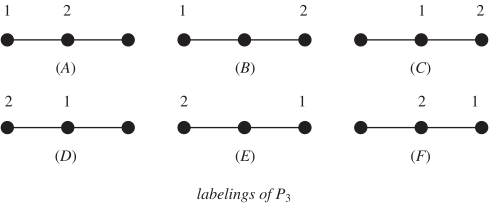
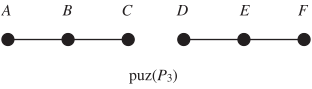
The possible labelings of two vertices of the path graph  are illustrated above, giving
  as illustrated.
If  is the square graph
  , then
  consists of two disjoint cycles with 12 nodes. In general, the puz-graph of an
  -cycle graph has
  connected components, each having
  nodes (Vajda 1992). Wilson proved that the puz-graph of a finite simple biconnected graph
  that is not polygonal always has two connected components if
  is bipartite. Otherwise, with one surprising exception,
  is connected. The exception is the puz-graph of the theta-0 graph, which surprisingly has six connected components.
The paths connecting two labelings  and
and  in
in  represent the sequences of moves that take
  to
to  . Hence, these can be transformed into each other if and only if they belong to the same connected component of
  . In most of the cases, this cannot be decided by looking at
  , which almost always has too many nodes to be adequate for practical use. This problem is solved using a criterion by Wilson, which can be easily expressed in terms of
  ,
,  and
and  :
:  and
and  are linked by a sequence of moves if and only if the distance between their unoccupied nodes and the permutation taking
  to
to  are either both even or both odd.
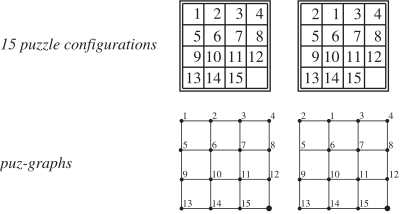
Wilson's criterion can be applied to the 15 puzzle as follows. Each arrangement of the 15 squares corresponds to a labeling of 15 nodes of the grid graph  . Since
  is bipartite,
  is disconnected, so the puzzle does not always have a solution. This can be seen by looking at the labelings of the 15 puzzle configurations illustrated above. The distance between the unoccupied nodes is 0, but the permutation taking one labeling to the other is the cycle (1 2), which is odd. Hence it is impossible to solve the puzzle starting from the configuration at right.
The Hanoi graph  is the puz-graph of the possible configurations of
  towers of Hanoi. Since it is connected, the game always has a solution.
REFERENCES
Vajda, S. Mathematical Games and How to Play Them. Chichester, England: Ellis Horwood, pp. 1-2, 1992.
Wilson, R. M. "Graph Puzzles, Homotopy, and the Alternating Group." J. Combin. Th. B 16, 86-96, 1974.








