Line Graph
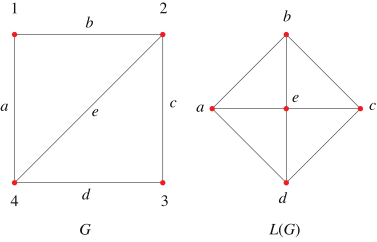
A line graph  (also called an adjoint, conjugate, covering, derivative, derived, edge, edge-to-vertex dual, interchange, representative, or
  -obrazom graph) of a simple graph
  is obtained by associating a vertex with each edge of the graph and connecting two vertices with an edge iff the corresponding edges of
  have a vertex in common (Gross and Yellen 2006, p. 20).
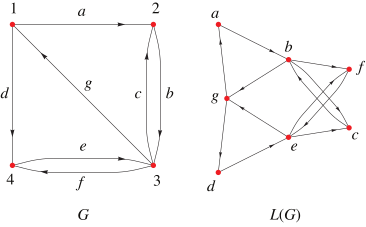
The line graph of a directed graph  is the directed graph
  whose vertex set corresponds to the arc set of
  and having an arc directed from an edge
  to an edge
  if in
if in  , the head of
  meets the tail of
  (Gross and Yellen 2006, p. 265).
Line graphs are implemented in the Wolfram Language as LineGraph[g]. Precomputed line graph identifications of many named graphs can be obtained in the Wolfram Language using GraphData[graph, "LineGraphName"].
The numbers of simple line graphs on  , 2, ... vertices are 1, 2, 4, 10, 24, 63, 166, 471, 1408, ... (OEIS A132220), and the numbers of connected simple line graphs are 1, 1, 2, 5, 12, 30, 79, 227, ... (OEIS A003089).
The following table summarizes some named graphs and their corresponding line graphs.
 |
 |
claw graph  |
triangle graph  |
complete bipartite graph  |
prism graph  |
| cubical graph |
cuboctahedral graph |
cycle graph  |
cycle graph  |
| dodecahedral graph |
icosidodecahedral graph |
path graph  |
singleton graph  |
path graph  |
path graph  |
square graph  |
square graph  |
star graph  |
tetrahedral graph  |
star graph  |
pentatope graph  |
star graph  |
complete graph  |
tetrahedral graph  |
octahedral graph |
triangle graph  |
triangle graph  |
Line graphs are claw-free.
The line graph of a graph with  nodes,
  edges, and vertex degrees
  contains
  nodes and
edges (Skiena 1990, p. 137). The incidence matrix  of a graph and adjacency matrix
  of its line graph are related by
where  is the identity matrix (Skiena 1990, p. 136).
Krausz (1943) proved that a solution  exists for a simple graph
  iff
iff  decomposes into complete subgraphs with each vertex of
  appearing in at most two members of the decomposition. This theorem, however, is not useful for implementation of an efficient algorithm because of the possibly large number of decompositions involved (West 2000, p. 280).
van Rooij and Wilf (1965) shows that a solution to  exists for a simple graph
  iff
iff  is claw-free and no induced diamond graph of
  has two odd triangles. Here, a triangular subgraph
  is said to be even if the neighborhood
  and vertex set
  intersect in an odd number of points for some
  and even if
  and
and  intersect in an even number of points for every
  (West 2000, p. 281).
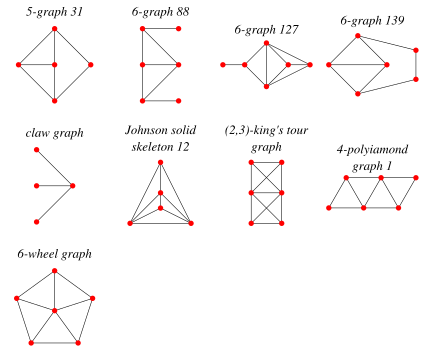
A simple graph is a line graph of some simple graph iff if does not contain any of the above nine graphs as an induced subgraph (van Rooij and Wilf 1965; Beineke 1968; Skiena 1990, p. 138; Harary 1994, pp. 74-75; West 2000, p. 282; Gross and Yellen 2006, p. 405). This statement is sometimes known as the Beineke theorem. These nine graphs are implemented in the Wolfram Language as GraphData["Beineke"]. Of the nine, one has four nodes (the claw graph = star graph  = complete bipartite graph
  ), two have five nodes, and six have six nodes (including the wheel graph
  ).
).
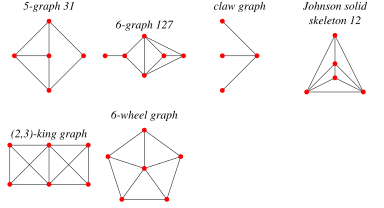
A graph with minimum degree at least 5 is a line graph iff it does not contain any of the above six graphs as an induced subgraph (Metelsky and Tyshkevich 1997). These six graphs are implemented in the Wolfram Language as GraphData["Metelsky"].
A graph is not a line graph if the smallest element of its graph spectrum is less than  (Van Mieghem, 2010, Liu et al. 2010).
Whitney (1932) showed that, with the exception of  and
and  , any two connected graphs with isomorphic line graphs are isomorphic (Skiena 1990, p. 138).
Lehot (1974) gave a linear time algorithm that reconstructs the original graph from its line graph. Liu et al. (2010) give an  algorithm for reconstructing the original graph from its line graph, where
  is the number of vertices in the line graph. This algorithm is more time efficient than the efficient algorithm of Roussopoulos (1973).
The line graph of an Eulerian graph is both Eulerian and Hamiltonian (Skiena 1990, p. 138). More information about cycles of line graphs is given by Harary and Nash-Williams (1965) and Chartrand (1968).
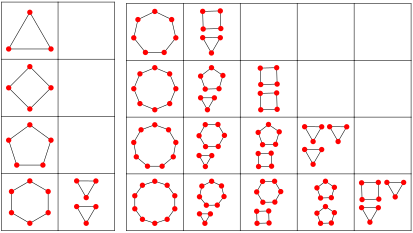
Taking the line graph twice does not return the original graph unless the line graph of a graph  is isomorphic to
  itself. In fact, The only connected graph that is isomorphic to its line graph is a cycle graph
  for
for  (Skiena 1990, p. 137). Graph unions of cycle graphs (e.g.,
  ,
,  , etc.) are also isomorphic to their line graphs, so the graphs that are isomorphic to their line graphs are the regular graphs of degree 2, and the total numbers of not-necessarily connected simple graphs that are isomorphic to their lines graphs are given by the number of partitions of their vertex count having smallest part
  , given for
  , 2, ... by 0, 0, 1, 1, 1, 2, 2, 3, 4, 5, 6, 9, 10, 13, 17, ... (OEIS A026796), the first few of which are illustrated above.
REFERENCES
Beineke, L. W. "Derived Graphs and Digraphs." In Beiträge zur Graphentheorie (Ed. H. Sachs, H. Voss, and H. Walther). Leipzig, Germany: Teubner, pp. 17-33, 1968.
Beineke, L. W. "Characterizations of Derived Graphs." J. Combin. Th. 9, 129-135, 1970.
Chartrand, G. "On Hamiltonian Line Graphs." Trans. Amer. Math. Soc. 134, 559-566, 1968.
Degiorgi, D. G. and Simon, K. "A Dynamic Algorithm for Line Graph Recognition." In WG '95: Proceedings of the 21st International Workshop on Graph-Theoretic Concepts in Computer Science. London: Springer-Verlag, pp. 37-48, 1995.
DistanceRegular.org. "Line Graphs." http://www.distanceregular.org/indexes/linegraphs.html.Gross, J. T. and Yellen, J. Graph Theory and Its Applications, 2nd ed. Boca Raton, FL: CRC Press, pp. 20 and 265, 2006.
Harary, F. Graph Theory. Reading, MA: Addison-Wesley, 1994.Harary, F. and Nash-Williams, C. J. A. "On Eulerian and Hamiltonian Graphs and Line Graphs." Canad. Math. Bull. 8, 701-709, 1965.
Krausz, J. "Démonstration nouvelle d'une théorème de Whitney sur les réseaux." Mat. Fiz. Lapok 50, 78-89, 1943.
Lehot, P. G. H. "An Optimal Algorithm to Detect a Line Graph and Output Its Root Graph." J. ACM 21, 569-575, 1974.
Liu, D.; Trajanovski, S.; and Van Mieghem, P. "Reverse Line Graph Construction: The Matrix Relabeling Algorithm MARINLINGA Versus Roussopoulos's Algorithm." 22 Oct 2010. http://arxiv.org/abs/1005.0943.Metelsky, Yu. and Tyshkevich, R. "On Line Graphs of Linear 3-Uniform Hypergraphs." J. Graph Th. 25, 243-251, 1997.
Naor, J. and Novick, M. B. "An Efficient Reconstruction of a Graph from Its Line Graph in Parallel." J. Algorithms 11, 132-143, 1990.
Saaty, T. L. and Kainen, P. C. "Line Graphs." §4-3 in The Four-Color Problem: Assaults and Conquest. New York: Dover, pp. 108-112, 1986.
Skiena, S. "Line Graph." §4.1.5 in Implementing Discrete Mathematics: Combinatorics and Graph Theory with Mathematica. Reading, MA: Addison-Wesley, pp. 128 and 135-139, 1990.
Sloane, N. J. A. Sequences A003089/M1417, A026796, and A132220 in "The On-Line Encyclopedia of Integer Sequences."Van Mieghem, P. Graph Spectra for Complex Networks. Cambridge, England: Cambridge University Press, 2010.
van Rooij, A. and Wilf, H. "The Interchange Graph of a Finite Graph." Acta Math. Acad. Sci. Hungar. 16, 263-269, 1965.
Roussopoulos, N. D. "A ![max<span style=]() {m,n}" src="https://mathworld.wolfram.com/images/equations/LineGraph/Inline75.svg" style="height:22px; width:84px" /> Algorithm for Determining the Graph
{m,n}" src="https://mathworld.wolfram.com/images/equations/LineGraph/Inline75.svg" style="height:22px; width:84px" /> Algorithm for Determining the Graph  from its Line Graph
  ." Inform. Proc. Lett. 2, 108-112, 1973.
West, D. B. "Characterizing Line Graphs." Introduction to Graph Theory, 2nd ed. Englewood Cliffs, NJ: Prentice-Hall, pp. 279-282, 2000.
Whitney, H. "Congruent Graphs and the Connectivity of Graphs." Amer. J. Math. 54, 150-168, 1932.








