I Graph
"The"  graph is the path graph on two vertices:
  .
.
An  -graph
  for
for  and
and  is a generalization of a generalized Petersen graph and has vertex set
![V(I(n,j,k))=<span style=]() {u_0,u_1,...,u_(n-1),v_0,v_1,...,v_(n-1)} " src="https://mathworld.wolfram.com/images/equations/IGraph/NumberedEquation1.svg" style="height:21px; width:334px" /> {u_0,u_1,...,u_(n-1),v_0,v_1,...,v_(n-1)} " src="https://mathworld.wolfram.com/images/equations/IGraph/NumberedEquation1.svg" style="height:21px; width:334px" /> |
and edge set
![E(I(n,j,k))=<span style=]() {u_iu_(i+j),u_iv_i,v_iv_(i+k);i=0,...,n-1}, " src="https://mathworld.wolfram.com/images/equations/IGraph/NumberedEquation2.svg" style="height:23px; width:364px" /> {u_iu_(i+j),u_iv_i,v_iv_(i+k);i=0,...,n-1}, " src="https://mathworld.wolfram.com/images/equations/IGraph/NumberedEquation2.svg" style="height:23px; width:364px" /> |
where the subscripts are read modulo  (Bouwer et al. 1988, Žitnik et al. ). Such graphs can be constructed by graph expansion on
  .
.
If the restriction  is relaxed to allow
  and
and  to equal
  ,
,  gives the ladder rung graph
  and
and  gives the sunlet graph
  .
.
Two  -graphs
  and
and  are isomorphic iff there exists an integer
  relatively prime to
  such that either
 ![<span style=]() {j_1,k_1}={aj (mod n),ak (mod n)}" src="https://mathworld.wolfram.com/images/equations/IGraph/Inline22.svg" style="height:22px; width:277px" /> or
{j_1,k_1}={aj (mod n),ak (mod n)}" src="https://mathworld.wolfram.com/images/equations/IGraph/Inline22.svg" style="height:22px; width:277px" /> or ![<span style=]() {j_1,k_1}={aj (mod n),-ak (mod n)}" src="https://mathworld.wolfram.com/images/equations/IGraph/Inline23.svg" style="height:22px; width:290px" /> (Boben et al. 2005, Horvat et al. 2012, Žitnik 2012).
{j_1,k_1}={aj (mod n),-ak (mod n)}" src="https://mathworld.wolfram.com/images/equations/IGraph/Inline23.svg" style="height:22px; width:290px" /> (Boben et al. 2005, Horvat et al. 2012, Žitnik 2012).
The graph  is connected iff
  . If
. If  , then the graph
  consists of
  copies of
  (Žitnik et al. 2012).
The  -graph
  corresponds to
  copies of the graph
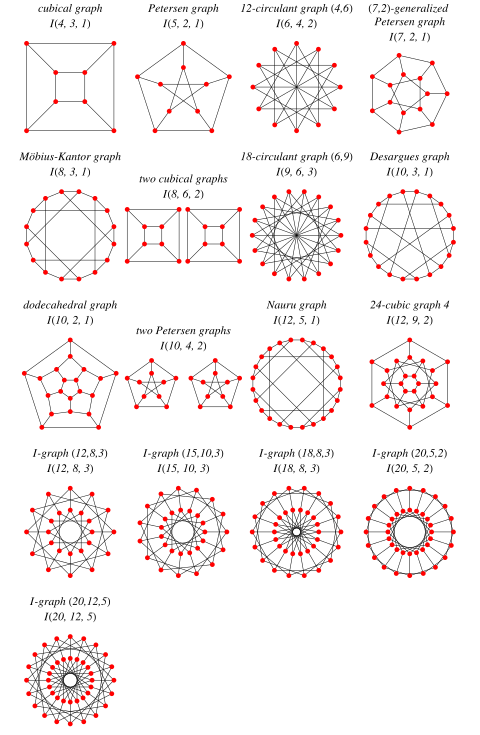
The following table summarizes special named  -graphs and classes of named
  -graphs.
| graph |
 |
cubical graph  |
 |
Petersen graph  |
 |
| Dürer graph |
 |
| Möbius-Kantor graph |
 |
| dodecahedral graph |
 |
| Desargues graph |
 |
| Nauru graph |
 |
prism graph  |
 |
generalized Petersen graph  |
 |
All  -graphs with
  have a non-vertex degenerate unit-distance representation in the plane, and with the exception of the families
  and
and  , the representations can be constructed with
  -fold rotational symmetry (Žitnik et al. 2012). While some of these may be vertex-edge degenerate (i.e., an edge passes over a vertex to which it is not incident), computer searching has found only four distinct such cases (
 ,
,  ,
,  , and
, and  ), and in each case, a different indexing of the I graph gives a unit-distance embedding that is not degenerate in this way (Žitnik et al. 2012).
REFERENCES
Alspach, B. "The Classification of Hamiltonian Generalized Petersen Graphs." J. Combin. Th. B 34, 293-312, 1983.
Boben, M.; Pisanski, T.; and Žitnik, A. "I-Graphs and the Corresponding Configurations." J. Combin. Des. 13, 406-424, 2005.
Bouwer, I. Z.; Chernoff, W. W.; Monson, B.; and Star, Z. The Foster Census. Charles Babbage Research Centre, 1988.Frucht, R.; Graver, J. E.; and Watkins, M. E. "The Groups of the Generalized Petersen Graphs." Proc. Cambridge Philos. Soc. 70, 211-218, 1971.
Horvat, B.; Pisanski, T.; and Žitnik, A. "Isomorphism Checking of  -Graphs." Graphs Combin. 28, 823-830, 2012.
Lovrečič Saražin, M. "A Note on the Generalized Petersen Graphs That Are Also Cayley Graphs." J. Combin. Th. B 69, 226-229, 1997.
Nedela, R. and Škoviera, M. "Which Generalized Petersen Graphs Are Cayley Graphs?" J. Graph Th. 19, 1-11, 1995.
Petkovšek, M. and Zakrajšek, H. "Enumeration of  -Graphs: Burnside Does It Again." To appear in Ars Math. Contemp. 3, 2010.
Steimle, A. and Staton, W. "The Isomorphism Classes of the Generalized Petersen Graphs." Disc. Math. 309, 231-237, 2009.
Žitnik, A.; Horvat, B.; and Pisanski, T. "All Generalized Petersen Graphs are Unit-Distances Graphs." J. Korean Math. Soc. 49, 475-491, 2012.








