Caveman Graph
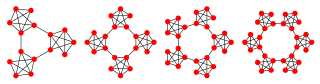
The (connected) caveman graph is a graph arising in social network theory formed by modifying a set of isolated  -cliques (or "caves") by removing one edge from each clique and using it to connect to a neighboring clique along a central cycle such that all
  cliques form a single unbroken loop (Watts 1999). A number of cavemen graphs formed in this manner from
  are illustrated above.
Caveman graphs are perfect.
Caveman graphs will are implemented in the Wolfram Language as GraphData[![<span style=]() {" src="https://mathworld.wolfram.com/images/equations/CavemanGraph/Inline4.svg" style="height:22px; width:6px" />"Caveman",
{" src="https://mathworld.wolfram.com/images/equations/CavemanGraph/Inline4.svg" style="height:22px; width:6px" />"Caveman", ![<span style=]() {" src="https://mathworld.wolfram.com/images/equations/CavemanGraph/Inline5.svg" style="height:22px; width:6px" />n, k
{" src="https://mathworld.wolfram.com/images/equations/CavemanGraph/Inline5.svg" style="height:22px; width:6px" />n, k![<span style=]() }" src="https://mathworld.wolfram.com/images/equations/CavemanGraph/Inline6.svg" style="height:22px; width:6px" />
}" src="https://mathworld.wolfram.com/images/equations/CavemanGraph/Inline6.svg" style="height:22px; width:6px" />![<span style=]() }" src="https://mathworld.wolfram.com/images/equations/CavemanGraph/Inline7.svg" style="height:22px; width:6px" />].
}" src="https://mathworld.wolfram.com/images/equations/CavemanGraph/Inline7.svg" style="height:22px; width:6px" />].
REFERENCES
Watts, D. J. Small Worlds: The Dynamics of Networks between Order and Randomness. Princeton, NJ: Princeton University Press, 1999.
Watts, D. J. "Networks, Dynamics, and the Small-World Phenomenon." Amer. J. Soc. 105, 493-527, 1999.








