Accomplishments contain activities and achievements, which in turn contain states
When an unwell person gets better (an accomplishment), there is a phase of healing or taking medicine or whatever (an activity) which culminates in a transition from ill to well (an achievement), and immediately after that the person is in good health (a state). A compact representation of this is offered in (4.8): states and activities are taken as simple situations; an achievement is more complex because it contains a state as an embedded proposition; and an accomplishment is even more complex because it contains both an activity and an achievement.

The pattern is not restricted to getting well after injury. The scheme of four situation types is much more general, and another set of examples (4.9) will now be discussed to begin to illustrate this.
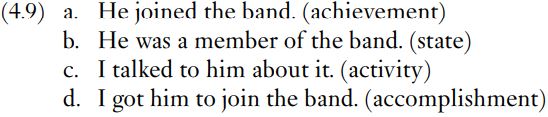
An achievement, such as (4.9a), incorporates an implicit end-state, (4.9b) in this instance: joining the band results in him being a member of the band. There is an entailment here: as soon as (4.9a) becomes true, (4.9b) does too, provided he refers to the same person in both sentences and the referent of the band remains constant. The part of an accomplishment, such as (4.9d), that works towards the goal is an activity, like (4.9c): one way – not the only way – of getting people to join a band is to talk to them about it. The goal of an accomplishment is an entailed achievement, here (4.9a).
If you applied the tests of Table 4.3 to the sentences in (4.9), then perhaps you judged He was joining the band – the progressive version of (4.9a) – as okay, which, of course, would not fit with the second asterisk in the achievements row of Table 4.3. It is worth explaining why this judgement does not undermine the proposed test. Three possibilities would allow progressive marking to be added to (4.9a) unproblematically:
• Joining this particular band may be a drawn-out process. You do not just get accepted the first time you turn up for a practice. Instead there are auditions, forms to fill in and committee approval to be obtained. If so, it becomes an accomplishment situation instead. As noted in Table 4.3, accomplishments accept progressive marking, which then operates on the rigmarole that precedes the achievement.
• He was joining the band at the beginning of every semester and dropping out after a couple of weeks. Extended in this way (4.9a) has an interpretation called habitual, which could alternatively be expressed with used to: He used to join the band at the beginning of every semester … This converts the sequence of his joinings into an activity. As an activity, it should be acceptable with stop. It is: He has stopped joining the band at the beginning of every semester. So a more rigorous version of the Table 4.3 criteria would exclude habitual interpretations.
• In certain circumstances we can use progressive aspect to talk about the future, notably when something is scheduled, for example: The timetable says there’s another bus arriving in an hour. So (4.9a) with progressive marking could have been a scheduled event at some time in the past: He was joining the band, so he bought a new trombone. This usage would have to be ruled out too in applying the Table 4.3 tests.
The point of this discussion is that doing semantics calls for careful thought. Asking why a test seems to fail can lead to deeper understanding and a better specification of the conditions under which the test does work. Or it can show that a test should be discarded, though I do not think this is the case here.
As well as being an accomplishment, the sentence in (4.9d) is a causative on the pattern of those in Table 4.1. I regard causative sentences as a subspecies of accomplishments. It is not possible to pursue the issue here, but it appears that all the causatives in Tables 4.1 and 4.2 fit the criteria for accomplishments given in Table 4.3








