Synonyms
Synonymy is equivalence of sense. The nouns mother, mom and mum are synonyms (of each other). When a single word in a sentence is replaced by a synonym – a word equivalent in sense – then the literal meaning of the sentence is not changed: My mother’s/mum’s/mom’s family name was Christie. Sociolinguistic differences (such as the fact that mom and mum are informal, and that mom would typically be used by speakers of North American English while mum has currency in British English) are not relevant, because they do not affect literal meaning. (As explained in earlier, literal meaning is abstracted away from contexts of use.) Sentences with the same meaning are called paraphrases. Sentences (2.2a, b) are paraphrases. They differ only by intersubstitution of the synonyms impudent and cheeky.
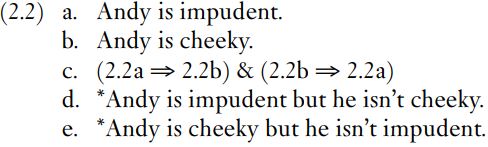
(Remember that ⇒ represents entailment, and an asterisk at the beginning of a sentence signals that it has serious meaning problems.)
Sentence (2.2a), if it is true, entails – guarantees the truth of – sentence (2.2b), provided it is the same Andy at the same point in time. When (2.2a) is true, (2.2b) must also be true. To establish paraphrase we have to do more, however, than show that one sentence entails another: the entailment has to go both ways, (2.2a) entails (2.2b) and it is also the case that (2.2b) entails (2.2a), as summarized in (2.2c). In normal discourse, both (2.2d) and (2.2e) are contradictions, because entailments cannot be cancelled. When an entailed sentence is false, sentences that entail it cannot be true.
What has been said about the synonyms impudent and cheeky can be employed in two different directions. One way round, if you are doing a semantic description of English and you are able to find paraphrases such as (2.2a, b) differing only in that one has cheeky where the other has impudent, then you have evidence that these two adjectives are synonyms of each other. Alternatively, if someone else’s description of the semantics of English lists impudent and cheeky as synonyms, that would tell you that they are predicting that sentences such as (2.2a, b) are paraphrases of one another, which is to say that the two-way entailments listed in (2.2c) hold. The claim that impudent is a synonym of cheeky predicts that sentences such as (2.2d, e) are contradictions; or the contradictions can be cited as evidence that the two words are synonymous.
Paraphrase between two sentences depends on entailment, since it is defined as a two-way entailment between the sentences. The main points of the previous paragraph are that entailments indicate sense relations between words, and sense relations indicate the entailment potentials of words.
How can one find paraphrases? Well, you have to observe language in use, think hard and invent test sentences for yourself, to try to judge whether or not particular entailments are present. The examples in (2.3) show how the conjunction so can be used in test sentences for entailment.

So generally signals that an inference is being made. When we are dealing with sentences out of context, as in cases when it does not matter who the Andy in (2.3a, b) is, then the inferences are entailments rather than some kind of guess based on knowledge of a situation, or of the character of a particular Andy.
Sentence (2.3a) is an entirely reasonable argument. People who accept it as reasonable accept (tacitly at least) that Andy is cheeky entails that ‘Andy is impudent’. Sentence (2.3b) is also an entirely reasonable argument. People who accept it as reasonable are accepting that Andy is impudent entails ‘Andy is cheeky’. If both of the arguments (2.3a, b) are accepted as reasonable, then we have two-way entailment – paraphrase – between Andy is cheeky and Andy is impudent and we can conclude that the two adjectives are synonymous with each other. (People who do not accept (2.3a, b) as reasonable arguments perhaps do not know either or both of the adjectives in question, or use meanings for one or both of these words that are different to those used by the author, or they are focusing on a difference that is the concern of other branches of linguistics: sociolinguistics and stylistics.)
Some other pairs of synonymous adjectives are listed in (2.4).

It is important to realize that the two-way, forward-and-back entailment pattern illustrated in (2.2c) is defining for synonymy. Huge and big are related in meaning, but they are not synonyms, as confirmed by the fact that, while The bridge is huge entails The bridge is big, we do not get entailment going the other way; when The bridge is big is true, it does not have to be true that The bridge is huge (it might be huge, but it could be big without being huge).
Synonymy is possible in other word classes, besides adjectives, as illustrated in (2.5).

In principle, synonymy is not restricted to pairs of words. The triplet sofa, settee and couch are synonymous.








