Compositionality
We need to account for sentence meaning in order to develop explanations of utterance meaning, because utterances are sentences put to use. The number of sentences in a human language is potentially infinite; so our account cannot be a list of all the sentences with an interpretation written next to each one. We have to generalize, to try to discover the principles that enable people to choose sentences that can, as utterances in particular contexts, have the intended meanings and that make it possible for their addressees to understand what they hear or read.
Semanticists, therefore, aim to explain the meaning of each sentence as arising from, on the one hand, the meanings of its parts and, on the other, the manner in which the parts are put together. That is what a compositional theory of meaning amounts to. The meaningful parts of a sentence are clauses, phrases and words; and the meaningful parts of words are morphemes.
Consider an analogy from arithmetic: the numbers that go into a sum affect the answer, as in (1.15a); so do the operations such as addition and multiplication by which we can combine numbers (1.15b). With more than one operation, the order they are performed in can make a difference (1.15c), where round brackets enclose the operation performed first.

The examples in (1.16) show something similar in the construction of words from morphemes – similar but not identical, because this is not addition and multiplication, but an operation of negation or reversal performed by the prefix un-, and the formation of “capability” adjectives by means of the suffix -able.

The analysis indicated by the brackets in (1.16a) could describe a locker with a broken hasp. The one in (1.16b) could describe a locked locker for which the key has just been found. The brackets indicate the scope of the operations: which parts of the representation un- and -able operate on. In (1.16a) un- operates on lockable, but -able operates only on lock. In (1.16b) un- operates on just lock, and -able operates on unlock. The meaning differences based on scope differences in (1.16) are not a quirk of the word – or pair of words – unlockable. The same bracketing will yield corresponding meanings for unbendable, unstickable and a number of others.
In syntax too there can be differences in meaning depending on the order that operations apply. Example (1.17a) is an unambiguous sentence. It covers the case of someone who was awake for two days. But (1.17b), containing the same words, is ambiguous, either meaning the same as (1.17a) or applying to someone who was asleep, but not for two days (possibly for only two hours or maybe for three days).
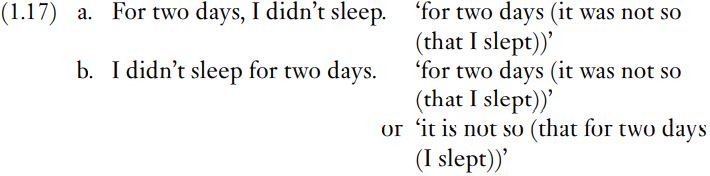
The ‘meanings’ indicated to the right of the examples are not in a standard notation. They are there to informally suggest how the overall meanings are built up. In (1.17a) the listener or reader first has to consider a negation of sleeping and then to think about that negative state – wakefulness – continuing for two days. To understand the second meaning given for (1.17b), first think what it means to sleep for two days, then cancel that idea. Syntactically, for two days is an adjunct in (1.17a) and also for the first of the meanings shown for (1.17b). When it is a complement to slept, we get the second meaning of (1.17b). Try saying (1.17b) with stress on two if you initially find the second meaning difficult to get.
The interpretations in (1.17) are not one-off facts regarding a particular sentence about sleeping – or not sleeping – for two days. Other sentences involving the operation of negation and a prepositional phrase that is either an adjunct or a complement have corresponding meanings. For instance, when we lived in a village some distance from town, I once overheard a member of my family say (1.18) over the phone.

I couldn’t tell which of the meanings – parallel to the two given for (1.17b) – was intended: being out of town until 4 pm and arriving in town only then or later, or arriving in town at some earlier time and then not staying in town as late as 4 pm. If the speaker had instead said “Until 4 o’clock, I won’t be in town”, it would have been unambiguous, as with (1.17a).
Idioms are exceptions. An expression is an idiom if its meaning is not compositional, that is to say it cannot be worked out from knowledge of the meanings of its parts and the way they have been put together. Come a cropper means ‘fall heavily’ but we cannot derive this meaning from the meanings of come, a, crop and -er. Browned off (meaning ‘disgruntled’), and see eye to eye (meaning ‘agree’) are other examples. Idioms simply have to be learned as wholes. Ordinary one-morpheme words are also, in a sense, idioms. The best we can hope to do for the word pouch is to pair it with its meaning, ‘small bag’. The meaning of pouch cannot be worked out compositionally from the meaning of ouch and a supposed meaning of p.








