Example
A 1-methylethyl substituent takes precedence over an ethyl substituent. Connected to the first carbon atom, ethyl only has one other carbon, whereas the 1-methylethyl has two carbon atoms attached to the first; this is the first point of difference. Therefore, 1-methylethyl ranks higher in priority than ethyl, as shown below:
.JPG?revision=1)
However:

Remember that being double or triple bonded to an atom means that the atom is connected to the same atom twice. In such a case, follow the same method as above.
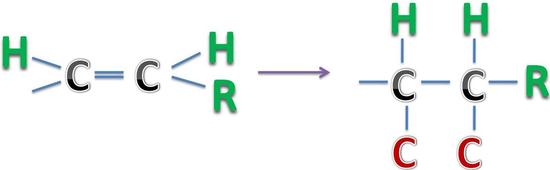
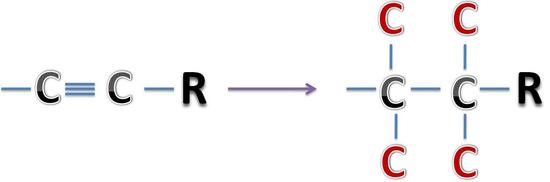
Caution!!
Keep in mind that priority is determined by the first point of difference along the two similar substituent chains. After the first point of difference, the rest of the chain is irrelevant.
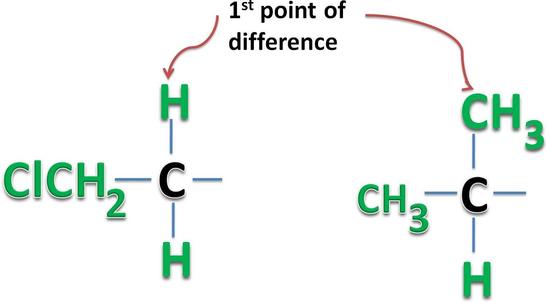
When looking for the first point of difference on similar substituent chains, one may encounter branching. If there is branching, choose the branch that is higher in priority. If the two substituents have similar branches, rank the elements within the branches until a point of difference.
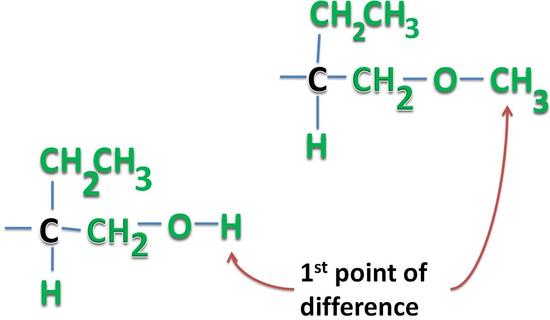
After all your substituents have been prioritized in the correct manner, you can now name/label the molecule R or S.
- Put the lowest priority substituent in the back (dashed line).
- Proceed from 1 to 2 to 3. (it is helpful to draw or imagine an arcing arrow that goes from 1--> 2-->3)
- Determine if the direction from 1 to 2 to 3 clockwise or counterclockwise.
i) If it is clockwise it is R.
ii) if it is counterclockwise it is S.








