الوضع الليلي


 3:14:52
  2022-11-19
  288
288
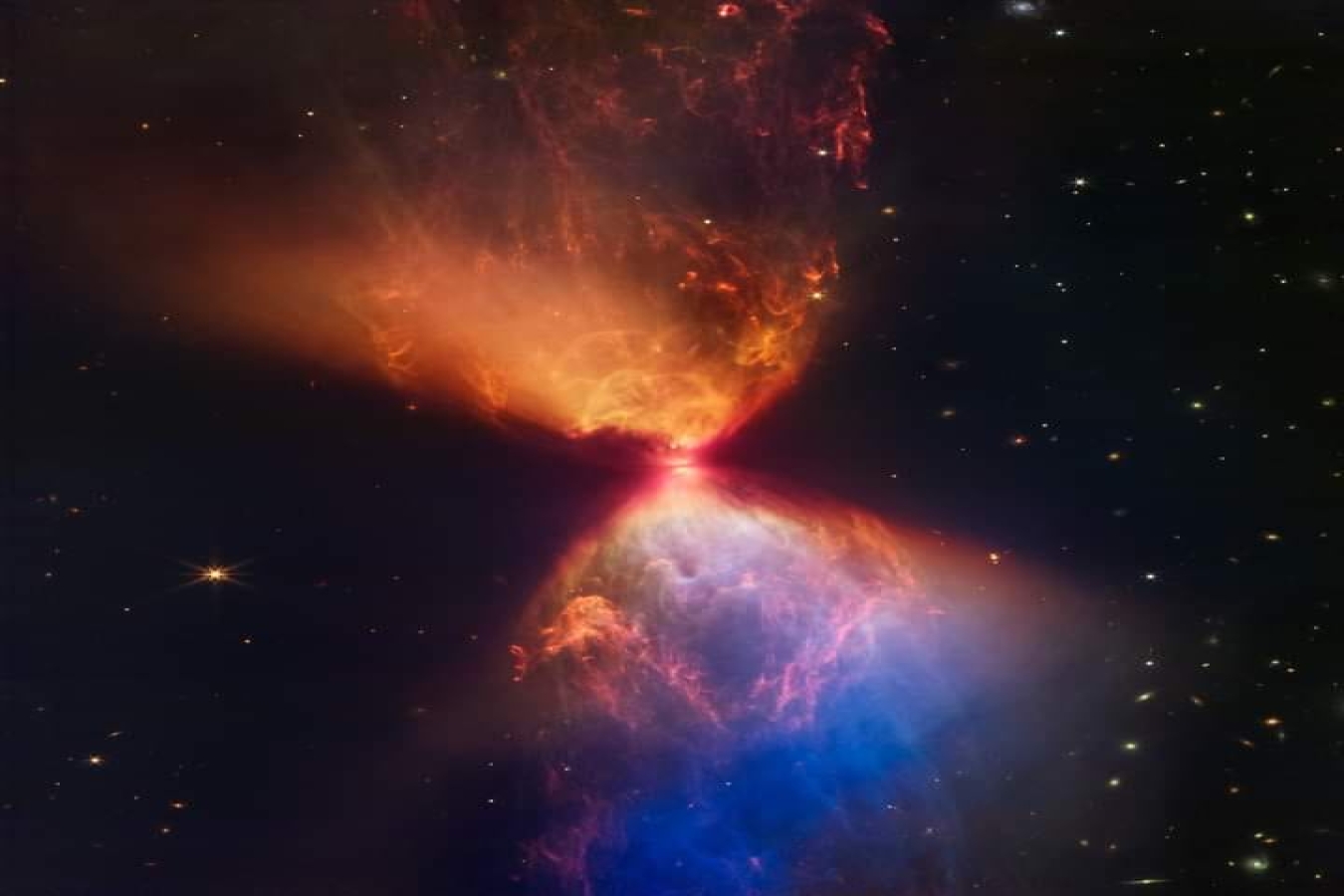
The James Webb Telescope dazzles us with its latest photo of a proto-star in the making.
This protostar can only be observed using James Webb's infrared radiation; It is a cloud of cosmic dust that repels higher wavelengths.
This protostar is a hot, blowing mass of gas, with a small mass that is a fraction of the mass of our Sun. while shrinking by its own gravity; Its center continues to be compressed and heated, until nuclear fusion occurs, and.... Congratulations! We got a new star!
Do you see that black line in the middle of the "hourglass"? It is a distinct view of a planetary disk pulled by a forming star, which may form in the future into a group of planets, which increases our understanding of the way the planets of our solar system are formed.
The protostar illuminates the dust clumps around it, located above and below the disk. The blue areas shown in the image have less dense dust, while the red areas represent higher density areas of dust.
Reality Of Islam |
|

Keeping sil
Two experim
Changing a
Plants are
 9:3:43
2018-11-05
9:3:43
2018-11-05
10 benefits of Marriage in Islam
7:5:22
2019-04-08
benefits of reciting surat yunus, hud &
9:45:7
2018-12-24
advantages & disadvantages of divorce
11:35:12
2018-06-10
6:0:51
2018-10-16
8:15:37
2023-02-16
7:45:39
2018-06-21
7:59:14
2018-06-21
12:47:1
2022-12-20
10:43:56
2022-06-22
7:34:7
2023-02-28
6:28:21
2022-12-20
5:41:46
2023-03-18
| LATEST |
 HOME
HOME