Game of Life
The game of life is the best-known two-dimensional cellular automaton, invented by John H. Conway and popularized in Martin Gardner's Scientific American column starting in October 1970. The game of life was originally played (i.e., successive generations were produced) by hand with counters, but implementation on a computer greatly increased the ease of exploring patterns.
The life cellular automaton is run by placing a number of filled cells on a two-dimensional grid. Each generation then switches cells on or off depending on the state of the cells that surround it. The rules are defined as follows. All eight of the cells surrounding the current one are checked to see if they are on or not. Any cells that are on are counted, and this count is then used to determine what will happen to the current cell.
1. Death: if the count is less than 2 or greater than 3, the current cell is switched off.
2. Survival: if (a) the count is exactly 2, or (b) the count is exactly 3 and the current cell is on, the current cell is left unchanged.
3. Birth: if the current cell is off and the count is exactly 3, the current cell is switched on.
The game of life is a totalistic cellular automaton, and can be implemented as follows using the built-in command CellularAutomaton, where the initial conditions are specified as a binary matrix  and the results for generations
  through
  are returned. (Here,
  corresponds to the initial pattern.)
  Life[m_List?MatrixQ, {g1_Integer?NonNegative,
      g2_Integer?NonNegative}] :=
    CellularAutomaton[
      {
        224,
        {2, {{2, 2, 2}, {2, 1, 2}, {2, 2, 2}}},
        {1, 1}
      },
      {m, 0},
      g2,
      {
        {g1, g2},
        Automatic
      }] /; g2>=g1
Weisstein gives an extensive alphabetical tabulation of life forms and terms.

A pattern which does not change from one generation to the next is known as a still life, and is said to have period 1. Several still lifes are illustrated above. The numbers of still lives of  cells for
  , 2, 3, ... are 0, 0, 0, 2, 1, 5, 4, 9, 10, 25, 46, 121, 240, 619, 1353, ... (OEIS A019473).
Patterns that cycle through a set of configurations are called oscillators.
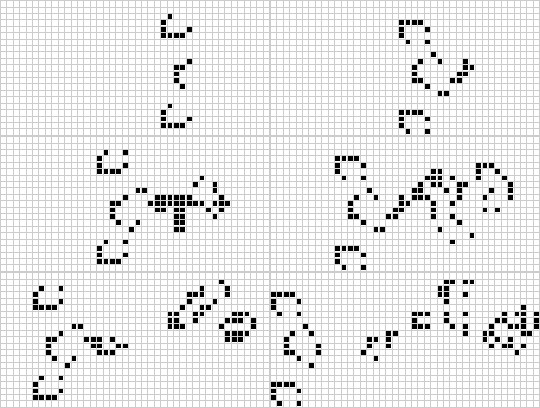
Conway originally believed that no pattern could produce an infinite number of cells, and offered a $50 prize to anyone who could find a counterexample before the end of 1970 (Gardner 1983, p. 216). Many counterexamples were subsequently found, including guns and puffer trains (illustrated above).
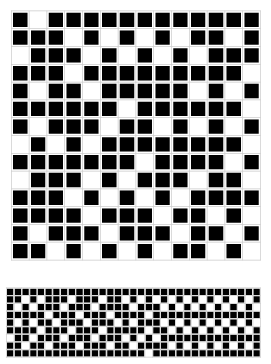
A life pattern which has no father pattern is known as a Garden of Eden (for obvious biblical reasons). The first such pattern was not found until 1971, and at least three are now known. It is not, however, known if a pattern exists which has a father pattern, but no grandfather pattern (Gardner 1983, p. 249).
Amazingly, life is a universal cellular automaton, in the sense that it is effectively capable of emulating any cellular automaton, Turing machine, or any other system that can be translated into a system known to be universal. The outlines of a proof for life's universality were given by Berlekamp et al. (1982) and independently by Gosper (Gardner 1983, pp. 250-253). Around 2000, a Turing machine that can be extended to a universal Turing machine was explicitly implemented in life by P. Rendell (Rendell, Adamatzky 2001). While Rendell's machine can be made into a "true" universal computer simply by making his tape infinite, he neither noted this fact nor provided an actual construction of a universal Turing machine. Subsequently, on November 11, 2002, P. Chapman constructed a life pattern based on D. Hickerson's "sliding block memory" approach that implements the actions of a universal register machine. Unlike the finite tape of Rendell's Turing machine, the values in the registers of Chapman's machine are unbounded, making it a true model of universal computation in the game of life. Chapman's construction uses  live cells in an area of
  , and can calculate approximately 20 generations per second on a 400 MHz computer.
More amazingly still, as shown by Wolfram (2002), even one-dimensional cellular automata (in particular, rule 110), can be universal.
Two-dimensional cellular automaton games similar to life but with different rules have been constructed and given the names HexLife and HighLife. HashLife is a life algorithm that achieves remarkable speed by storing subpatterns in a hash table and using them to skip forward, sometimes thousands of generations at a time.
REFERENCES:
Adamatzky, A. (Ed.). Collision Based Computing. Mult.-Valued Log. 6, pp. 397-514, 2001. Yverdon: Gordon and Breach, 2001.
Bays, C. "A Note on the Game of Life in Hexagonal and Pentagonal Tessellations." Complex Systems 15, 245-252, 2005.
Berlekamp, E. R.; Conway, J. H.; and Guy, R. K. "What Is Life?" Ch. 25 in Winning Ways for Your Mathematical Plays, Vol. 2: Games in Particular. London: Academic Press, 1982.
Callahan, P. "Patterns, Programs, and Links for Conway's Game of Life." https://www.radicaleye.com/lifepage/.
Chapman, P. "Life Universal Computer." https://www.igblan.com/ca/.
Flammenkamp, A. "Game of Life." https://www.uni-bielefeld.de/~achim/gol.html.
"The Game of Life." Math Horizons. p. 9, Spring 1994.
Gardner, M. "The Game of Life, Parts I-III." Chs. 20-22 in Wheels, Life, and other Mathematical Amusements. New York: W. H. Freeman, 1983.
Hensel, A. "PC Life Distribution." https://www.mindspring.com/~alanh/lifep.zip.
Hensel, A. "Conway's Game of Life." Includes a Java applet for the Game of Life. https://www.ibiblio.org/lifepatterns/.
Koenig, H. "Game of Life Information." https://pentadecathlon.com/lifeInfo.php.
McIntosh, H. V. "Life." https://www.cs.cinvestav.mx/mcintosh/oldweb/life.html
Poundstone, W. The Recursive Universe: Cosmic Complexity and the Limits of Scientific Knowledge. New York: Morrow, 1985.
Rendell, P. "This Is a Turing Machine Implemented in Conway's Game of Life." https://www.rendell.uk.co/gol/tm.htm.
Resnick, M. and Silverman, B. "A Zoo of Life Forms." https://lcs.www.media.mit.edu/groups/el/projects/emergence/life-zoo.html.
Sloane, N. J. A. Sequence A019473 in "The On-Line Encyclopedia of Integer Sequences."
Toffoli, T. and Margolus, N. Cellular Automata Machines: A New Environment for Modeling. Cambridge, MA: MIT Press, 1987.
Wainwright, R. T. "LifeLine." https://members.aol.com/life1ine/life/lifepage.htm.
Wainwright, R. T. LifeLine: A Quarterly Newsletter for Enthusiasts of John Conway's Game of Life. Nos. 1-11, 1971-1973.
Weisstein, E. W. "Eric Weisstein's Encyclopedia of the Game of Life." https://www.ericweisstein.com/encyclopedias/life/.
Wolfram, S. A New Kind of Science. Champaign, IL: Wolfram Media, 2002.








