Relativization strategies
As noted above, the case marking of the relative pronoun in German indicates the Grammatical Relation that the head noun is under stood to bear within the modifying clause.1 This is clearly a very important function, since we cannot interpret the meaning of the NP correctly without understanding the semantic relationship between the head noun and the modifying clause. But not all languages have relative pronouns, and some languages that do have them (e.g. English) also allow relative clauses to be formed without using relative pronouns. How can the hearer identify the function of the head noun when the relative clause does not contain a relative pronoun?
Recall that in discussing (35), repeated below, we noted that the NP which contains the relative clause functions as the subject of the main clause. We might refer to this as the “external” Grammatical Relation of the NP. At the same time, the head noun (woman) is interpreted as being the object of the modifying clause. We will refer to this “internal” Grammatical Relation as the RELATIVIZED FUNCTION: the Grammatical Relation that is assigned to the head noun within the modifying clause.2 Thus the relativized function in (35) is the direct object.
(35) [The woman [that I love]S՛]NP is moving to Argentina.
But how can the hearer determine this, since the relativizer that provides no clues? The answer is related to our earlier observation that the modifying clause is in complete: even though the verb love is transitive, the modifying clause lacks a direct object. This “missing” argument of the modifying clause must be the relativized function. Since the modifying clause needs an object in order to be grammatical, this relation must be assigned to the head noun.
This method of signaling the identity of the relativized function is often referred to as the GAP strategy, since the only clue is the “gap” or missing argument in the modifying clause. The head noun is interpreted as filling this gap. What is significant here is not merely the presence of a gap: an English relative clause contains a gap whether or not a relative pronoun is used, as illustrated in (50). The crucial point is that when the relative pronoun is present it provides at least some information about the relativized function. When there is no relative pronoun, the gap itself is the hearer’s only clue. This is the situation we refer to as the gap strategy.
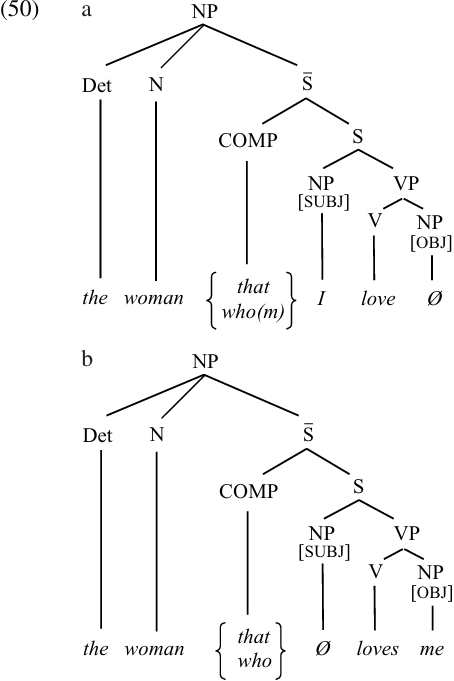
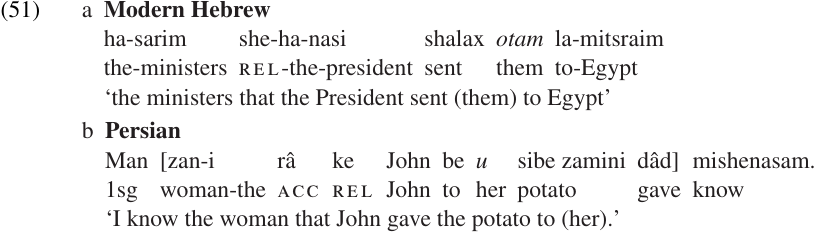
Gaps and relative pronouns are two different strategies which languages may use to accomplish the same goal, namely to identify the relativized function. The third commonly used strategy is PRONOUN RETENTION. In this pattern, the relativized function is represented by a pronominal “copy” of the head noun– a regular personal pronoun which occurs inside the modifying clause and agrees with the head noun in gender and number.
This pronominal copy is often called a RESUMPTIVE PRONOUN. The examples in (51) are from Keenan (1985:146).
We have identified three basic strategies which languages commonly use to indicate the relativized function within a relative clause; (i) gaps; (ii) relative pronouns; and (iii) pronoun retention.3 There are three interesting questions we might ask relating to the use of these strategies: (a) which languages use which strategy?; (b) which specific functions can be relativized in particular languages?; and (c) for languages which allow more than one strategy, is one of them preferred over the others for certain relativized functions?
The second and third questions lead to issues which are beyond our scope. Here we can only stress that it is the relativized function (the Grammatical Relation which the head noun bears inside the modifying clause) that is relevant to these questions, and not the external Grammatical Relation. This fact needs to be emphasized because it is a common source of confusion for beginning linguists. It is rare to find restrictions on the external Grammatical Relation of the NP which contains the relative clause; relative clauses can appear anywhere in the matrix sentence where a “normal” NP would be allowed. But languages do place interesting restrictions on the relativized function and how it is marked.
Investigations of the first question above have revealed some interesting correlations between relativization strategy and word order. The gap strategy is found in all types of languages, and is virtually the only strategy used in prenominal relative clauses. Relative pronouns have (so far) been found only in postnominal relative clauses. Pronoun retention is also found almost exclusively in postnominal relative clauses.4
1. This is the normal case marking pattern for relative pronouns. There are, however, a few languages (e.g. Latin) in which the case marking of the relative pronoun may reflect instead the external Grammatical Relation, i.e. the Grammatical Relation which the NP containing the relative clause is assigned in the larger (matrix) sentence.
2. A number of other authors use the term RELATIVIZED POSITION for what we call here the relativized function. Our purpose in coining a different term is to emphasize the fact that we are concerned primarily with Grammatical Relations, rather than positions in Phrase Structure.
3. Relativizers may occur with either the gap or the pronoun retention strategies. The use of a relativizer is not a distinct strategy, since the relativizer itself provides no information about the relativized function.
4. Keenan (1985:149) cites Chinese as the only known counter-example to this generalization.








