Relative pronoun vs. relativizer
In discussing (35), we referred to the word that as a RELATIVIZER. A relativizer is basically a special type of complementizer which marks the modifying clause in a relative clause construction. In many languages (e.g. Chinese and Tagalog) the same particle which functions as a relativizer is also used to link other modifiers to the head noun.
In (37) we saw that English relative clauses do not always contain that. Another option, illustrated in (37a), is to use a Wh-word to introduce the modifying clause. An English Wh-word used in this way is called a relative pronoun. RELATIVE PRONOUNS in other languages may be derived from question words, definite articles, or demonstratives.
We can define a RELATIVE PRONOUN cross-linguistically by saying that it is an anaphoric element which introduces the modifying clause and takes the head noun as its antecedent. But if that and whom are often interchangeable, as illustrated in (37), what basis do we have for assigning them to different categories–for calling one a relative pronoun and the other a relativizer? More generally, why do we distinguish these two types of elements in any language, and how can we recognize them?
The crucial difference is that a relative pronoun is a special type of pronoun, i.e. an anaphoric NP, while a relativizer is not. The clearest evidence for the anaphoric nature of the relative pronoun is agreement, i.e. a change in the form of the relative pronoun depending on some features of the head noun (gender, number, animacy, etc.). Moreover, a relative pronoun is often inflected for case, which is a property of NPs. A relativizer, in contrast, is normally an invariant particle (one that doesn’t change shape), much like a complementizer. If there are changes in the shape of the relativizer, they are usually morphophonemic in nature and do not reflect agreement or case features.
In English, as we have noted, neither case nor agreement is strongly reflected in the morphology. Vestigial case marking can be observed in the choice between who (nominative), whom (dative/accusative), and whose (genitive), as seen in (46).1 A kind of animacy agreement determines the choice between who (for humans) and which (for non-humans), as illustrated in (47). The relativizer that could take the place of the relative pronoun in all of these examples except (46c, e), with no change in form; it is not marked for case or agreement.
(46) a the spy who loves me
b the spy who(m) I love
c the spy from whom I bought these documents
d the spy who I bought these documents from
e the spy whose sister I love
(47) a the professor who/*which my brother studied under
b the monkey which/??who(m) my brother trained
c the book which/*who(m) my brother edited
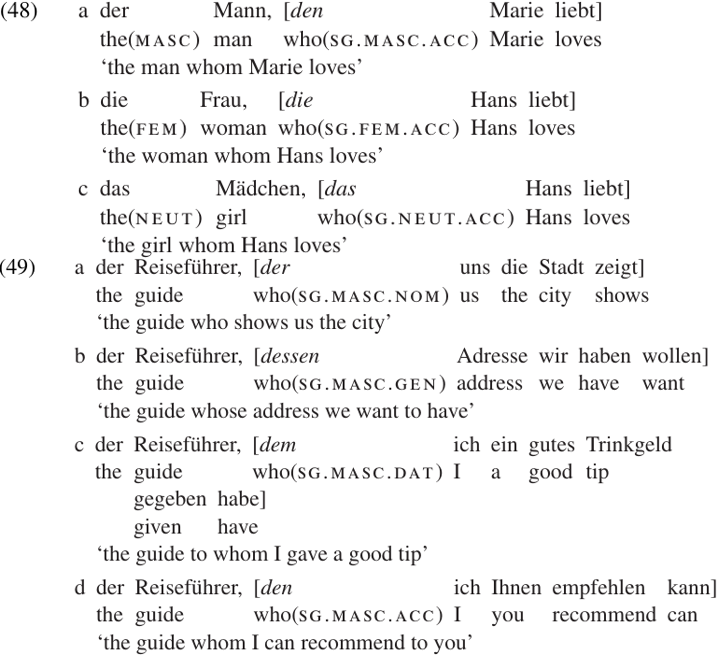
The case and agreement features of the relative pronoun are much more obvious in other languages. German provides a very clear example. The German demonstrative pronouns (der, die, das ‘that one’) also function as relative pronouns.2 A relative pronoun agrees with the head noun for gender and number, while its case marking indicates the Grammatical Relation which the head noun is understood to bear within the modifying clause. The examples in (48) illustrate agreement with the grammatical gender of the head noun, while (49) illustrates the change in case marking.3
1. The form whom is now rarely used in informal conversation. It is optional when the relativized function is the direct object (46b), and obligatory only when it follows a preposition as in (46c).
2. The German demonstrative pronouns are identical in form with the definite article except for the addition of–en in the dative plural and all genitive forms; a genitive example is seen in (49b).
3. (48) is adapted from Keenan (1985:149), while example (49) is taken from Stern and Bleiler (1961:46–47).








