THE BOTTOM-UP APPROACH
There may be frequent occasions when you find that your thinking is not fully enough developed to work out the top part of the pyramid. Perhaps you can't decide precisely what your Subject is, or the Question isn't clear to you, or you can't sort out what the reader does and doesn't know for sure. In such cases, simply move down to the Key Line level.
If you can think of any Key Line points, fine; but often you won't be able to. Do not despair. You can work out the ideas from the bottom up by following a 3-step process.
1. List all the points you think you want to make.
2. Work out the relationships between them.
3. Draw conclusions.
Again, let me demonstrate how this technique would work by using a document that needs rewriting (Exhibit 7). This is a memorandum written by a young consultant to his engagement manager after 2 weeks of working on his first assignment. The client was a printing company in England.
I know nothing about the situation or the subject other than what is stated in the memorandum. We therefore have to treat the document as a closed universe, with-holding judgment on whether what he says is true or right. We just want to make what it says clear.

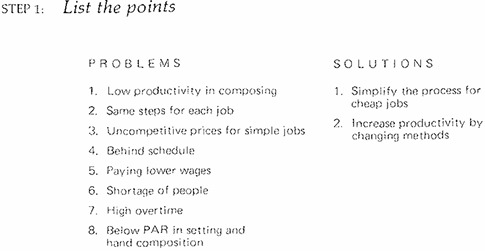
Go first to the recommendations, since it is always easier to determine the validity of action ideas than of situation ideas (see, Summarizing Grouped Ideas). What is the relationship between simplifying the process and changing the methods? None; they both say the same thing, so there is nothing to be gained by analyzing these.
We move on to the problems, and in looking at them a moment, it becomes apparent that there are some cause-and-effect relationships implied here, which you want to lay out as visually as possible.
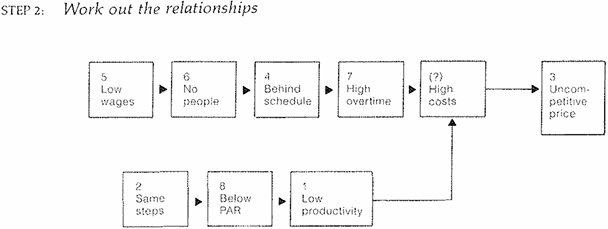
This analysis reveals two separate lines of reasoning, with the possibility that some points that should be made have been omitted. Now you're ready to draw some conclusions. Either he's saying that the costs are high because the productivity is low and the overtime is high, or he's saying that to cut the costs you have to simplify the methods and raise the wages.
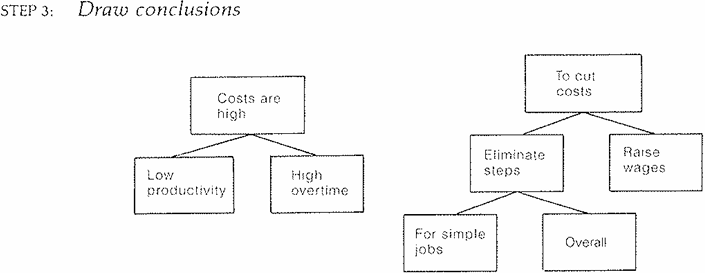
To decide which, you want to think through the introduction. What does the original memo indicate the reader already knows? Apparently he knows that costs are important, that TTW is uncompetitive in its pricing of simple jobs, and probably that nobody at TTW knows whether the costs are too high or not. In that case, your thinking might go something like this:
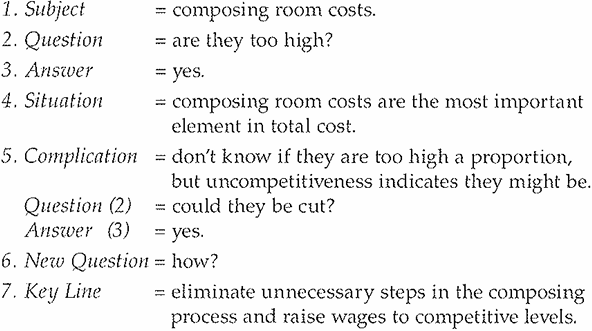
Exhibit 8 following shows these ideas in what might have been an acceptable version of this memorandum. You may not agree with the young consultant's reasoning, but at least it is presented so clearly that you the reader can determine whether you agree with it or find things to question about it.
I have reprinted the memorandum in full here because I Want to demonstrate that the total introduction includes a statement of the Key Line points. With these included, the reader can get your entire thinking in the first 30 seconds or so of reading. And since the rest of the document exists only to explain or defend what you have already stated, he can be confident that no important points are going to jump up and surprise him later on. Consequently, he can scan if he has limited time available. Indeed, if your entire thinking is not clear to the reader in the first 30 seconds of reading, you should rewrite.

In addition, the headings serve to highlight the major points of the structure so that the reader can quickly find the detailed discussion of any point. This is particularly helpful if the document is a lengthy one. To this end, you want to take some care in the way you word the headings (see, Reflecting the Pyramid on the Page), making sure to state them so that they reflect ideas rather than categories. Never have a heading called "Findings," for example, or "Conclusions." Such headings have no scanning value.
Finally, a word about writing style. You will note that the original TTW memorandum and its rewritten version differ very little in the way in which the language is used or the sentences worded. The clarity of the second document comes from the pyramidal ordering of the ideas, rather than from any refinement of writing style.








