Reflection: To be politic or not to be politic?
Watts’s and Locher’s view that politeness is associated with a marked surplus of relational work clearly rings true. One problem, however, is that Watts’s definitions, as given in the previous paragraph, suggest a hard line between politic behavior and politeness: if it is not one, it is the other. This seems unrealistic; surely there is a scale between politic behavior and politeness that captures degrees of difference between relatively “normal” behaviors and situations, such as greetings and leave-takings in expected contexts, and those which are more creative (see Leech 2007: 203, for a similar comment). Indeed, contrary to the definitions, the dotted lines in Figure 7.1 suggest fuzziness.
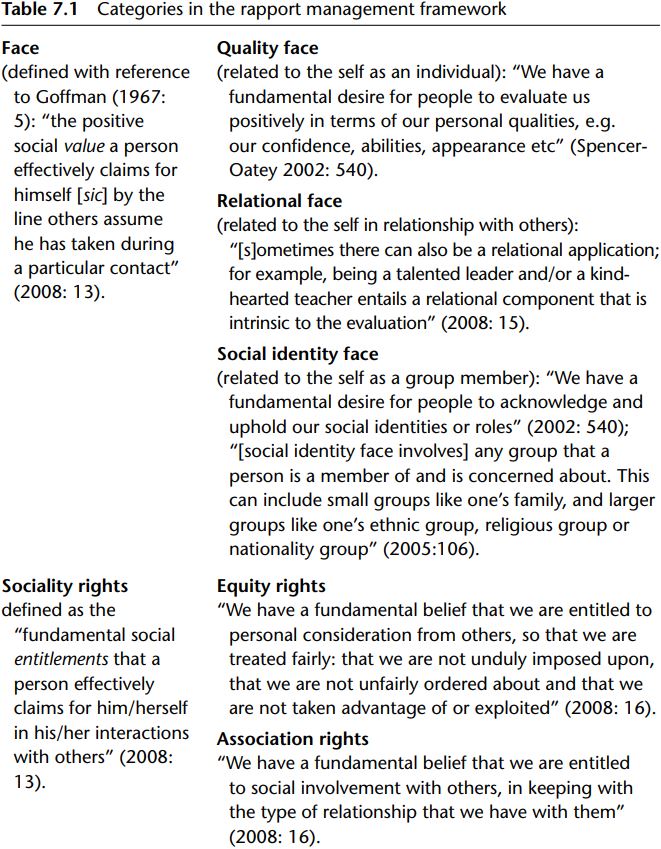
Spencer-Oatey (e.g. 2002, 2005, 2008) proposes a model of rapport management, which concerns the management of harmony–disharmony amongst people. A particular concern was that “Brown and Levinson’s (1987) conceptualization of positive face has been underspecified, and that the concerns they identify as negative face issues are not necessarily face concerns at all” (2008: 13). Thus, her model not only consists of three types of face – “quality”, “relational” and “social identity” – but also two types of “sociality rights”. These are summarized in Table 7.1.
In addition to face and rights, Spencer-Oatey (2008: 17) argues for the importance of interactional goals:
People often (although not always) have specific goals when they interact with others. These can be relational as well as transactional (i.e. task-focused) in nature. These “wants” can significantly affect their perceptions of rapport because any failure to achieve them can cause frustration and annoyance.
Threats to positive rapport or harmony between people can be related to face, rights/obligations or interactional goals. However, rapport management is not confined, as in the case of Brown and Levinson (1987), to counterbalancing threats. Spencer-Oatey (2008: 32) suggests that there are four orientations:
1. Rapport enhancement orientation: a desire to strengthen or enhance harmonious relations between the interlocutors;
2. Rapport maintenance orientation: a desire to maintain or protect harmonious relations between the interlocutors;
3. Rapport neglect orientation: a lack of concern or interest in the quality of relations between the interlocutors (perhaps because of a focus on self);
4. Rapport challenge orientation: a desire to challenge or impair harmonious relations between the interlocutors
Rapport enhancement tallies with Leech’s (1983) accommodation of acts that simply enhance politeness, for example, to strengthen friendship. Rapport maintenance could be simply a matter of performing politic behavior, or a matter of restoring relations in the light of threatening behavior. Rapport neglect accommodates Brown and Levinson’s (1987) observation about the bald on record strategy that in emergency situations politeness is not an issue, along with the many other reasons why somebody may neglect relations (e.g. weighting their own concerns above those of others). Finally, rapport challenge accommodates impoliteness.
Spencer-Oatey (e.g. 2008) devotes considerable space to elaborating how these three components are linked to pragmatic, linguistic and contextual features. This elaboration goes well beyond simple lexically and grammatically defined output strategies or simple social variables. The important point for the model is that Spencer-Oatey provides a detailed analytical framework which we can apply to language data.








