Relational
Relational approaches have a central focus on interpersonal relations in common, rather than a central focus on the individual performing “politeness” which is then correlated with interpersonal relations as variables, as happens with Brown and Levinson (1987). This, in fact, has important implications. The term polite has been stretched, especially in the classic theories, to cover a range of different phenomena, not all of which would readily be recognized as polite by the lay person. In Britain, saying please or thank you would readily be recognized as polite, but would giving someone a compliment attract the same label? Perhaps the latter is just seen as an example of “nice”, “kind” or “supportive” behavior, or even “sneaky”, “manipulative” or “arse-licking” behavior. Of course, it is an empirical question as to what perceptions and labels particular behaviors attract, but there is no doubting that their discussions of politeness encompass such a breadth of phenomena that the label polite is unlikely to be the descriptor of choice for each individual phenomenon. Relational approaches avoid seeing everything through the prism of politeness. In point of fact, they also encompass impolite behavior. We will briefly outline the two main relational approaches, the relational work approach of Locher and Watts’ (e.g. Locher 2004, 2006; Locher and Watts 2005; Watts 2003) and the rapport management approach of Spencer-Oatey (e.g. 2008).
Locher and Watts state that “relational work can be understood as equivalent to Halliday’s (1978) interpersonal level of communication” (2005: 11) and, further, that “[r]elational work is defined as the work people invest in negotiating their relationships in interaction” (2008: 78). Relational work is not switched off and on in communication but is always involved. The concept of face is central to relational work, though not as defined by Brown and Levinson (1987) but by Goffman (1967: 5). Face is treated as discursively constructed within situated interactions. Watts (2005: xliii, see also Locher and Watts 2005: 12; Locher 2004: 90) offers a diagram which usefully attempts to map the total spectrum of relational work, reproduced in Figure 7.1.
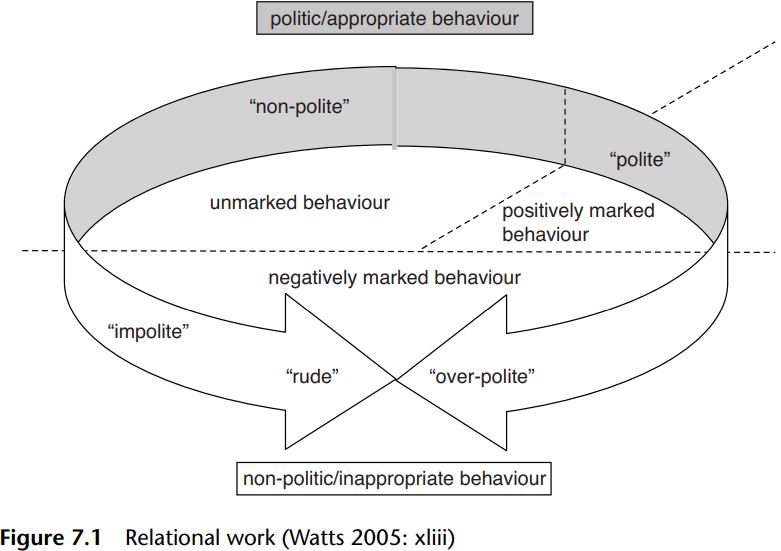
Relational work in this perspective incorporates the issue of whether behavior is marked or not. Markedness here relates to appropriateness; if the behavior is inappropriate, it will be marked and more likely to be noticed. Note that the notion of appropriateness can be viewed in terms of acting in accordance or otherwise with social norms. Unmarked behavior is what Watts (e.g. 2003) refers to in his earlier work as “politic behavior”: “[l]inguistic behavior which is perceived to be appropriate to the social constraints of the ongoing interaction, i.e. as non-salient, should be called politic behavior” (Watts 2003: 19), and is illustrated by the following examples:
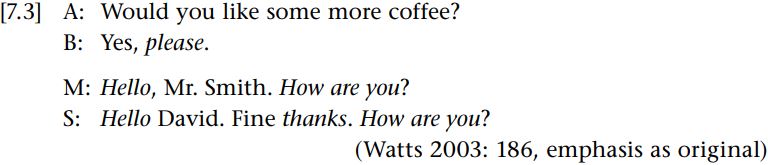
Politeness, on the other hand, is positively marked behavior. Watts (2003: 19) writes that “[l]inguistic behavior perceived to go beyond what is expectable, i.e. salient behavior, should be called polite or impolite depending on whether the behavior itself tends towards the negative or positive end of the spectrum of politeness”. By way of illustration, we can re-work Watts’s examples accordingly:










