Participant footings
The move towards appreciating that there are multiple perspectives on speaker meaning was foreshadowed in Goffman’s (1981: 129) seminal claim that we need to deconstruct the “folk categories” of speaker and hearer into “smaller, analytically coherent elements”. He proposed the notion of footing, which refers to the alignment or interactional positioning of an individual in relation to a particular utterance. He further suggested that the footing of a speaker involves a production format, while the footing of a hearer involves a participation status. The idea is, essentially, that the particular footing of an individual encompasses different roles and responsibilities in interaction or discourse. A participation framework encompasses the different footings of all individuals involved in an interaction (i.e. both production format and participation status). The notion of footing thus allows us to develop a more nuanced understanding of speakers and hearers. One important upshot of this, as we shall see, is that pragmatic meaning representations can be understood differently depending on the footing of the individual concerned.
The production format of utterances concerns what might be called production roles in relation to pragmatic meaning (Levinson 1988).
According to Goffman there are four different speaker footings: animator, author, principal and figure. An animator (or utterer) is the one producing an utterance (or the talk), an author is the entity that creates or designs an utterance, a principal is the party responsible for an utterance, and a figure is the character portrayed within an utterance. Take, for instance, the statement made by then President of the United States, George W. Bush, soon after the September 11 attacks, Either you are with us, or you are with the terrorists. In this case, while Bush was the animator, it is an open question whether he was actually the author (this being the eternal question of whether politicians ever write their own speeches). He most certainly was not the only principal here, as the United States Government, and indeed in some circles the people of the United States, were held responsible for this utterance, along with Bush himself. There is also some degree of ambiguity in relation to the figures portrayed in this assertion. The first person plural pronoun (us), for instance, can be understood as either exclusive (referring to the US government) or inclusive (referring to all Americans). And the referent of the second person pronoun (you), and the implications, clearly varies according to who was listening to or reading this statement.
Speakers can mean things on behalf of others in more mundane situations as well. In the following interaction, reported by Kiesling and Johnson (2010), two mothers are talking after taking their children to a music class. Paula here initiates an invitation from her son to Julie’s daughter Emma.
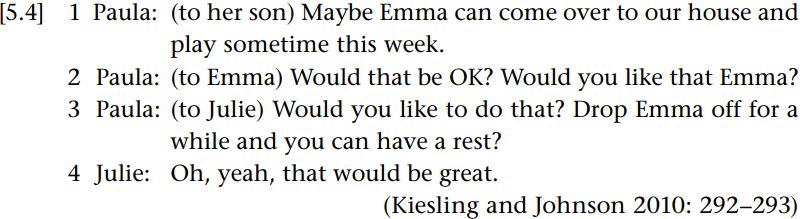
In turn , Paula makes a suggestion to her son that he invite Emma over to their house to play. In turn , however, she goes on to make that invitation on behalf of her son as, while Paula is clearly the animator and author of turn , the principal is evidently meant to be her son, that is, the utterance is designed as if her son has already made the invitation. We can see this in the formulation of the invitation itself, which builds on Paula’s prior suggestion to her son through the use of referring expression that. This is then followed up by an attempt to confirm acceptance through an invitation from Paula to Emma’s mother in turn , which is once again tied back to the invitation that was ostensibly made by Paula’s son to Emma.
It is also interesting to note that, given the figure of the suggestion in turn 1, namely Emma, is co-present, it also counts as an indirect invitation to her, a point to which we shall return on pragmatic acts.








