

Grammar


Tenses


Present

Present Simple

Present Continuous

Present Perfect

Present Perfect Continuous


Past

Past Simple

Past Continuous

Past Perfect

Past Perfect Continuous


Future

Future Simple

Future Continuous

Future Perfect

Future Perfect Continuous


Parts Of Speech


Nouns

Countable and uncountable nouns

Verbal nouns

Singular and Plural nouns

Proper nouns

Nouns gender

Nouns definition

Concrete nouns

Abstract nouns

Common nouns

Collective nouns

Definition Of Nouns

Animate and Inanimate nouns

Nouns


Verbs

Stative and dynamic verbs

Finite and nonfinite verbs

To be verbs

Transitive and intransitive verbs

Auxiliary verbs

Modal verbs

Regular and irregular verbs

Action verbs

Verbs


Adverbs

Relative adverbs

Interrogative adverbs

Adverbs of time

Adverbs of place

Adverbs of reason

Adverbs of quantity

Adverbs of manner

Adverbs of frequency

Adverbs of affirmation

Adverbs


Adjectives

Quantitative adjective

Proper adjective

Possessive adjective

Numeral adjective

Interrogative adjective

Distributive adjective

Descriptive adjective

Demonstrative adjective


Pronouns

Subject pronoun

Relative pronoun

Reflexive pronoun

Reciprocal pronoun

Possessive pronoun

Personal pronoun

Interrogative pronoun

Indefinite pronoun

Emphatic pronoun

Distributive pronoun

Demonstrative pronoun

Pronouns


Pre Position


Preposition by function

Time preposition

Reason preposition

Possession preposition

Place preposition

Phrases preposition

Origin preposition

Measure preposition

Direction preposition

Contrast preposition

Agent preposition


Preposition by construction

Simple preposition

Phrase preposition

Double preposition

Compound preposition

prepositions


Conjunctions

Subordinating conjunction

Correlative conjunction

Coordinating conjunction

Conjunctive adverbs

conjunctions


Interjections

Express calling interjection

Phrases

Sentences


Grammar Rules

Passive and Active

Preference

Requests and offers

wishes

Be used to

Some and any

Could have done

Describing people

Giving advices

Possession

Comparative and superlative

Giving Reason

Making Suggestions

Apologizing

Forming questions

Since and for

Directions

Obligation

Adverbials

invitation

Articles

Imaginary condition

Zero conditional

First conditional

Second conditional

Third conditional

Reported speech

Demonstratives

Determiners


Linguistics

Phonetics

Phonology

Linguistics fields

Syntax

Morphology

Semantics

pragmatics

History

Writing

Grammar

Phonetics and Phonology

Semiotics


Reading Comprehension

Elementary

Intermediate

Advanced


Teaching Methods

Teaching Strategies

Assessment
An interim conclusion: on pragmatic meaning representations
المؤلف:
Jonathan Culpeper and Michael Haugh
المصدر:
Pragmatics and the English Language
الجزء والصفحة:
114-4
9-5-2022
935
An interim conclusion: on pragmatic meaning representations
While Grice started with an initial distinction between what is said and what is implicated, both neo-Gricean and contextualist approaches to pragmatic meaning have proposed more nuanced and layered understandings of meaning representations, as summarized in Figure 4.2.
In Figure 4.2, the different layers of pragmatic meaning are represented vertically within distinct approaches, while the different ways of conceptualizing these different layers are represented horizontally across approaches. Solid lines indicate representations that have been treated as key meaning representations in those approaches, while dotted lines indicate representations that are either the subject of ongoing debate (e.g. Gricean what is said), or are not recognized as meaning representations proper (e.g. logical forms). However, since the various types of meaning representations are theorized in different ways, Figure 4.2 represents only analogous, not equivalent, concepts of pragmatic meaning. But putting terminological and theoretical battles aside for the moment, it is apparent that there have been a number of key developments of Grice’s initial approach to conceptualizing pragmatic or speaker meaning representations.
One key development is that representations of what is said may be approached both at the level of what is literally said and at the level of a pragmatically enriched notion of what is said (i.e. explicature), which mirrors, to some extent at least, the folk distinction between saying1 and saying2. What contextualist approaches have added is a deeper understanding of the different types of representations that such pragmatic enrichments involve. A second key development is the claim that there is an important layer of utterance-type pragmatic meaning that has only received passing attention thus far, including routine expressions and short-circuited implicatures (SCI) (less controversially), and generalized conversational implicatures (GCI),
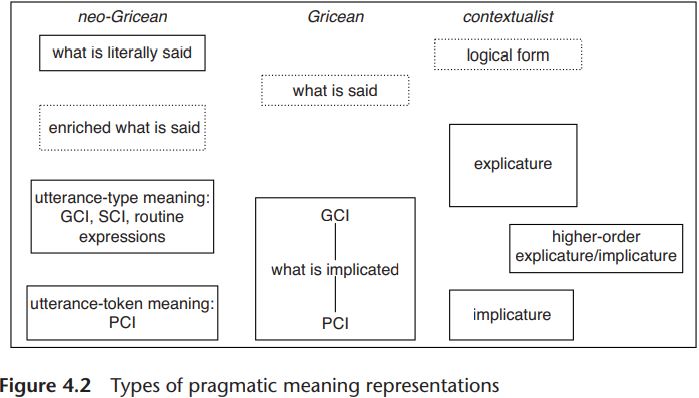
Including scalar implicatures (more controversially). A third key development is that meaning representations may be further embedded within other meaning representations, a point we take up further.
It is interesting to note that, throughout this discussion, natural language concepts from English have frequently been used to conceptualize and even define pragmatic meaning representations. The question we have already raised in relation to what is said (cf. saying) and what is implicated (cf. implying), and to which we might add the distinction between saying1 and saying2, is whether such distinctions, which can be made in English, are equally as useful for examining pragmatic meaning representations in other languages. If we take a purely analytical perspective then many would argue it does not matter. However, if we engage with the understandings of participants then such issues evidently require much more serious attention, a point to which we return when discussing the ways in which pragmatic meanings can be created by speakers in interaction.
الاكثر قراءة في pragmatics
اخر الاخبار
اخبار العتبة العباسية المقدسة
الآخبار الصحية

قسم الشؤون الفكرية يصدر كتاباً يوثق تاريخ السدانة في العتبة العباسية المقدسة
"المهمة".. إصدار قصصي يوثّق القصص الفائزة في مسابقة فتوى الدفاع المقدسة للقصة القصيرة
(نوافذ).. إصدار أدبي يوثق القصص الفائزة في مسابقة الإمام العسكري (عليه السلام)


